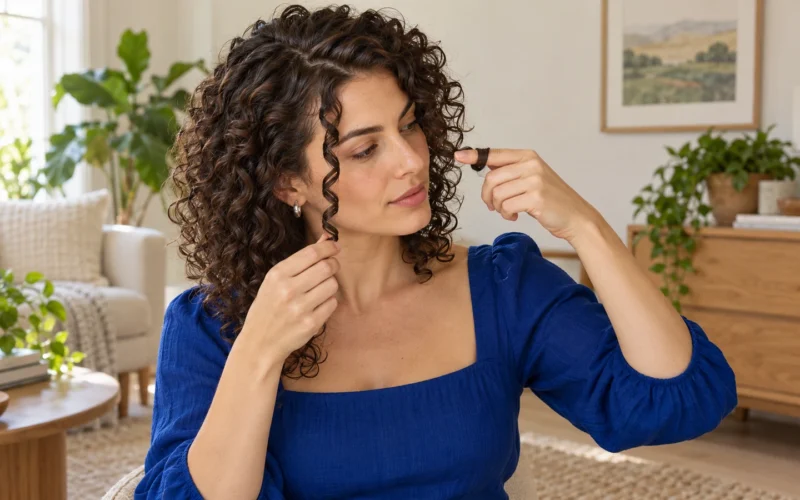
Your lengths form curls, but the first few inches sit against your scalp. Adding more mousse, clips and upside-down diffusing can create temporary height, yet the crown often drops again before the rest of your hair is dry.
Flat roots on curly hair usually come from one of four things: too much weight near the scalp, roots being styled and dried downward, length or haircut shape pulling from below, or a naturally looser pattern at the crown. The useful fix depends on which one you see. A bigger pile of volume tricks can hide the clue.
Start with one controlled wash day: clean the roots properly, keep rich products off the crown, style the top away from its usual resting position and dry the roots before the heavy lengths can pull them flat. If that changes the result, your routine was the main cause. If it does not, look at length, shape and your natural root pattern.
First, identify when the roots go flat
The timing matters more than your curl-type number. Look at the crown after styling, halfway through drying and again when the hair is fully dry.
| What you notice | Most likely issue | Best first test |
|---|---|---|
| The roots lie flat as soon as you finish styling | Downward brush direction, a fixed part or heavy product placement | Style the crown upward and keep rich cream below the ears |
| You have lift while wet, but it disappears during drying | Water weight, slow roots or drying in one position | Dry the root area first and change head direction |
| The roots lift on wash day, then collapse quickly | Soft hold, oil or accumulated product | Use less conditioning product near the scalp and compare a thorough wash |
| The first few inches have always been looser than the lengths | Natural pattern, long-hair weight or haircut shape | Set a realistic lift goal before changing products |
Flat roots are not automatically a sign that something is wrong. Many people have looser texture near the scalp, and long or dense curls naturally pull downward. If the change is sudden and comes with increased shedding, a widening part or visible thinning, styling advice is not the right investigation.
Remove weight before buying a root-lifting product
Fine curls and loose waves can lose height under a full portion of leave-in, cream, oil and gel. The problem is not that moisturizing products are bad. It is that every layer adds weight, and the crown often needs less than the ends.
On your test wash, apply rinse-out conditioner mainly through the lengths. Use a lighter leave-in only where the hair feels rough, then choose one primary styler. If you are currently layering both leave-in and curl cream, our curl cream versus leave-in comparison explains when one product may be enough.
The American Academy of Dermatology notes that curly hair tends to be dry and benefits from conditioning. That does not require coating the scalp. Keep the moisture where your hair needs it while leaving the root area light enough to move.
If the roots feel waxy, dull or oily soon after washing, buildup may be part of the problem. Do not clarify simply because the crown is flat. First check for a coated feel, slow wetting, persistent residue or products that have stopped behaving normally. Our guide to clarifying versus chelating helps separate styling residue from mineral buildup.
Stop styling the crown in the position you do not want
Hair often dries close to the shape in which it was arranged. If you brush every crown section straight down from a long middle part, then let wet lengths hang in that direction, the roots are being trained into a flat result for that wash day.
Instead, shorten the visible part and divide the crown into a few workable sections. Brush or rake each section upward or slightly across the opposite side, then scrunch close to the root. The goal is not to create perfect ringlets at the scalp. It is to stop pressing the first inch flat before drying begins.
A styling brush can help, but tension and angle matter more than the logo on the handle. The curly hair brush comparison shows which designs favor larger clumps and which create more separation. For volume, use smaller crown sections and direct them away from the scalp rather than smoothing them downward.
Dry the roots before the lengths can pull them down
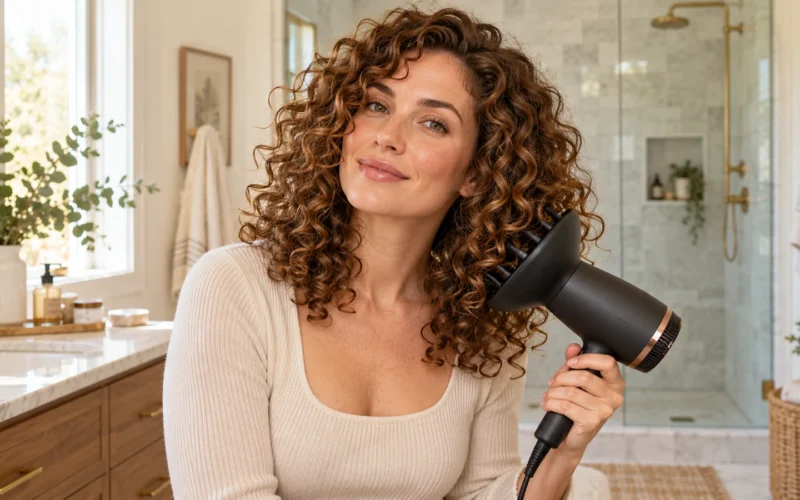
If the wet crown looks lifted but dries flat, give the roots a head start. Hover a diffuser around the scalp on low airflow and low or medium heat, moving between the front, sides and back crown. Tilt left, right and slightly forward so the roots do not set in one fixed direction.
Once the surface of the curl clumps feels more stable, use the diffuser prongs to lift the root area gently. Do not rake through wet curls or repeatedly reposition the lengths. That trades root height for surface frizz. The full diffusing method explains when to hover, cup and move closer to the scalp.
Air-drying can still work, especially for hair that frizzes easily, but change the part once or twice while the roots are damp. Leaving heavy wet hair on the same side for the entire drying time usually preserves that flat position.
Use root clips when direction alone is not enough
Root clipping holds small crown sections away from the scalp while they set. It is most useful when the lengths have good definition but water weight keeps the part and crown pressed down.
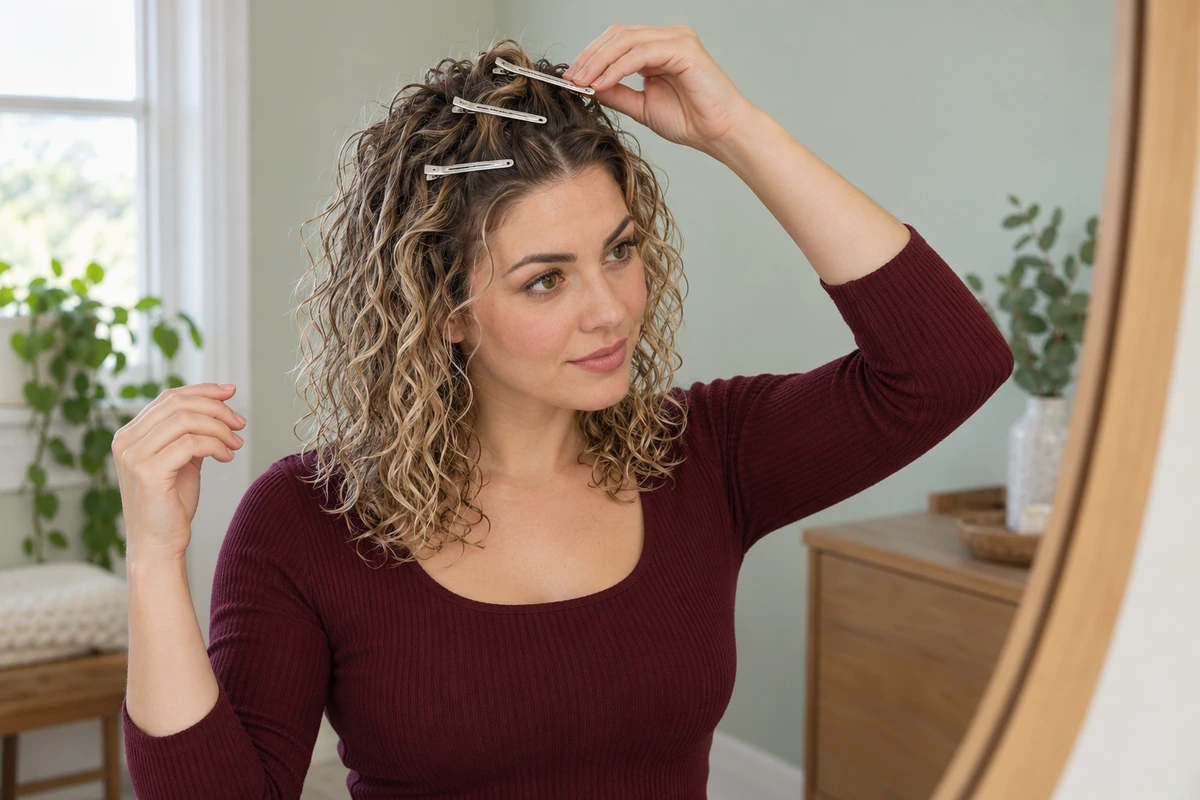
- Finish applying your styler and form the curl clumps first.
- Lift a small section on each side of the part without pulling it tight.
- Slide a clean duckbill clip horizontally across the base so it bridges the section upward.
- Add two or three more clips only where the crown normally collapses.
- Air-dry or diffuse, then remove the clips only when the roots are dry.
If a clip dents the hair, pinches the scalp or forces a large section into a sharp peak, it is doing too much. Use smaller sections and less tension. More clips do not automatically create better volume.
Know when the haircut is setting the limit
Technique can change how hair leaves the scalp, but it cannot remove the pull of very long, dense lengths. If lighter product and better drying direction help for an hour but the crown always sinks, the shape may need adjustment.
Ask a curl-aware stylist about crown layers that release some weight without thinning the perimeter. Fine or lower-density hair needs caution here. Too many short layers can expose more scalp or make the ends look sparse, so the goal is balance rather than maximum removal.
Your natural pattern also matters. Some curls begin with a straighter root and bend farther down the strand. Root clips and directional drying can create lift, but they will not permanently turn that first inch into a ringlet. A believable amount of movement usually looks better than forcing height that disappears the moment the hair settles.
Run one test, then keep only the fix that worked
Do not clarify, change your haircut, buy mousse, add clips and learn a new diffuser routine on the same day. You will get a different result without knowing why.
Start with product placement and drying direction because they are easy to reverse. Add root clips on the next wash if needed. Investigate buildup only when the hair actually feels coated, and consider haircut changes after routine fixes have had a fair test.
Judge the result when the hair is completely dry and again several hours later. The best fix is not the one that creates the highest crown for a photograph. It is the smallest change that gives your roots enough lift without breaking up the curls you already like.