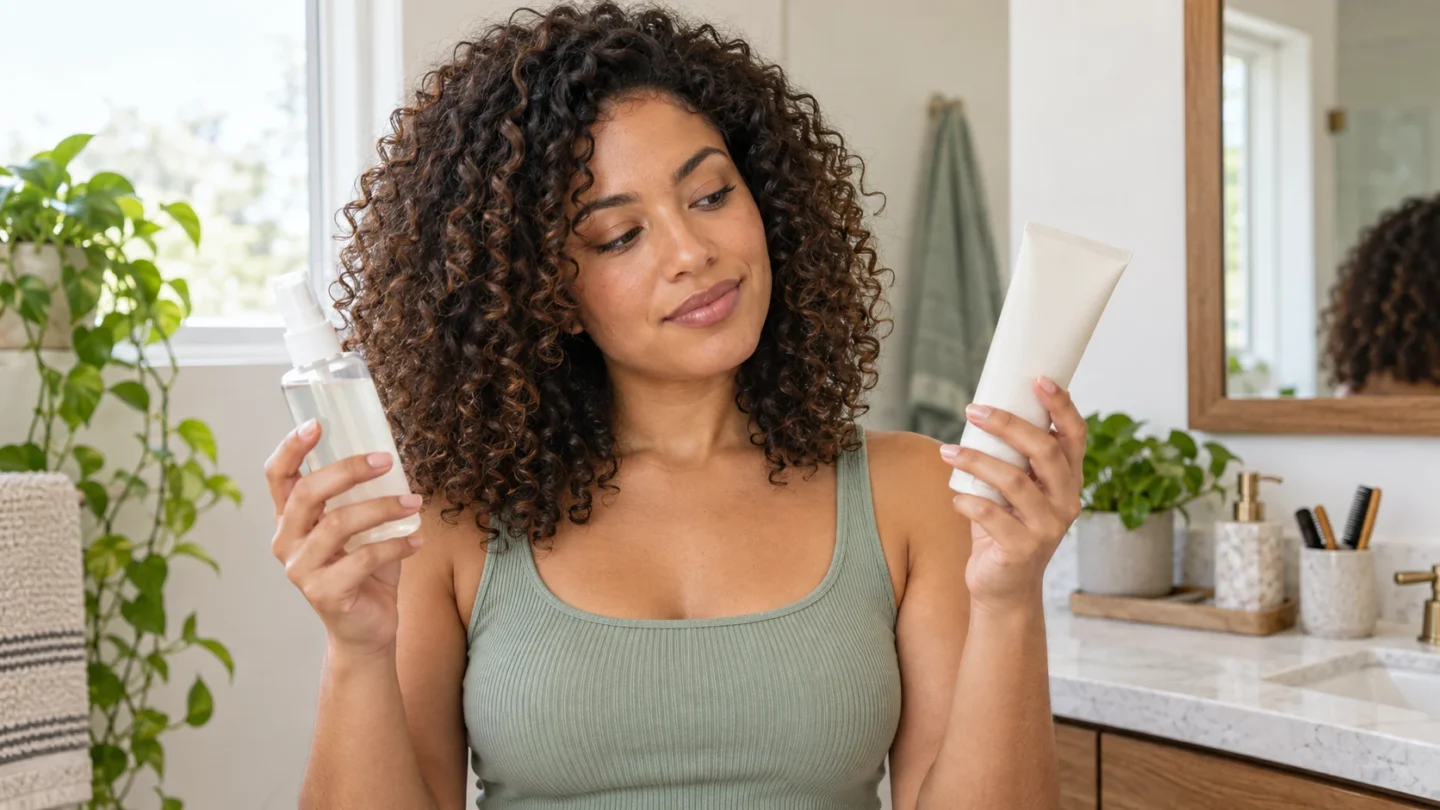
If your curls feel soft but flat after styling, adding another creamy product is probably not the answer. In the curl cream vs leave-in conditioner decision, the useful difference is simple: a leave-in mainly improves softness, slip and manageability, while a curl cream mainly helps the curl pattern look more deliberate.
You may need one, both or neither. Choose according to the result your hair is missing, not the number of products in somebody else’s routine.
Curl cream vs leave-in conditioner: use the missing-result test
Start with what happens between rinsing out your conditioner and finishing your style. Hair that still feels rough, catches on your fingers or tangles easily is asking for conditioning. Hair that already feels soft but dries fluffy or loses its shape is asking for styling control.
| What you notice | Best first test | What it can solve | Main limitation |
|---|---|---|---|
| Hair feels rough or tangled before styling | Leave-in conditioner | Slip, softness and easier handling | Usually little or no hold |
| Hair feels soft but the pattern needs shaping | Curl cream | Clumping, smoothing and light definition | May not hold through a full day |
| Hair is dry and loses its shape | A small amount of both | Conditioning plus soft styling control | Can add weight or residue |
| Hair dries slowly, looks limp or gets coated easily | One light product, or neither | A simpler routine with more movement | You may still need gel or mousse for hold |
This is a starting point, not a rule based on curl type. Two people with similar ringlets can have very different strand thickness, density, dryness and tolerance for product.
What each product actually changes
A leave-in conditioner stays on the hair after the rinse-out conditioner is washed away. Its practical job is to make the lengths easier to handle. The American Academy of Dermatology recommends using a small amount where the hair needs it, generally from the mid-lengths to the ends rather than on the scalp.
Choose a leave-in first when detangling still feels difficult, the ends feel rough after rinsing, or your usual styler drags instead of spreading. Sprays and light lotions can make it easier to control the amount, but texture is not a guarantee. Some cream leave-ins are richer than products sold as curl cream.
Curl cream is a styling product. It can smooth loose strands, encourage curls to group together and give the pattern soft definition. Hold varies widely. One cream may offer barely any control; another may contain enough film-forming ingredients to support a relaxed wash-and-go.
Read the directions and claims instead of trusting the front label. Words such as “detangle,” “soften” and “condition” point toward care. “Define,” “shape” and “light hold” point toward styling. Many formulas do some of both, which is exactly why buying both categories automatically can leave you with two products performing nearly the same job.
Do you need leave-in conditioner and curl cream together?
Use both only when each one fixes a separate problem. A lightweight leave-in can reduce roughness, then a small amount of curl cream can shape the pattern. Apply the leave-in first, followed by the cream. If you also use gel or mousse, that stronger hold product normally comes last.
Layering is more likely to help when hair is coarse, dense or persistently dry and still feels rough with curl cream alone. It is less likely to help when hair is fine, lower density, slow to dry or quick to lose root volume.
Start with less than the amount you would use alone. Full portions of leave-in and cream can turn a sensible routine into a soft, expensive blanket. If the finished hair feels waxy, takes much longer to dry or separates into limp strings, test one product at a time before blaming the gel, weather or haircut.
Run a three-wash test before buying anything else
Keep your shampoo, rinse-out conditioner, hold product and drying method the same. Changing the whole routine at once may produce a different result, but it will not tell you which change mattered.
- Wash one: use leave-in only. Apply a small amount through the areas that feel rough or tangle. Add your usual gel or mousse if you normally use one.
- Wash two: use curl cream only. Keep the amount modest and use the same styling and drying steps.
- Wash three: combine half amounts. Do this only if leave-in gave better softness but cream gave better shape. Apply leave-in first and cream second.
Judge the result only after the hair is fully dry. Compare wet slip, root volume, softness at the ends, definition later that day and residue on day two. The winner is the simplest routine that gives you the result you care about. If you are still building the rest of your wash day, use the same controlled approach in this beginner curly hair routine.
Neither product is a substitute for hold
Soft hair can still lose definition. Curl cream may provide light control, but neither category guarantees a cast or long wear. If your curls look good when wet and then expand, separate or fall by midday, the missing step may be gel or mousse rather than more conditioning.
That is a different decision. Our curl cream versus gel comparison explains when softness is enough and when the style needs stronger hold.
You can also skip leave-in and curl cream when your rinse-out conditioner leaves the hair manageable and your hold product gives the finish you want. A shorter routine is not incomplete simply because social media found room for five bottles.
Common reasons the test gives a confusing answer
- Product is concentrated near the roots. Move it toward the lengths and ends before deciding the formula is too heavy.
- The hair was partly dry during application. Uneven water and product distribution can create soft sections beside fuzzy ones.
- You changed the hold product too. Keep gel or mousse constant while comparing the creamy layers.
- You judged before the hair dried. Wet curls can look heavy or under-defined and change considerably once the water leaves.
- The label hides an overlap. A rich leave-in may already behave like a cream, while a conditioning curl cream may make a separate leave-in unnecessary.
Choose leave-in when the missing result is softness and easier handling. Choose curl cream when the hair already feels conditioned but needs shape. Layer both only when your test proves they solve different problems. If removing one product makes your curls lighter, faster to dry and just as defined, your shelf has its answer.