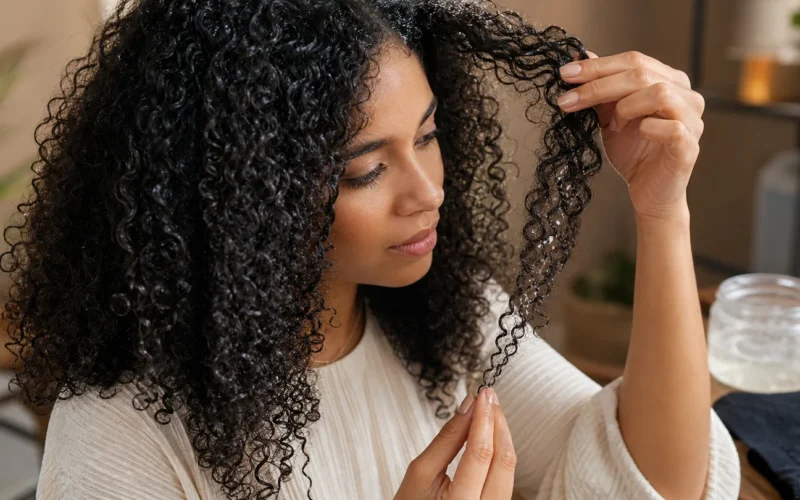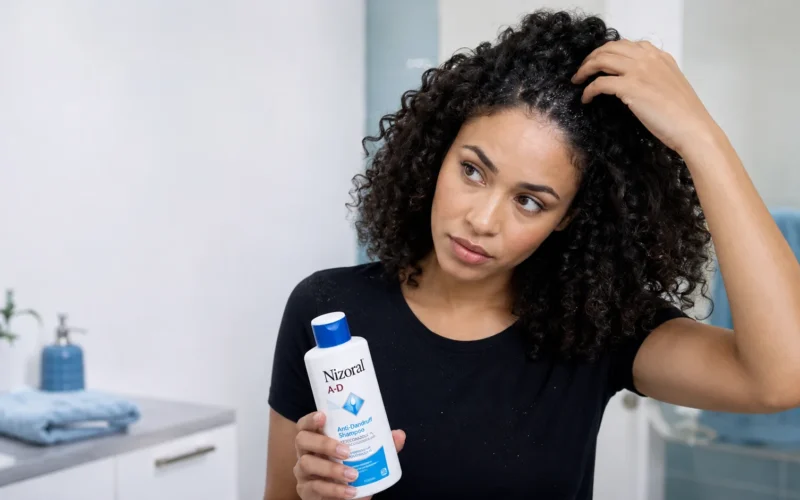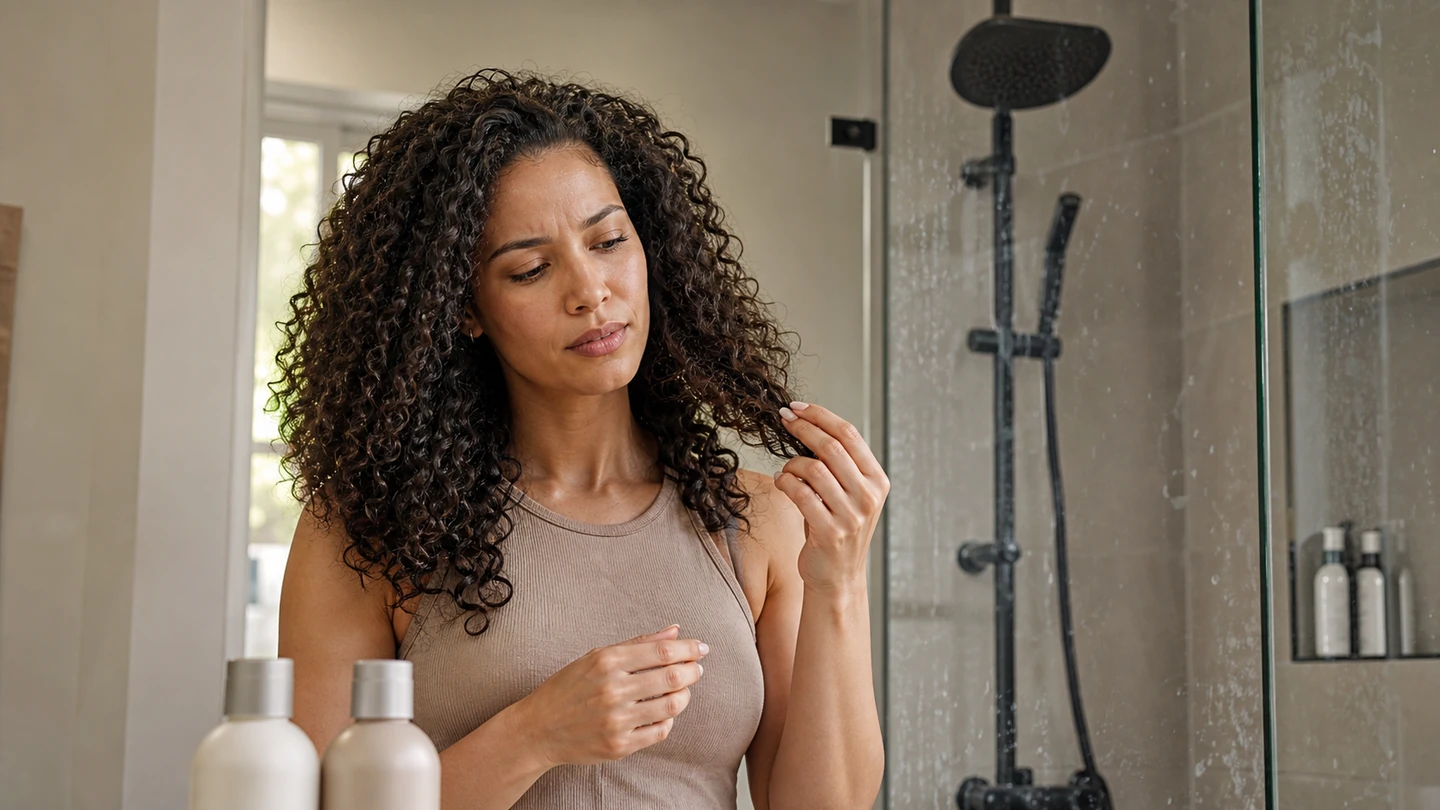
Your curls used to clump. Now they feel coated, look dull and stay strangely rough even after clarifying. Before you blame your conditioner, check whether you are cleaning the wrong kind of buildup.
Use clarifying shampoo for styling residue, excess oil and product film. Use chelating shampoo when hard-water minerals or pool metals are the likely problem. If you have hard water and your clarifier already contains an effective chelating system, you may not need two bottles. The label matters more than the name on the front.
Which buildup is sitting on your curls?
Heavy, dull and difficult-to-style hair can describe product buildup, mineral buildup or plain dryness. Hair symptoms alone cannot prove which one you have. Your recent routine and water history provide better clues.
| What changed? | More likely culprit | Better first test |
|---|---|---|
| You layered gel, cream, oil or dry shampoo, or went longer between thorough washes | Product and oil buildup | Clarifying shampoo |
| The problem began after moving, travelling or changing water supply; taps or shower glass also collect pale scale | Hard-water minerals | Confirm water hardness, then try chelating shampoo |
| A clarifying wash removes grease but the lengths still feel rough, dull or coated | Possible mineral buildup, damage or dryness | Check the water before cleansing again |
| Hair changed after regular swimming, especially light hair with a greenish cast | Possible copper or pool-related deposits | Use a product labelled for swimmers or metal removal |
| The scalp is sore, inflamed, intensely itchy or scaling in patches | Not a shampoo-selection problem | Stop experimenting and seek professional advice |
If a normal or clarifying wash makes your curls light and responsive again, stop there. More squeak is not more science.
Chelating vs clarifying shampoo: the useful difference
A clarifying shampoo relies on cleansing agents to remove sebum, silicones and styling residue. A chelating shampoo adds ingredients that can bind metal ions so they rinse away more readily. That second job matters when the deposit came from the water rather than your styling shelf.
Hardness is mainly a measure of dissolved calcium and magnesium. The U.S. Geological Survey’s water-hardness guide classifies 121 to 180 mg/L as hard and anything above 180 mg/L as very hard. Laboratory research has also found greater calcium and magnesium deposition on hair washed in hard water than on hair washed in distilled water, as reported in this scanning-electron-microscopy study.
The categories can overlap. Many chelating shampoos also clean product residue, and some shampoos sold as clarifying contain chelators. You do not automatically need a clarifier, a chelator and a tiny bathroom annex to store them.
Prove the water problem before buying another shampoo
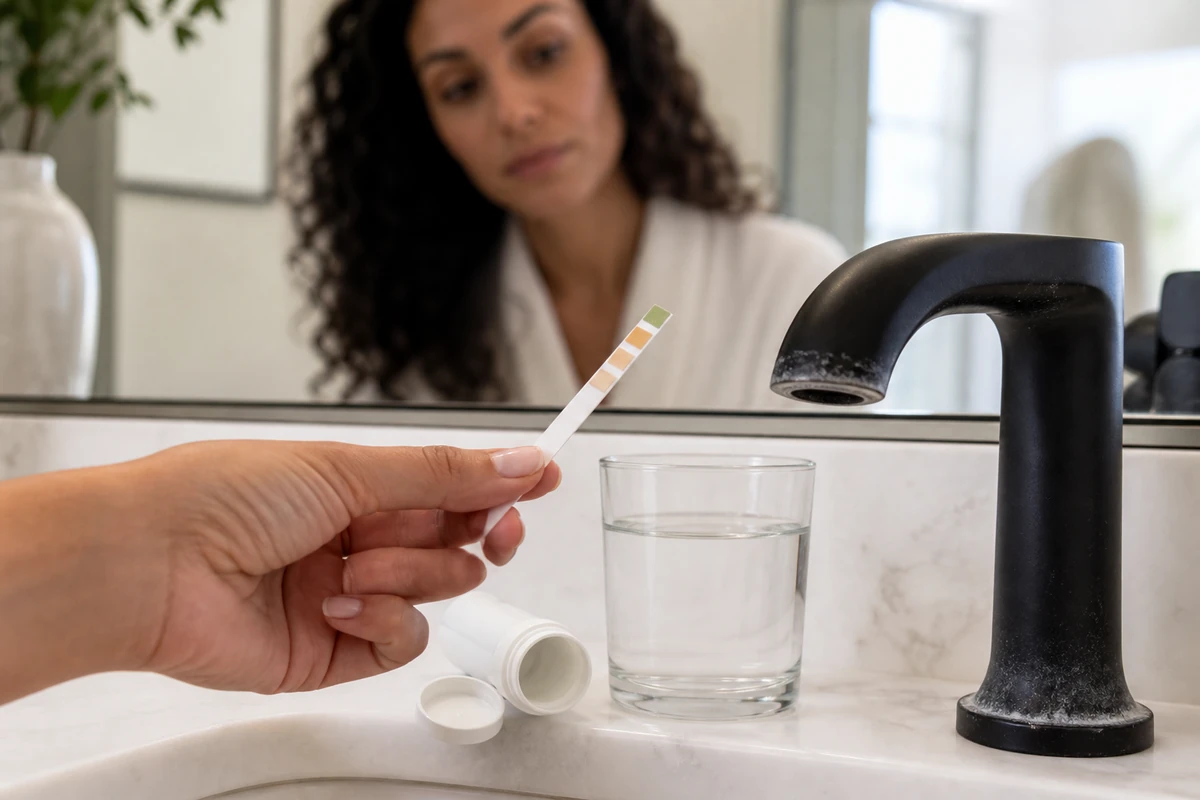
- Check your water report. Search your water provider’s report for “hardness,” usually stated as mg/L or ppm as calcium carbonate. US readers can start with the EPA’s Consumer Confidence Report finder. Well-water users may need a test.
- Look beyond your hair. Chalky marks on taps, shower glass or a kettle support the hard-water theory. They do not show exactly what is on your strands, but they are stronger evidence than frizz alone.
- Check the timing. A sudden change after moving or travelling is more persuasive than curls that have always been dry.
- Run one controlled wash. Keep the conditioner and stylers the same. Change only the cleanser, then compare wet slip, dry feel, shine and curl clumping. Otherwise every product gets questioned and none provides an answer.
How to spot a genuine chelating shampoo
Start with the product’s stated purpose. Look for clear language such as “hard water,” “mineral removal,” “metal detox” or “swimmers.” Then read the ingredient list. Chelating names may include disodium EDTA, tetrasodium EDTA, phytic acid, sodium phytate, sodium gluconate or pentasodium pentetate.
An ingredient name is a clue, not a performance certificate. The list does not reveal the finished formula’s concentration, pH, contact time or mineral-removal testing. A trace of EDTA used to keep the formula stable does not prove the shampoo will clear months of deposits. Prefer an explicit mineral-removal claim and follow that product’s directions.
For swimmers, the distinction can be more visible. A published dermatology case linked green discoloration in light, previously damaged hair to copper exposure and reported improvement with an EDTA-containing shampoo. That does not mean every dull curl contains copper, but it explains why a metal-removal formula has a different job from an ordinary deep cleanser.
Do you need both shampoos?
Usually, no. Choose by exposure and result:
- If a clarifying wash removes the coating, use your regular shampoo until product buildup returns.
- If confirmed hard water plus persistent roughness points to minerals, use a chelating shampoo as directed.
- If one product is explicitly both clarifying and chelating and your curls tolerate it, one bottle can cover both jobs.
- If neither changes the problem, stop escalating the cleanse. Bleach damage, heat damage, dryness and scalp conditions need different answers.
If product residue is the better match, this guide explains when clarifying shampoo helps and when it backfires. If you need bottle-level options, compare the clarifying shampoos selected for curly hair, including formulas that also address hard-water buildup.
Use chelating shampoo without turning curls to straw
Follow the bottle rather than inventing a longer treatment time. Wet the hair thoroughly, distribute the shampoo where deposits are suspected, rinse well and use a compatible conditioner afterward. Keep the rest of the routine unchanged for that wash so the result means something.
Do not make chelating an automatic every-wash step unless the manufacturer specifically says the formula is suitable and your hair tolerates it. Curly, bleached, color-treated or already brittle hair deserves a cautious first use. If the result is roughness, tangling or scalp irritation, stop and reassess rather than doubling the dose.
A shower filter is not necessarily a hard-water fix. NSF explains that certified shower filters address free chlorine, while certified water softeners reduce calcium and magnesium through ion exchange. Check what a device is certified to remove before expecting a prettier showerhead to negotiate with minerals.
The one-wash decision
Choose clarifying when the evidence points to products. Choose chelating when the water or pool is the stronger suspect. If you cannot confirm either, test the water before performing another “reset” on curls that may simply be dry.
The right cleanser should solve a specific deposit and then leave the stage. Your shampoo does not need a permanent starring role.