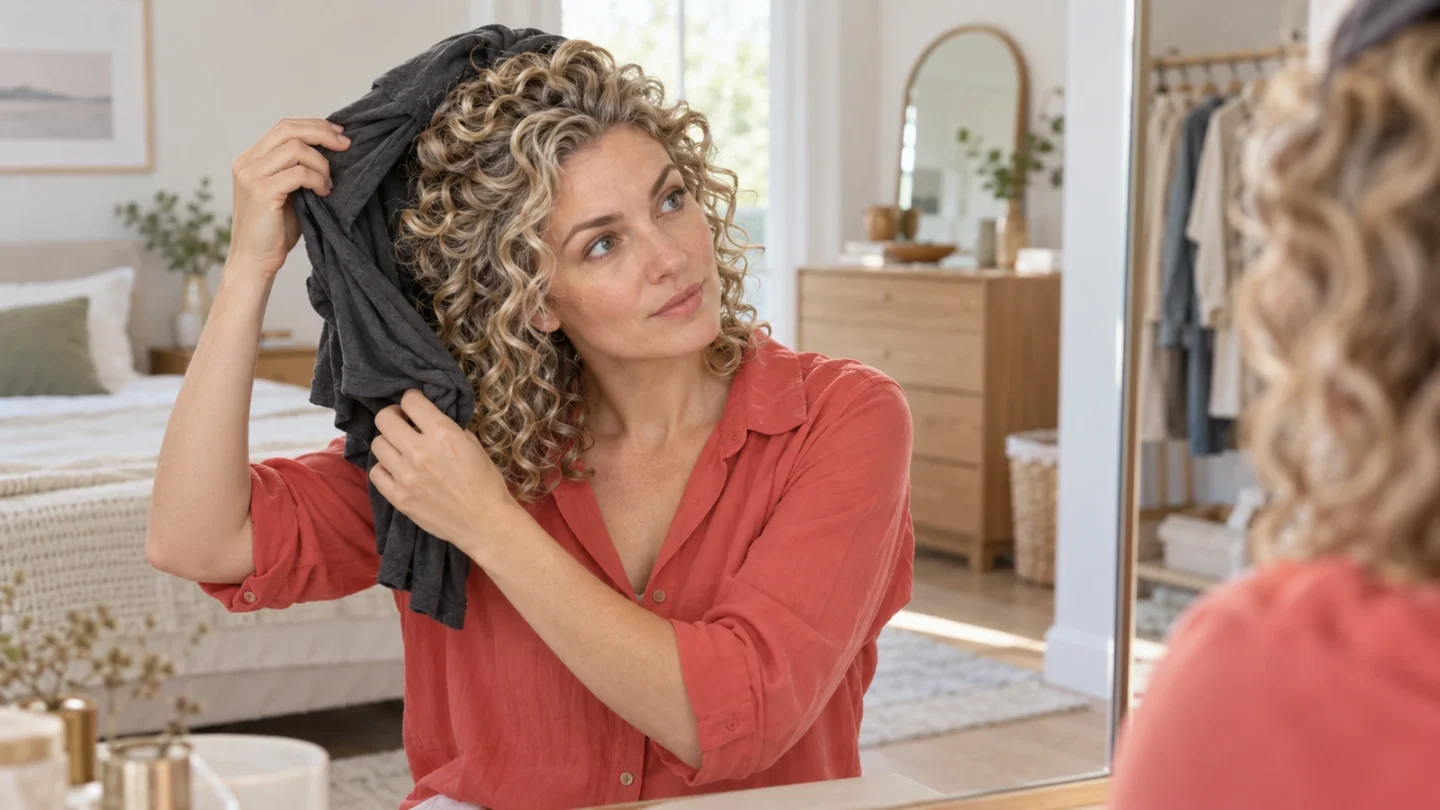
Your curls looked promising before they went into the T-shirt. Then you unwrapped flat roots, a dented crown and a few ringlets pointing in directions nobody requested.
Plopping is not a required curly-hair step. A full plop helps when wet lengths stretch an otherwise good pattern. Microplopping is usually the better test when your roots flatten easily, your waves are loose, your hair is short or the wrap keeps changing your part. If curls already dry well without fabric, skip it.
Read the result before changing your products
Plopping only controls how wet, styled hair is held while fabric removes some water. It cannot create a curl pattern or repair a weak gel combination. When the result goes wrong, the shape of the failure is more useful than another random tutorial.
| What happened | Likely plopping problem | Next wash-day test |
|---|---|---|
| Ends look defined but the crown is flat | Roots dried pressed against the scalp or the wrap sat too low | Microplop the lengths and leave the roots free |
| Curls have dents, hooks or one flat patch | Hair folded sideways, the wrap was tight or it stayed compressed too long | Place curls straight down into the fabric and release earlier |
| Clumps turn stringy when unwrapped | The fabric shifted them or absorbed too much water and styler | Use fewer presses with a smoother cloth |
| Surface frizz appears immediately | Rough fabric, rubbing or a fast release disturbed the set | Use a soft T-shirt and peel it away slowly |
| The crown stays wet long after the ends | Dense hair held water inside a closed bundle | Skip the wrap and begin drying the roots sooner |
If the same flat roots appear even when you do not plop, check product weight, natural growth direction and haircut shape with our broader flat-root troubleshooting guide. The wrap may be revealing the problem rather than causing all of it.
Choose the version that solves your actual problem
The internet often treats plopping as one technique. In practice, you have three useful choices.
Full plopping: for lengths that stretch while wet
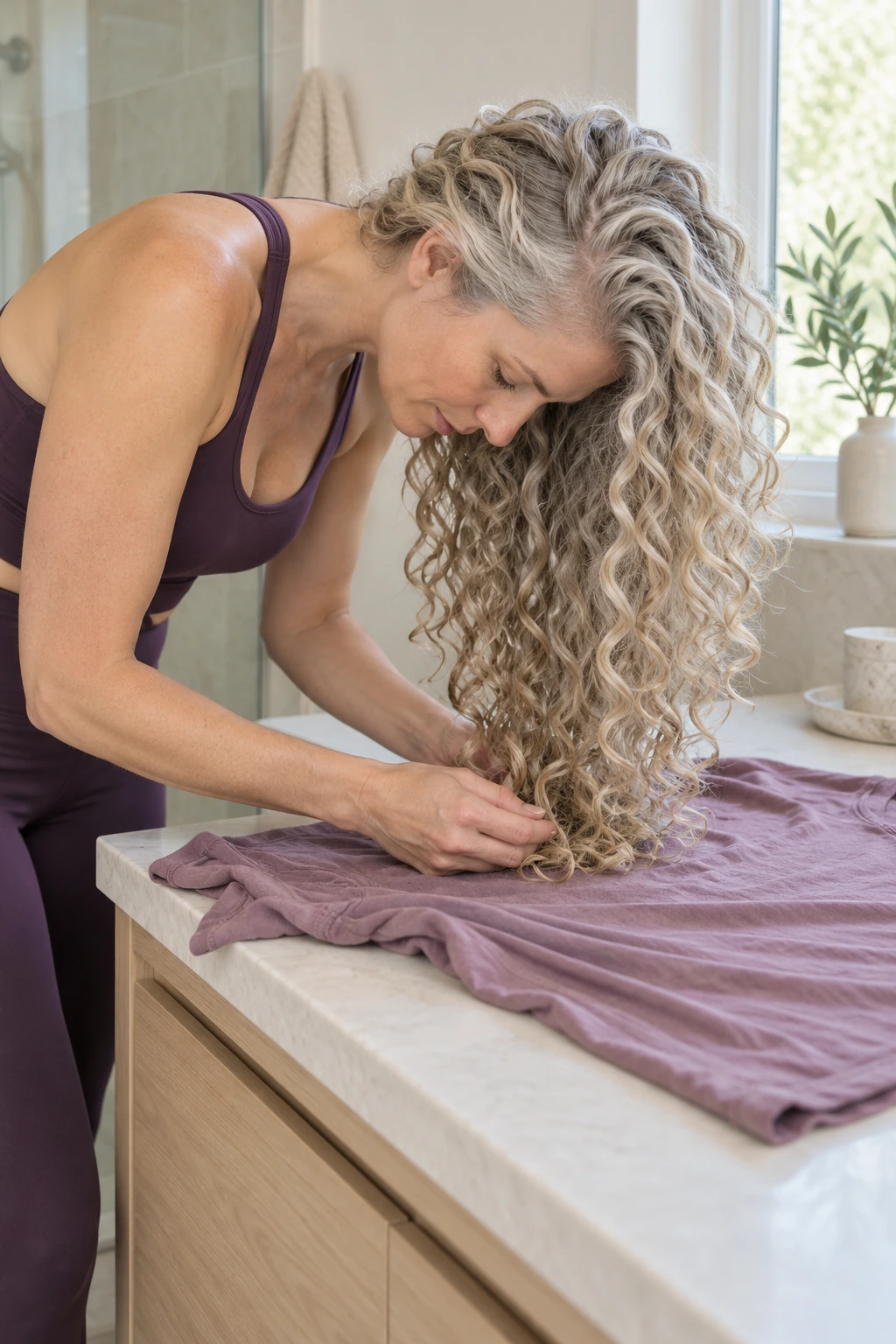
Use a full plop when your curl clumps already look good but hanging wet hair pulls them longer before they set. Apply your normal styler first. Lay a soft cotton T-shirt or smooth microfiber towel flat, bend forward and lower the ends onto the center so the lengths fold upward like an accordion.
Bring the fabric around the head without twisting the hair inside it. Secure it loosely enough that you can move your eyebrows and jaw comfortably. Stylists interviewed by Allure also recommend placing the hair onto a flat T-shirt or microfiber towel rather than using a traditional towel-and-twist motion.
Microplopping: for flat roots, loose waves or short curls
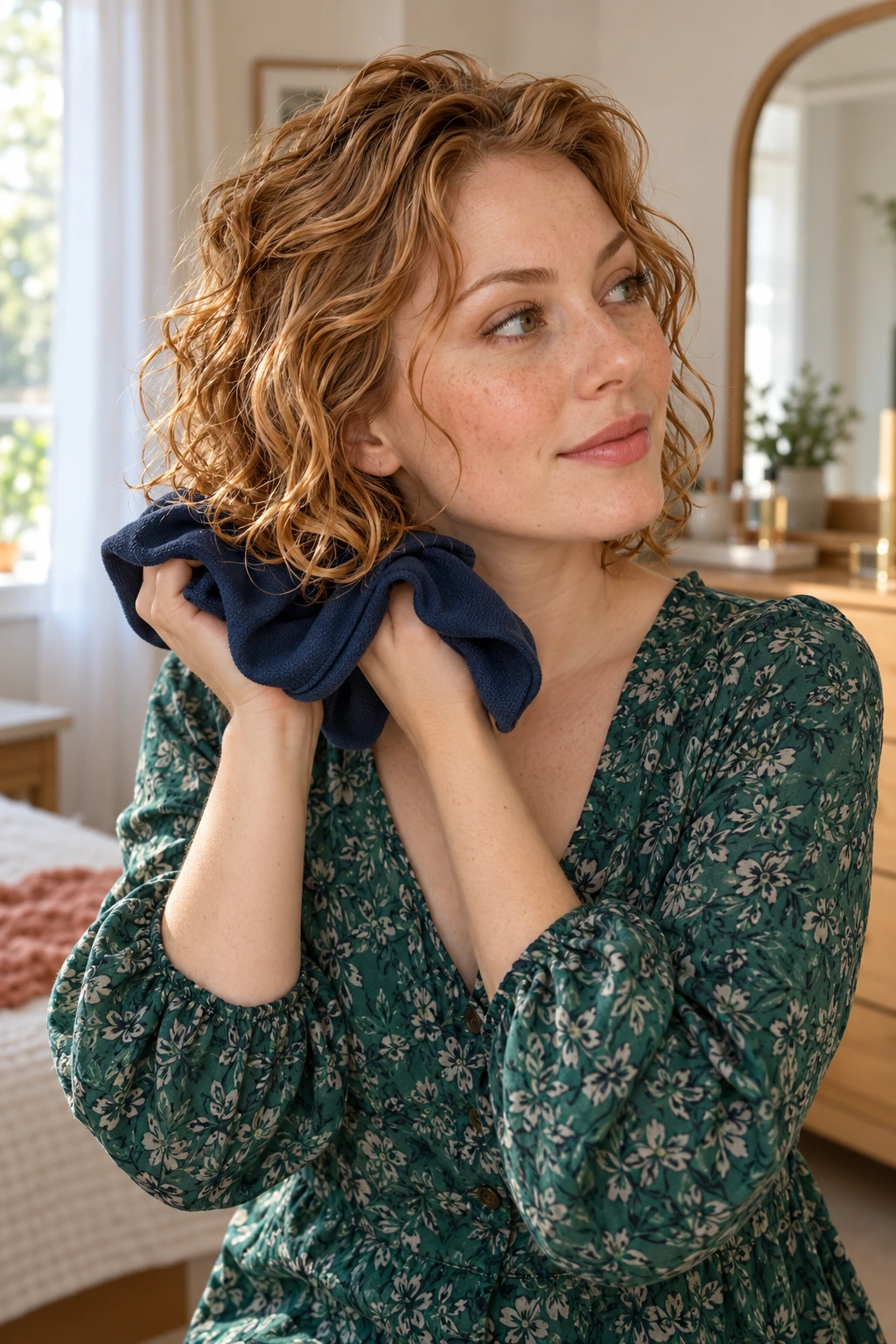
Microplopping removes water without enclosing the whole head. Spread a T-shirt or microfiber towel over both palms, cup the ends and press them upward once. Move around the head section by section. The fabric should meet the curls; it should not rub across them.
This is often the lower-risk choice when full plopping creates a square shape, shifts your part or traps short curls in the wrong direction. Keep the crown upright and use the cloth only where you want less water. If clumps start splitting into narrow strings, stop pressing and compare the result with our guide to finding where curly clumps fall apart.
Skip plopping: when the wrap creates more work
Skip it if upside-down styling makes your part chaotic, dense roots stay wet, your haircut is too short to stack comfortably or your curls look better when they fall in their normal direction. Gently squeeze excess water with bare hands, then air-dry or diffuse without a fabric wrap.
This is not failing the curly-hair routine. It is removing a step that does not solve your problem.
Do not use a universal plopping time
Five different heads can use the same shirt for the same number of minutes and get five different results. Fabric absorbency, density, length, water load, product and wrap pressure all change the outcome. A timing chart based only on curl type is too confident.
For your first test, release the wrap while the hair is still clearly damp and note the time. Shorten the next attempt if you see dents, a dry fuzzy surface or product disappearing into the fabric. Extend it slightly only if the clumps keep their shape and your goal is to remove more water. Curl specialists speaking to TODAY likewise describe plopping time as individual, especially for very tight curls where a long wrap may disturb placement.
Overnight plopping is rarely the cleanest experiment. It adds hours of compression and makes it difficult to know when the useful setting stage ended. If your goal is protecting finished curls while sleeping, start with dry hair and use an overnight protection method instead.
Protect the cast you already built
Plopping cannot rescue uneven product application. Make sure gel or mousse is distributed before the fabric touches your hair. If the wrap repeatedly leaves soft spots or removes so much product that no firm film develops, shorten the step or remove it from your routine. Our gel-cast test separates application problems from a formula that simply dries soft.
Unwrap slowly with your head tilted forward, then let the curls fall without raking or shaking them apart. Finish the roots first if they stay wetter than the lengths. The diffuser guide explains how to hover, cup and change drying direction without undoing the clumps you just protected.
Run one useful test next wash day
Keep your wash products, styler and drying method the same. Change only the fabric step: full plop, microplop or no plop. Photograph the crown and back once dry, not just the most cooperative front curl.
If full plopping gives better lengths but flatter roots, microplopping is the logical compromise. If every wrap creates dents or a damp crown, skip it. The best technique is not the one with the longest tutorial. It is the one that improves your curls without requiring another repair routine afterward.