Your curls are dry, but there is no crunch to scrunch. The gel seems to have vanished, and the definition often disappears with it.
A missing gel cast usually points to one of four things: the formula creates flexible hold instead of a hard shell, too little gel reached the hair, water or softer products diluted the layer, or the forming cast was disturbed before it dried. Start with the result, not the biggest tub of gel you can find.
If your curls stay defined for as long as you need, no crunch is not a failure. The cast is a means to longer-lasting shape, not a scorecard.
First, read what your curls are telling you
“No cast” can describe several different problems. Match what you actually feel after the hair is completely dry.
| What happens | What it may mean | Best first test |
|---|---|---|
| Hair dries soft but stays defined | The gel may form a flexible film rather than a rigid cast | Leave the routine alone and judge longevity |
| Hair dries soft and loses shape quickly | Hold may be too light, too diluted or unevenly applied | Test the gel alone on one wash |
| Only the ends turn crunchy | Most of the gel may be landing where you scrunch | Smooth it through sections before scrunching |
| Hair stays sticky for hours | It may still be damp, overloaded or layered with incompatible amounts | Use fewer products and confirm it is fully dry |
| A cast forms, then curls fall flat when scrunched | The cast formed; the problem is hold after removal | Break it more gently and skip finishing oil once |
| White specks appear | Product residue or a layering conflict may be breaking away | Test one styler instead of adding more |
The table is a starting point, not a diagnosis by vibes. Change one variable at a time or every wash becomes a tiny, expensive mystery.
A gel cast is a dried film, not a curl report card
Styling gels use film-forming ingredients to help groups of hair keep their arranged shape as water evaporates. Those films can be hard and obvious, soft and flexible, or somewhere between the two. Research on hair-styling ingredients even evaluates dried films by properties such as stiffness, adhesion and flexibility, so two products labelled “gel” can feel very different once dry. This open-access study of styling-polymer mechanics explains how those properties are measured.
That is why adding more of a light or flexible-hold gel may give you sticky curls rather than a louder crunch. Check the product description first. “Flexible,” “touchable” and “soft hold” are clues that a rigid cast may never be the intended finish. A strong-hold claim makes a firm cast more likely, but formulas and hair responses still vary.
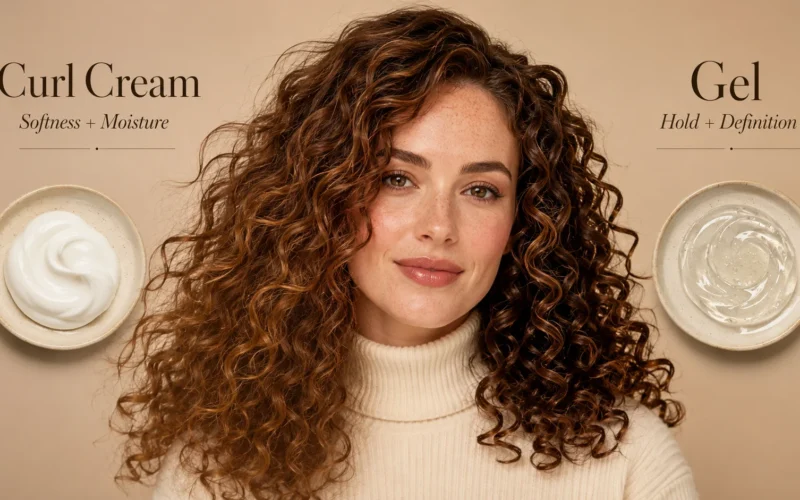
If you are choosing between softness and stronger hold, this curl cream versus gel comparison explains the different jobs before you start stacking both.
Cream, oil and streaming-wet hair can soften the test
Leave-in conditioner, curl cream and oil are not automatically enemies of gel. They can make hair feel softer and reduce friction. But a rich layer underneath may also make the final cast less obvious, especially when the gel itself is flexible.
For one troubleshooting wash, keep the test clean. Rinse your conditioner thoroughly, skip leave-in, cream and oil, then use the gel by itself. If a cast appears, the answer is not “never condition again.” It means you can add the softer product back in a smaller amount and see where the balance changes.
Water creates a similar tradeoff. Gel spreads more easily through wet hair, but it should not immediately stream off with the water. If your hands and shoulders are catching most of the product, gently squeeze out the dripping excess before applying the gel. Keep the hair wet enough to clump, not so flooded that the styler takes the scenic route to the drain.
Application can leave the roots underdressed
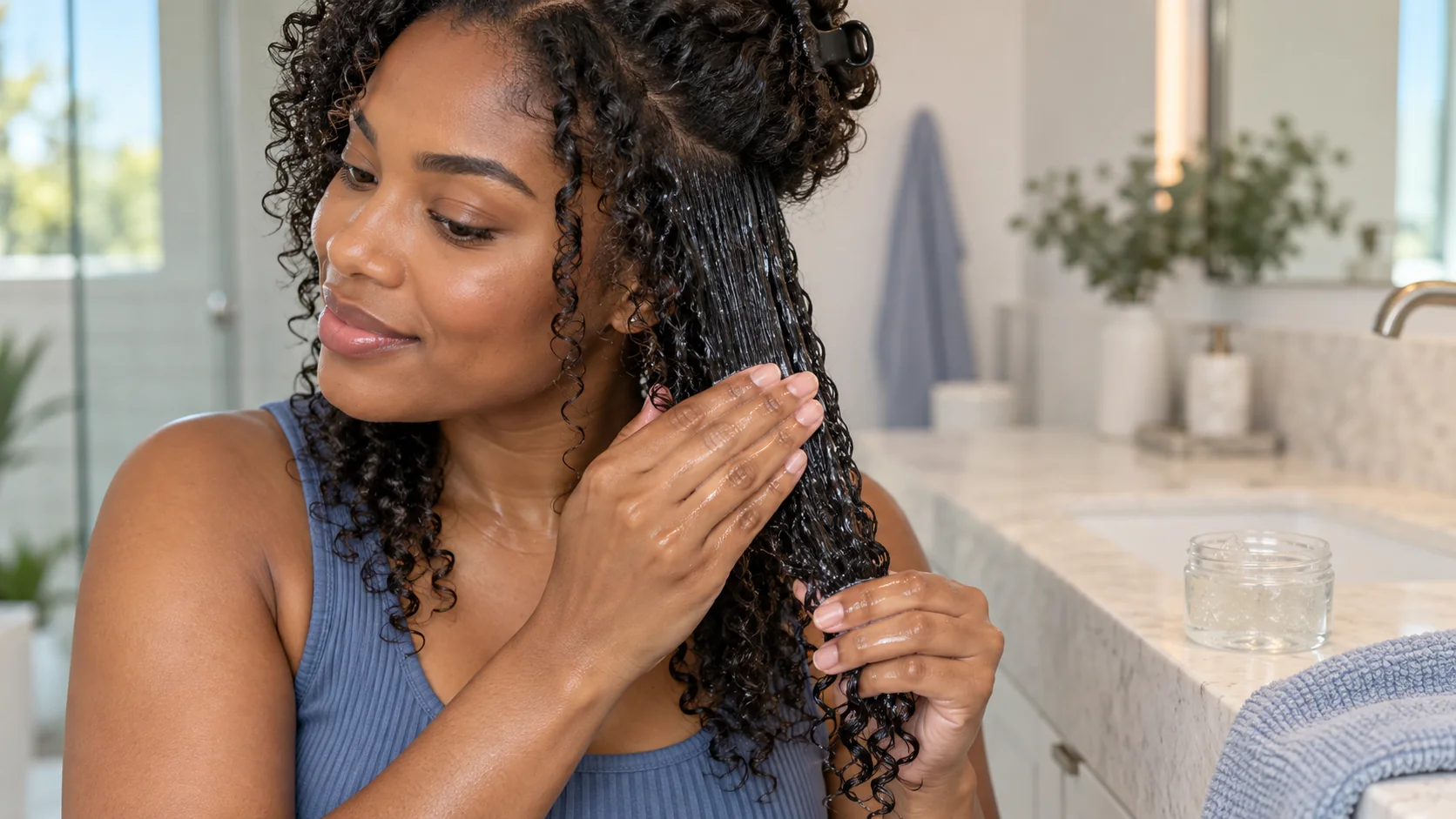
Scrunching gel only from the ends often creates a convincing cast there and almost none higher up. For even hold, divide the hair into workable sections, spread the gel across both palms, then smooth or glaze it through the lengths before scrunching. You do not need to plaster the scalp. You do need the product to reach more than the last few inches.
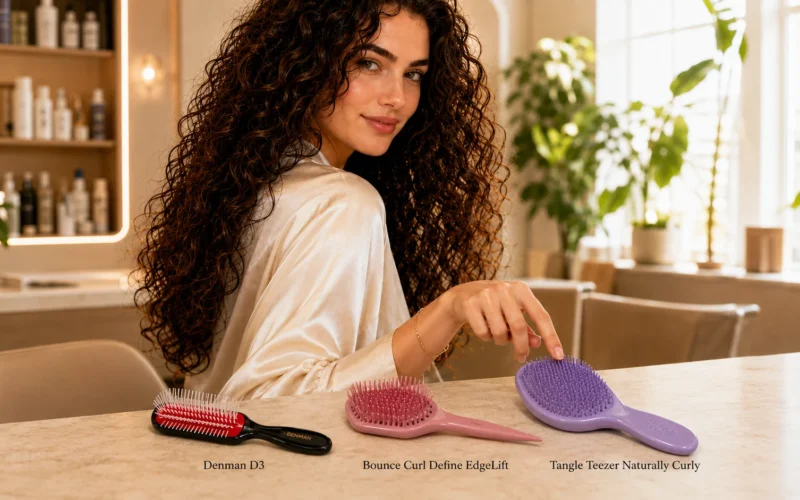
Brush styling can redistribute or remove some gel as the brush passes through. If you use a brush to create curl groups, add a light final glaze after the clumps are formed instead of assuming the first application is still evenly present.
Watch what happens next. Plopping or microplopping after gel can transfer product to the fabric. Repeated scrunching, checking and rearranging can crack a thin film before it finishes setting. During the test wash, style once and become temporarily unavailable to your own hair.
Run one clean gel-cast test
This is not a new routine. It is one controlled wash designed to answer whether the gel can cast on your hair.
- Wash as usual and rinse conditioner thoroughly.
- Skip leave-in, cream, oil and mousse for this test.
- Remove only the water that is actively dripping, keeping the curl groups wet.
- Apply gel section by section, smoothing before scrunching so the roots, middle and ends receive coverage.
- Do not towel the hair after application. Air-dry without touching it or diffuse with low airflow until every section is dry.
- Before scrunching, check the crown, middle and ends separately. Note where the cast formed and where it stayed soft.

If the gel casts by itself, reintroduce one skipped product on the next wash. If it remains soft and the style collapses, try a genuinely stronger-hold formula rather than doubling a product designed for touchable hair.
When the cast forms but the result still fails
A hard cast that goes flat the moment you break it is a different problem. First, confirm the hair is completely dry. Scrunch with open palms and small upward movements. For one test, skip oil; the extra slip can make it harder to tell whether the gel alone has enough lasting hold.
If the curl groups split into narrow, separated pieces before the cast forms, troubleshoot the first stage where that happens with the guide to curls that look good wet and turn stringy. More gel will not repair clumps that were already brushed, towelled or diffused apart.
If the cast forms but breaks into visible dust, stop increasing the amount. Use the gel alone and check the guide to white flakes left by hair gel before blaming your scalp.
Keep the result that works, even if it is quiet
Some curls need a firm shell to last. Others do well with a flexible film that never becomes dramatically crunchy. The useful measure is whether the hair dries cleanly, keeps its shape and remains comfortable until your next wash or refresh.
Use the gel-only test to identify the missing piece, then rebuild only what your hair needs. If the curls look good and hold well without a cast, congratulations: the crunch was optional.