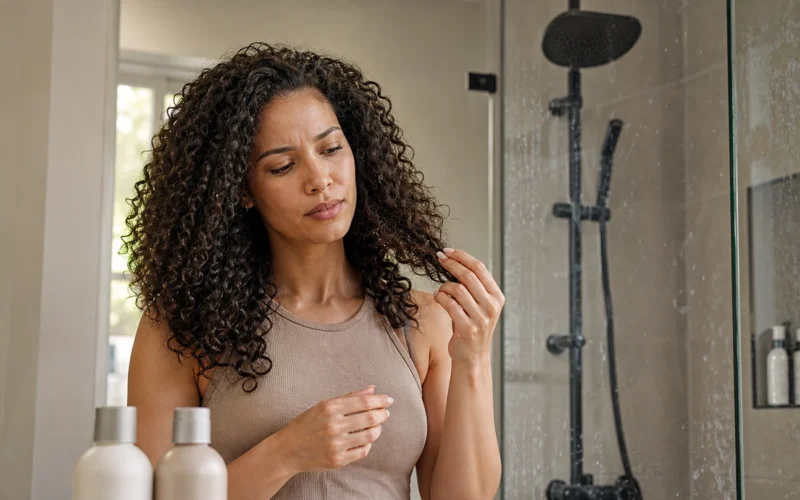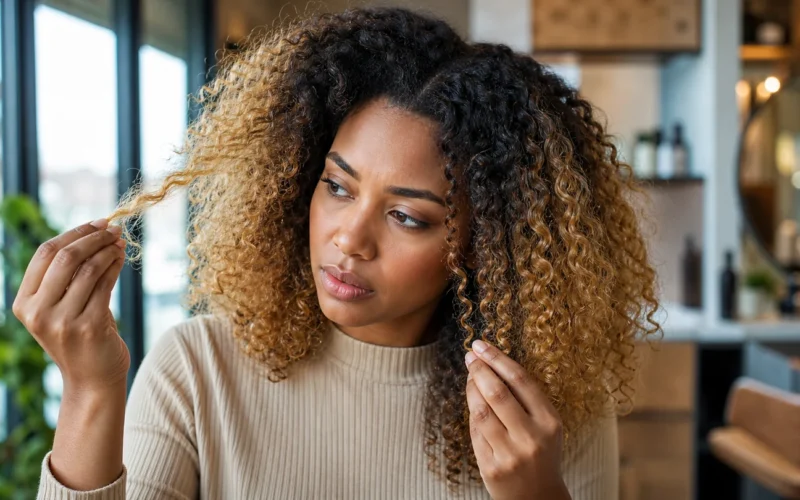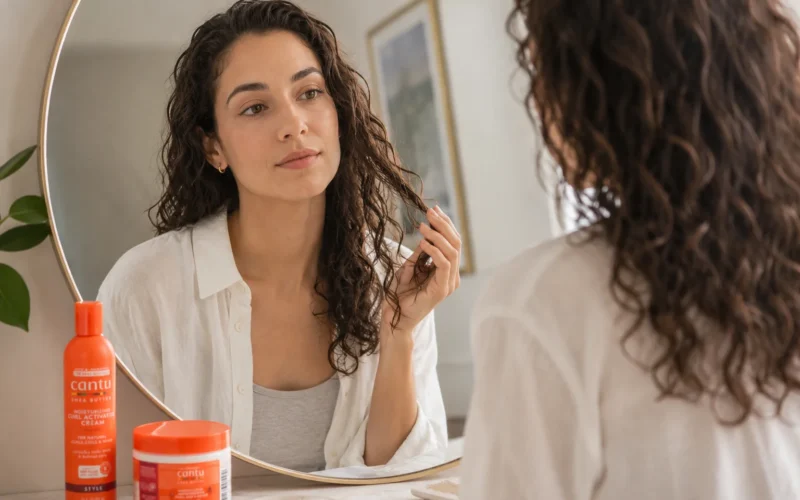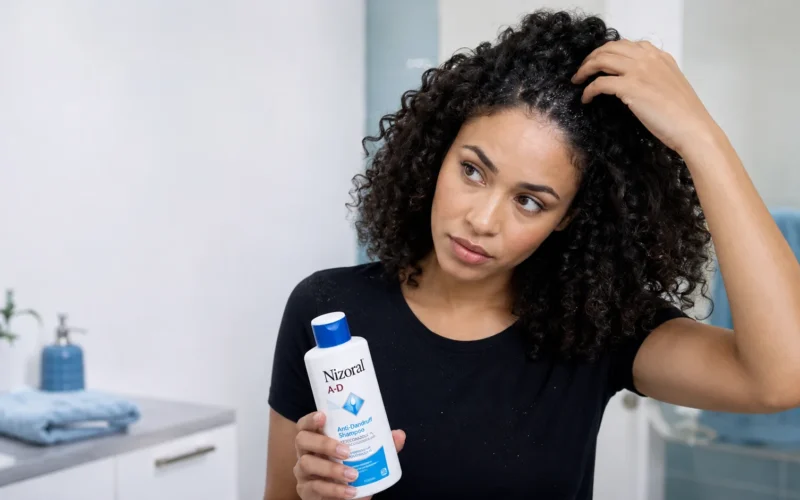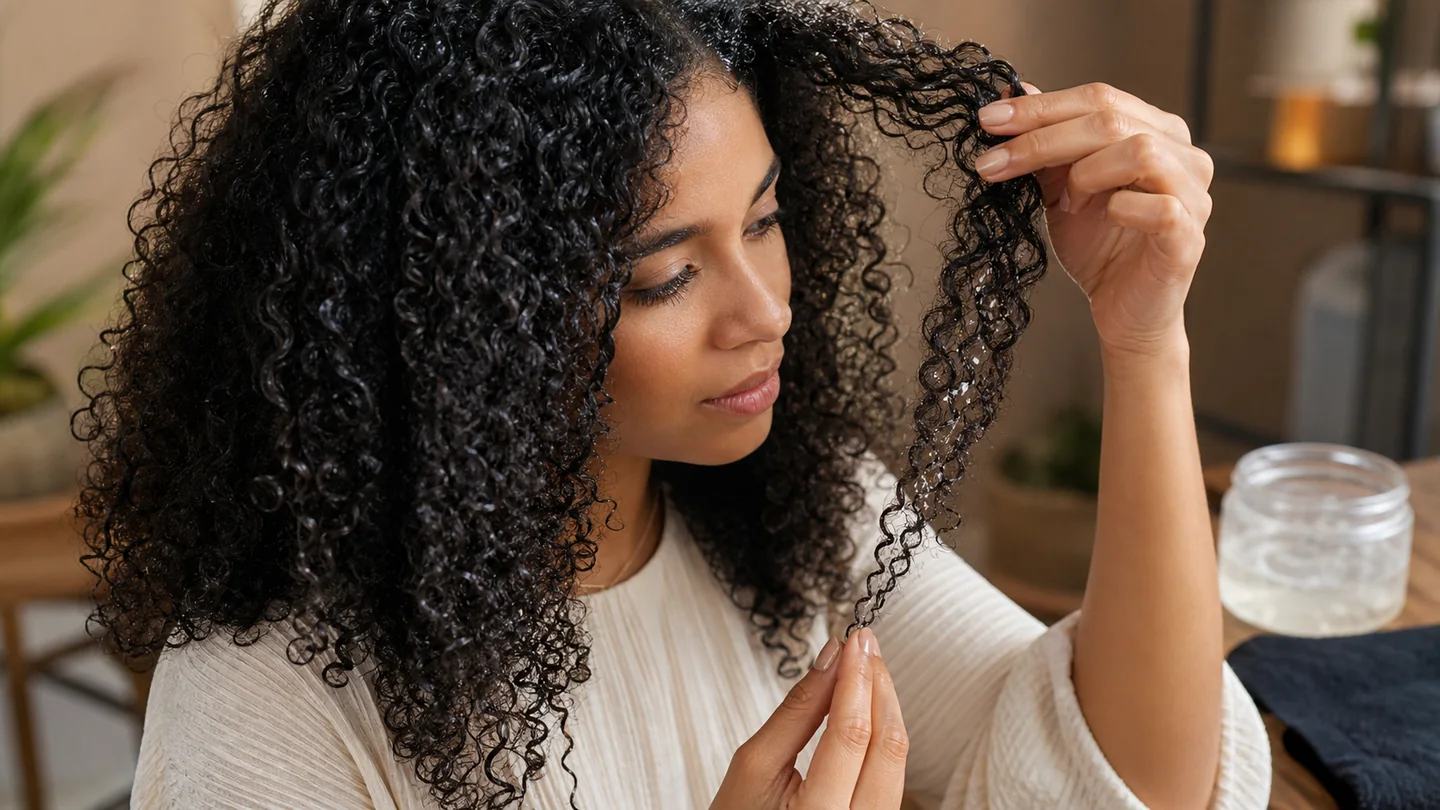
Your curls dried, you scrunched out the cast, and suddenly they looked dusted with white powder. Did your gel betray you, or is it dandruff?
If the white flakes sit along the curls while your scalp looks calm, dried styling product is the likeliest cause. Flakes that start on an itchy scalp, stay firmly attached to individual hairs or appear where strands are breaking need a different response. Before buying stronger dandruff shampoo, check where the material starts and whether it moves.
Health note: This guide cannot diagnose a scalp condition. Stop using a new product and seek medical advice for swelling, sores, pus, marked hair loss, a painful or spreading rash, or scaling that does not improve.
Is it product residue, dandruff, nits or breakage?
Color alone tells you very little. Location, texture and how firmly the specks are attached provide better clues.
| What you notice | What it may suggest | What to do next |
|---|---|---|
| Powdery specks along styled curls with little on the scalp | Dried gel, cream, mousse or product buildup | Test fewer products and a smaller amount |
| Loose flakes coming from an itchy, oily or irritated scalp | Dandruff or another scalp condition | Use appropriate scalp care and get advice if it persists |
| Small oval specks firmly attached near the roots, especially behind the ears or at the nape | Possible head-lice nits | Check with a lice comb or healthcare professional |
| White points on strands that bend or snap at the same spot | Hair-shaft damage | Reduce heat, chemical and mechanical stress |
The American Academy of Dermatology describes dandruff as skin flaking from the scalp. Nits behave differently: the CDC says they are firmly attached to hair near the scalp and are commonly confused with dandruff, hair-spray droplets and dirt. A speck that brushes away easily is less suggestive of a nit.
Why hair gel leaves white flakes
Gel forms a thin film as it dries. That film gives curls hold, but it can turn dusty when it is too thick, dries unevenly or clashes with a product underneath.
- Too much product: Excess gel collects where curl clumps overlap. Once the cast is scrunched, the thick coating breaks into visible dust.
- An incompatible leave-in: Two products can perform well alone and curdle when layered. Cosmetic-formulation research has documented incompatibility between some gel thickeners and conditioning polymers.
- Uneven application: Thick gel applied to a section that has started drying can remain in concentrated patches instead of spreading into a fine film.
- Old buildup: Adding fresh gel over several days of cream, oil and styler can leave the hair coated before the new cast even forms.
For a quick warning test, mix a tiny dab of your leave-in and gel in your palm. Immediate white clumps or curdling suggest a poor match. A smooth mixture is not proof that the combination will dry clean, so confirm it on a small section of hair.
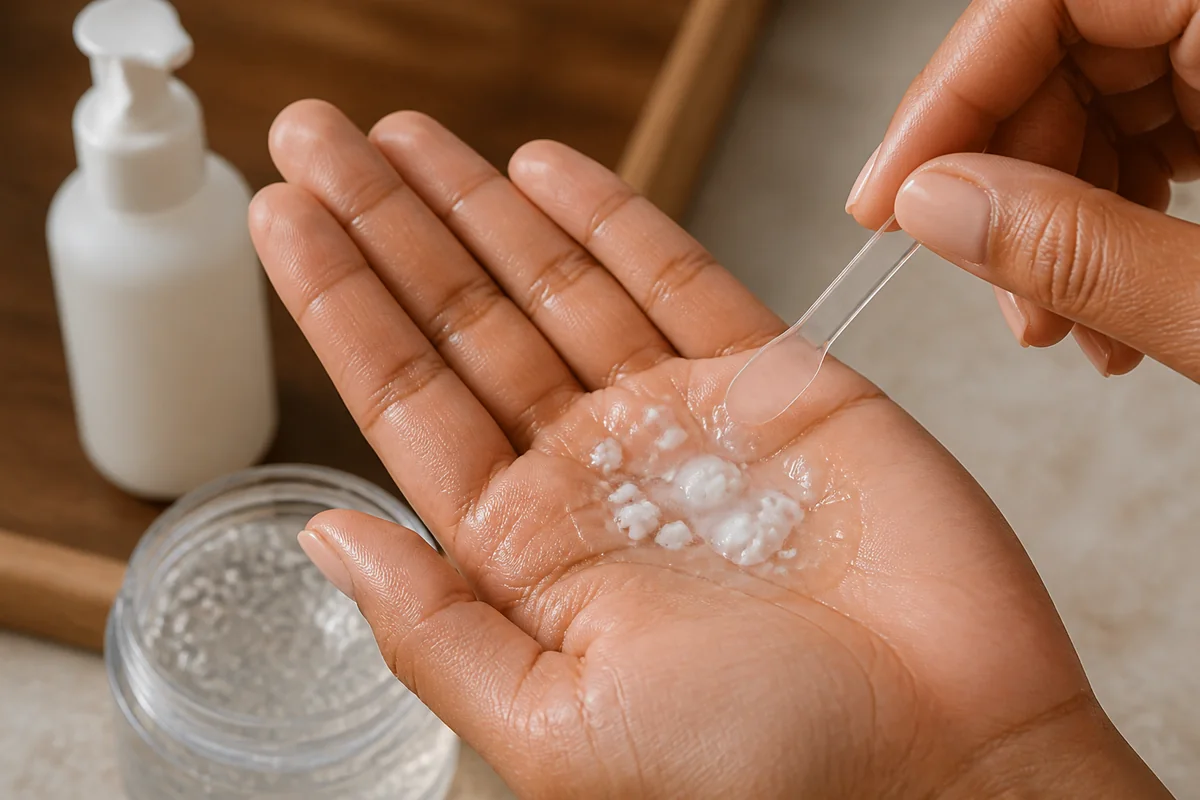
How to remove flakes from hair without making it worse
A few light flakes on the lengths may be fixable without a full wash. Heavy residue, stickiness or several days of buildup usually needs shampoo.
- Inspect the scalp. If the flakes clearly come from irritated skin, skip the styling rescue and address the scalp issue.
- Test one hidden curl. Smooth water over it with wet hands, then gently blot with a clean microfiber towel or cotton T-shirt.
- Let it dry completely. If the residue dissolves and stays away, repeat on the affected lengths.
- Wash when it remains. Shampoo rather than scraping, brushing aggressively or covering the dust with oil.
If your normal shampoo leaves the hair sticky, dull or coated, a suitable clarifying shampoo for curly hair can remove genuine buildup. One suspicious curl does not require a punishment wash.
Find the culprit with one wash
Changing your entire shelf at once tells you nothing. Use two small hidden sections on freshly washed hair.
- Apply gel alone to the first soaking-wet section.
- Apply your usual leave-in, then the same amount of gel, to the second.
- Leave both sections untouched until completely dry.
| Result | Likely explanation |
|---|---|
| Gel alone dries clean, but the layered section flakes | The product combination or combined amount is the likely problem |
| Both sections flake | Try less gel and more water; if that fails, the gel may not suit your routine |
| Neither section flakes | Another styler, buildup, uneven application or touching the cast too early may be involved |
Concentrated custards are especially sensitive to technique. The directions covered in our Kinky-Curly Curling Custard review, for example, call for very wet hair and avoiding a heavy cream underneath.
Stop gel from flaking next wash
- Use fewer layers. Give each product a job. If you are unsure which styler you need, compare curl cream versus gel before combining both.
- Keep every section wet. Re-wet hair that begins drying before the gel reaches it.
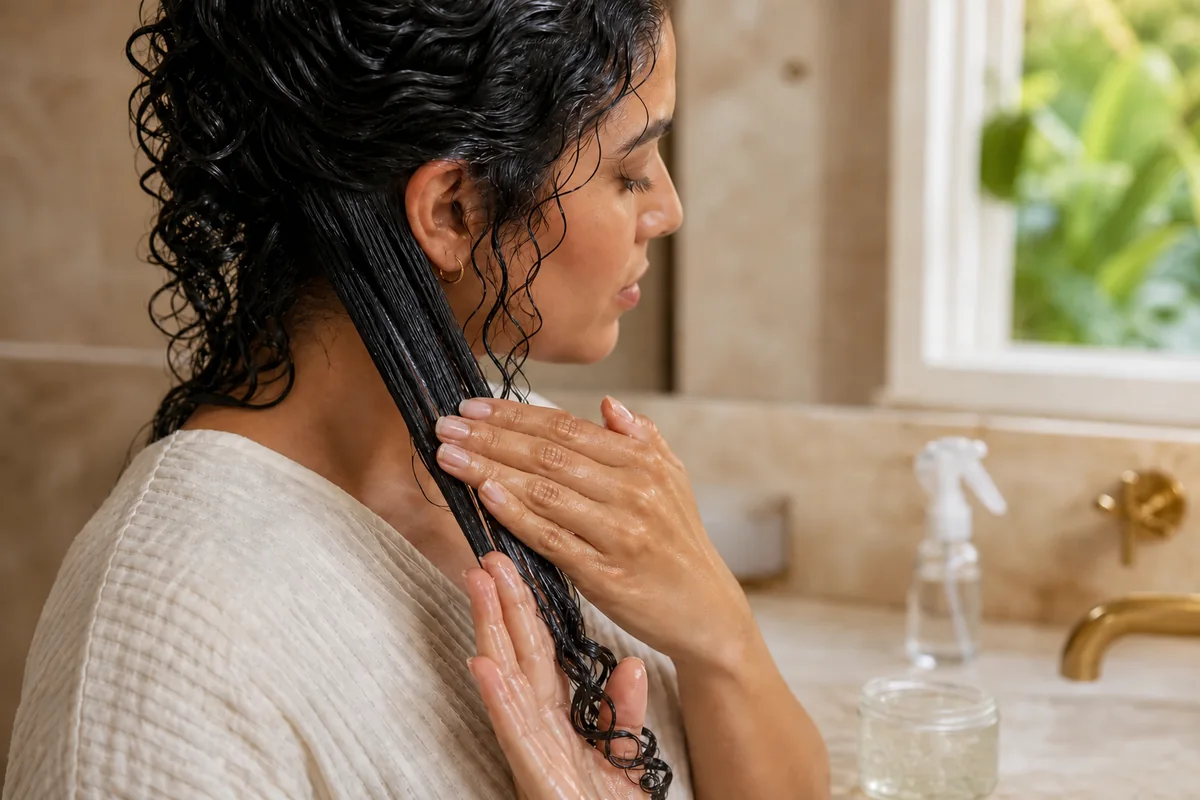
- Apply a thin, even film. Emulsify a small amount between wet palms, smooth it through and add more only where definition is missing.
- Keep ordinary gel off the scalp. Unless the label directs otherwise, coat the hair rather than the skin.
- Let the cast dry. Scrunching or fluffing too early can disturb the film while it is forming.
When white flakes need a different response
Product residue should improve after the product is removed or the routine changes. Stop a new product and seek advice if you develop intense itching, burning, swelling, blisters, oozing or a spreading rash. These can occur with contact dermatitis, according to the American Academy of Dermatology. The same caution applies if flaking and irritation begin soon after hair color or another chemical service.
Thick or painful scale, bleeding, inflamed patches extending beyond the hairline or noticeable hair loss deserves professional assessment. If anti-dandruff shampoo has already failed, our guide to why Nizoral may not be working explains what to check before repeating the same treatment.
White points built into the strand are not dandruff. DermNet’s hair-shaft guide explains that partial fractures can form visible nodes where weakened hair splits.
Can any hair gel guarantee no flakes?
No gel is non-flaking in every routine. A formula may dry clean by itself and become dusty over a particular leave-in, oil or cream. The most reliable “no-flake” choice is one that suits your desired hold, works with the fewest necessary layers and passes the small-section test.
If the flakes sit on the curls, simplify the products and application first. If they come from the scalp, remain glued to hairs or mark breaking strands, stop treating the problem as failed gel. The right fix starts with locating the white material, not buying the strongest shampoo in the aisle.