Editorial contribution by Wayne Parker. Wayne writes educational content for EWIGSC.
A hair topper can cover your part while your own curls still provide the sides, ends and movement. For a convincing blend, match the dry curl pattern first, then fit the base without pulling the hair that supports it. Extra product cannot fix a poor texture match or a clip that hurts.
Your curls may spring up after washing and loosen over the next few days; a synthetic topper keeps a more consistent shape. Some compression beneath the base is normal. The useful goal is comfortable coverage, a convincing visible blend and natural curls you can refresh after removal.
This guide covers removable clip-in toppers, especially synthetic pieces. Bonded systems need their own fitting, maintenance and removal instructions.
Match the topper to the curls you actually wear
Look at your hair dry, with your usual products in it. Leave it unstretched. Compare the curls beside your face and at the back with the topper’s perimeter, where the two will meet.
Check the size of the bends, how tightly they turn and where the ends land. Loose waves above tightly curled ends can leave a noticeable change in texture. Similar lengths on a product page can also fall differently once your own hair shrinks into its dry pattern.
If you usually wear second-day curls, compare the piece with that pattern too. A topper that matches only your tightest wash-day ringlets may need more blending as your own hair relaxes.
Color matters here, too. Compare the shade against the hair that will remain visible, especially around your face. A close root color alone will not disguise a very different texture through the lengths.
If you are browsing EWIGSC’s synthetic hair toppers, compare each listed texture with the curls that will remain visible. A wavy piece may suit loose waves; do not assume it will blend with tight ringlets. Choose a compatible pattern before trying to reshape either layer for every wear.
Prepare your curls without packing them flat
A partial topper needs a different preparation from a full wig. Leave the curls that form the finished hairstyle outside the covered area. Pulling everything into a tight bun can create a mound beneath the base and remove the very hair you need for blending.
Finish your usual wash-day styling and let your hair dry before fitting. Damp curls compressed beneath a base can dry into the flattened arrangement. A topper also makes it harder to reach those roots for adjustments.
Where hair bunches up, use your fingers to separate a small section and guide it loosely into its intended direction. Keep bulky twists and knots away from the base’s edge. Leave the attachment areas accessible. The base should settle without requiring you to pull the surrounding hair taut.
A full wig cap is usually unhelpful beneath an ordinary clip-in topper: it can cover the attachment hair and flatten curls you want visible. Use a cap or liner only when it works with that piece’s intended attachment system.
The American Hair Loss Association’s topper guide explains why coverage and attachment must be considered together: clips need surrounding hair capable of supporting the piece. More scalp coverage will not solve an attachment point that pulls on fragile hair.
How to fit a topper without pulling your curls
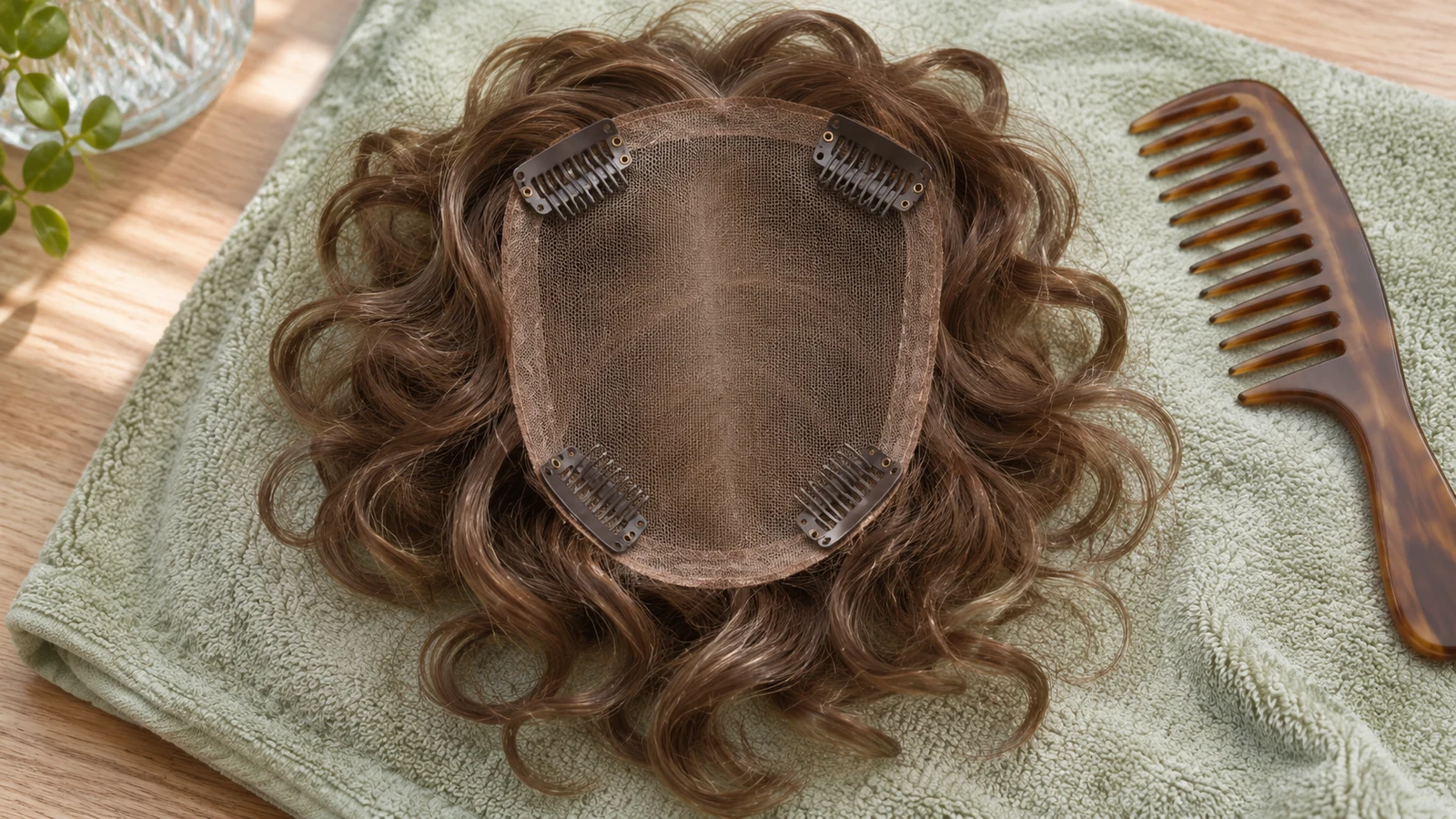
- Position it with the clips open. Line up the part and front edge before fastening. Leave your face-framing curls and the ends you need for blending outside the base.
- Fasten to supporting hair. Follow the piece’s fitting directions and keep neighboring curls clear of the clip teeth. The base should settle without pulling the surrounding hair taut.
- Test the fit before styling. Turn your head and look down. If a clip pulls, release it and reposition the piece. A fit that works only while you hold still needs another attempt.
- Blend a few curl groups with your fingers. Arrange the curls where the two layers meet and let them fall together. Brushing through both can break up natural curl groups without making the synthetic hair match.
The American Academy of Dermatology warns that repeated pulling can cause hair loss. Pain is a reason to undo the attachment. Sudden, patchy or painful hair loss also deserves medical assessment, separately from choosing cosmetic coverage.
If your scalp still feels sore at a clip after refitting, take the topper off and ask a fitter to reassess its base, weight and attachment points. A compatible topper grip can be an alternative for some pieces, but its fit and attachment method need checking too. Tightening the clips onto fragile hair is not the next step.
If the blend looks obvious, check what is mismatched
Use a second mirror or a phone photo to check the back in ordinary daylight. Turn your head as well as looking straight ahead. Watch for an abrupt shelf of hair, a different curl size or an edge exposed by movement.
| What you notice | What to change first |
|---|---|
| Your own curls look pressed down after removal | Refresh the affected natural curls and reduce bunching beneath the base next time. |
| The topper and your ends form visibly different shapes | Reconsider the texture match or a blending cut before adding more styling product. |
| The front lifts while the clips feel tight | Release and refit the piece. Check base coverage and attachment placement. |
| The color matches, but the topper forms a heavy shelf | Compare its density and dry length with your visible curls. Ask about a blending cut with the piece in its wearing position. |
A blending cut can soften an awkward length transition. Have the stylist assess the topper in its wearing position alongside your dry curls, with the fiber type identified. Cutting cannot make two very different curl patterns identical, so settle the texture choice first.
Refresh your curls separately from the topper
Take the topper off before working on your own hair. Support the base, open every clip and lift it clear without dragging it through the curls.
If a few curl groups are flattened but otherwise manageable, lightly dampen those sections and reshape them with your fingers. Allow them to dry before fitting the piece again. Hair Is Curly’s guide to matching a curl refresher to the actual problem is useful here: flattened hair, dryness and lost hold call for different adjustments.
Knots need a proper detangling session. The AAD’s curly hair care guidance recommends thoroughly wetting and conditioning natural curls for detangling, using fingers or an appropriate comb, and avoiding dry brushing.
Keep your usual curl cream and gel routine on your own hair. Synthetic strands need products intended for that fiber; adding more natural-hair conditioner will not give a synthetic wave a tighter curl pattern. Traditional synthetic toppers should stay away from curling irons and straighteners. Heat-friendly pieces have their own temperature and styling instructions.
For cleaning the piece itself, use our synthetic-wig washing guide alongside the topper’s own care instructions.
Between wears, support the topper on a suitable stand with its lengths free of anything that crushes the curl shape. Remove it for sleep so the clips are released and the piece is not pressed into the pillow.
When a full wig may be the easier choice
When matching the topper to your changing natural texture becomes the hardest part of getting ready, a full wig offers one finished texture across the head. A topper makes more sense when you want your own curls to remain part of the style and can achieve a comfortable attachment. Choose the routine you would actually want to repeat.