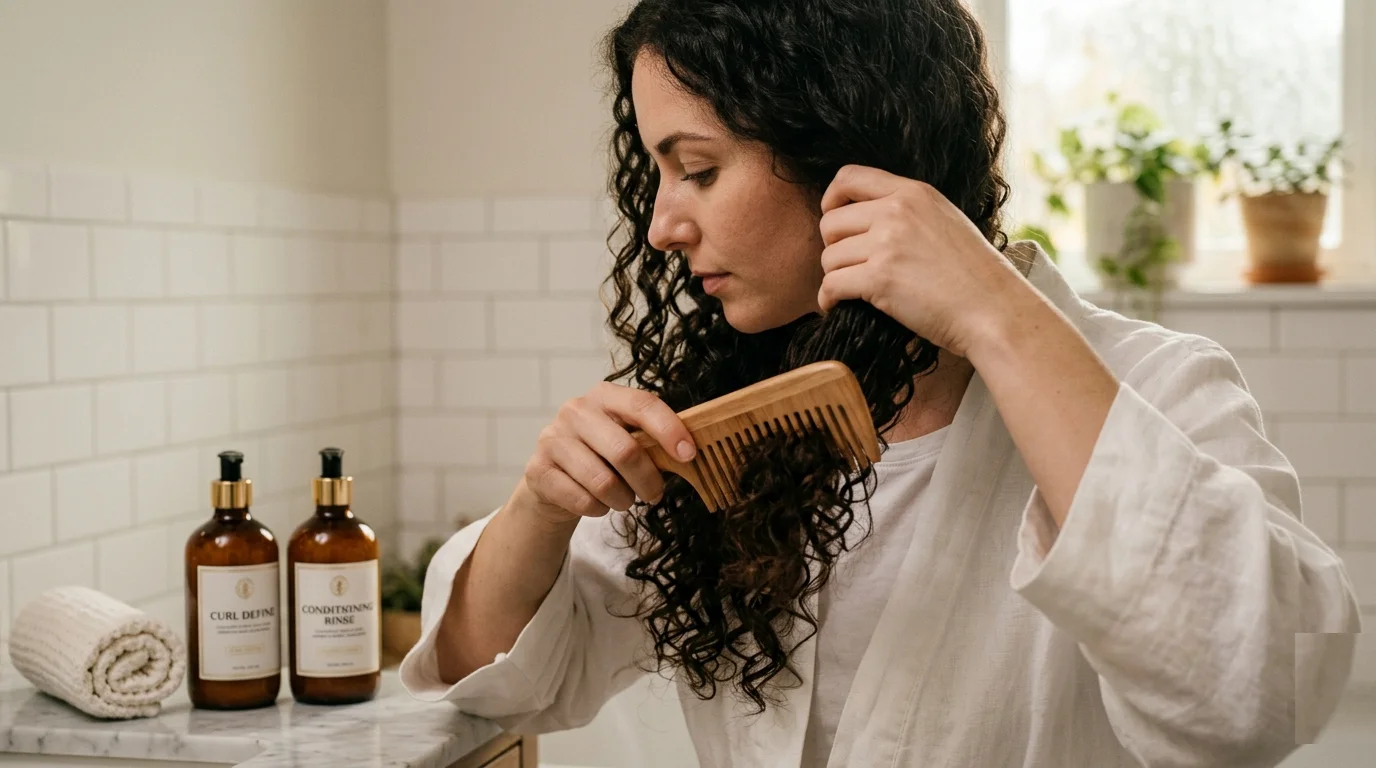
So a woman sat in my chair last week. Six years of flat ironing. Six years. She pulls out her phone, shows me this influencer’s wash day video, fourteen products on the counter, and goes “I bought all of these.” hadn’t even used them yet.
I made her return eleven.
That’s the thing about curly hair routines for beginners that nobody wants to say out loud. Most of them are too much. Way too much. You don’t need a fourteen-step system when you’ve never even seen your natural curl pattern. You need four products and a little bit of patience. Maybe five on a wild day.
I’ve been doing curls for 25 years in LA. What I’m about to walk you through is what I actually say to first-timers sitting in my chair. Not what I’d write for a brand deal. Not what sounds good on Instagram. What works.
But real quick before we get into wash day, we need to talk about the one thing that changes everything and it’s not your curl type.
Porosity. Not Curl Type. Porosity.
Everyone’s obsessed with curl typing. “Am I a 2b?” “I think I might be 3a.” Cool. Two women with the same exact curl pattern sat in my chair back to back last month. One needed lightweight products. The other needed heavy moisture. Same curls. Completely different hair.
The difference? hair Porosity.
How fast your hair absorbs water and how fast it loses it. That’s porosity. Healthline has a solid breakdown of the science behind it, backed by peer-reviewed research on hair porosity.
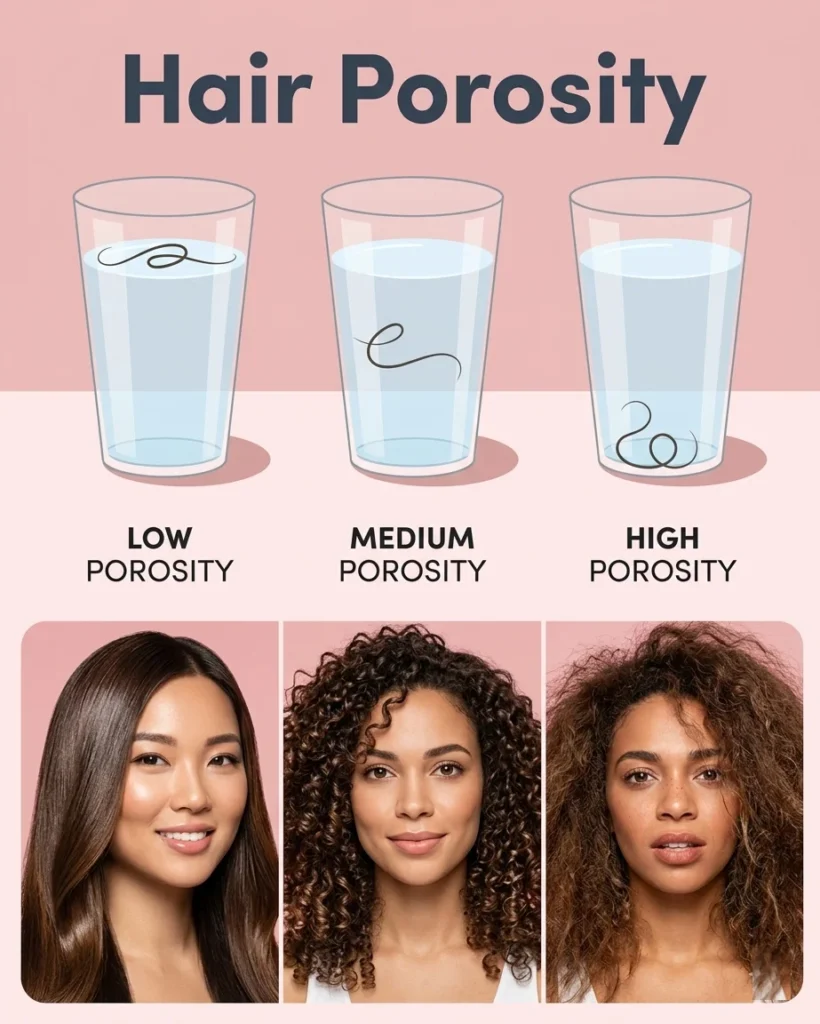
Drop a clean dry strand in a glass of water. Two minutes.
Floats? Low porosity. Your cuticles are sealed tight, products just sit there. Sinks to the middle? Medium. Lucky you. Drops straight to the bottom? High porosity. Probably from years of heat or color. Water gets in fast, leaves faster.
Skip this step and you’ll spend money on products your hair was never going to respond to. I’ve watched it happen so many times I stopped counting.
Wash Day Is the Whole Game
I’m not being dramatic. If wash day goes wrong, day two and three are a mess no matter what you do. If wash day goes right, the rest of the week mostly handles itself.
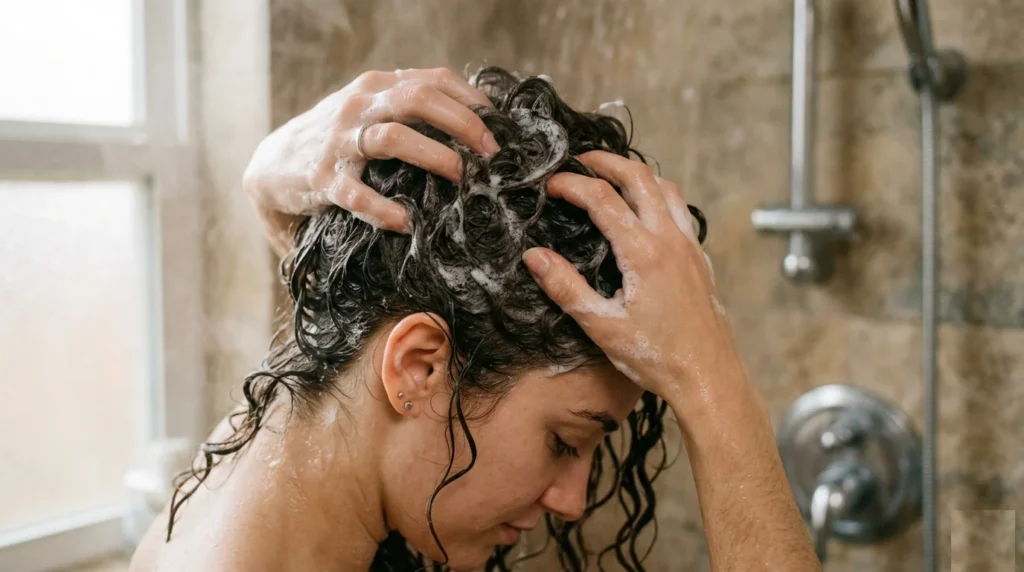
Sulfate-free shampoo. Scalp only. Fingertips in small circles, not nails, don’t drag it through your lengths. Sulfates strip natural oils from curly hair faster than straight hair because the curl shape already makes it harder for sebum to travel down the strand. A PubMed study on cuticle structure confirmed the cuticle plays a bigger role in moisture management than most people realize. The suds running down during rinse will handle the rest. I can’t tell you how many clients come in confused about why their hair frizzes and it turns out they’ve been scrubbing shampoo through their ends like it’s body wash.
Conditioner. Go heavy. Palmful. Everything from ears down. Grab a wide-tooth comb and detangle starting at the ends. Work up. I know your instinct says start at the root and pull down. Fight that instinct. You’ll rip through knots and create breakage. Hit a tangle? Add more conditioner to that spot. The Aussie Miracle Conditioner is what I hand beginners because the slip is unreal for the price point.
Three to five minutes. Let it sit. Then rinse cool. Not ice cold. Cool. Closes the cuticle, reduces frizz.
Style on Soaking Wet Hair (Not Damp, Wet)
This is where beginners blow it. Every time.
They step out of the shower, grab a towel, rough dry their hair, then try to style. And wonder why nothing holds.
Water makes curls clump. Without water, your strands separate and each one frizzes on its own. So leave your hair dripping.
- Scrunch in a pea-sized amount of leave-in conditioner (more if your hair is thick)
- Apply gel or curl serum by scrunching upward
- Don’t rake products through. Raking splits curl clumps apart
Drying options:
- Air dry: Don’t touch your hair. At all. Research published in the Journal of Cosmetic Science found that drying temperatures above 140°C cause irreversible structural damage to the cuticle, which is why low heat diffusing matters. A gel cast will form. It looks crunchy and weird. That’s correct. Once fully dry, scrunch out the crunch and your curls go soft.
- Diffuse: Low heat. Low speed. Cup curls into the bowl, press toward scalp, hold 10-15 seconds per section. Don’t scrunch with the diffuser.
One client told me she’d been scrunching out the crunch while her hair was still damp for months. Months. And couldn’t figure out why her curls never held past lunchtime.
Fully dry means fully dry. Not “mostly.” Not “close enough.”
Your Starter Kit (Four Products, That’s It)
| What | Why | When to use |
| Sulfate-free shampoo | Cleanses scalp without stripping moisture | Wash day, scalp only |
| Conditioner with good slip | Detangling + hydration | Wash day, ears down |
| Leave-in conditioner or curl cream | Lightweight moisture layer | After shower on wet hair |
| Gel or curl serum | Hold + frizz control | After leave-in on wet hair |
What you do NOT need right now:
- Deep conditioner (wait until week 3-4)
- Protein treatment (you don’t know if your hair needs protein yet)
- Ten different oils
- A diffuser (air drying is fine while you’re learning)
I’ve watched beginners quit because they overwhelmed themselves before their first wash day even happened. Four products. One month. Then evaluate.
Day Two: Five Minutes, Not a Redo
You’ll wake up with one side perfect and the other looking like something happened in your sleep. Normal.
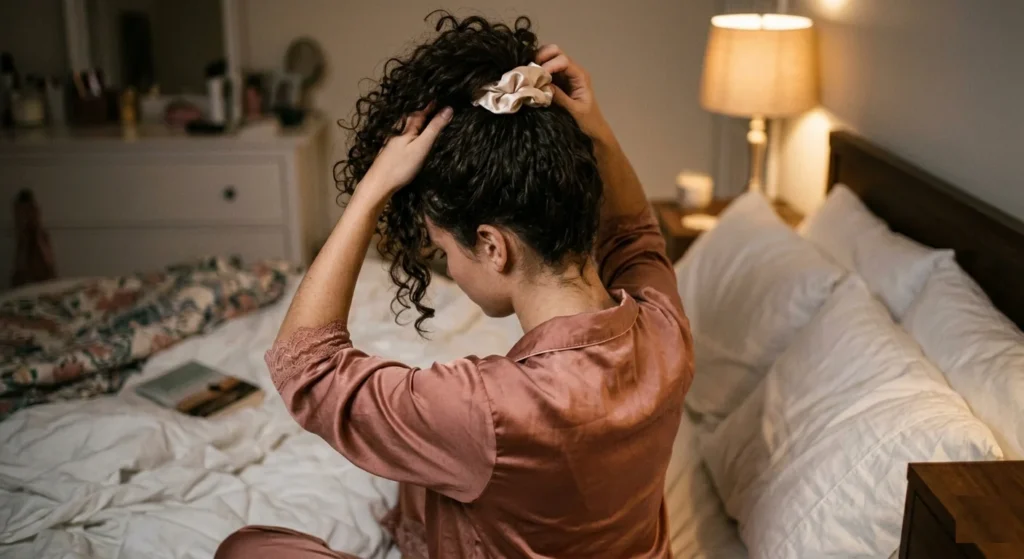
Night before: pineapple your hair. Loose scrunchie, top of your head, all hair flipped forward. Silk or satin scrunchie only. Looks stupid. Works great. Hair too short? Satin bonnet. Minimum? Silk pillowcase. Cotton pillowcases pull moisture out of curls all night.
Morning refresh:
- Spray bottle with water. Dampen the messy sections only
- Scrunch those spots upward
- One or two curls totally lost shape? Tiny gel on fingertips, twist the curl around your finger. That’s finger coiling
- Let it air dry. Done
Do not layer fresh leave-in over yesterday’s products. That’s how you get buildup by 2pm.
The secret nobody tells you about day two: less touching equals better curls. Every time you fuss with a curl clump, it separates. Separating means frizz.
Day Three: Read Your Hair, Don’t Fight It
Day three separates the curl types.
Tighter patterns, 3a and up, sometimes look better on day three. Natural oils travel down, add weight, curls get this soft lived-in thing going on. I’ve had clients who refuse to take selfies on wash day because they prefer their day three texture.
Looser waves? 2b? Usually falling apart by now. That’s not you failing. That’s just how finer textures behave.

If curls still have shape: same spray-and-scrunch from day two. Focus on front pieces, those always die first because they rub against your face and pillow more than anything else.
If everything’s flat: bun day. Braid day. Clip it up. Do not try to resurrect dead curls with more product layered on two-day-old styling. A client did this once. Cream over gel over yesterday’s leave-in. By 3pm she said her hair felt like dried glue. Her words.
No shame in a day three updo. Half the stylists I work with do exactly that.
Your Curly Week at a Glance
What to do, what to skip, how long it takes.
Why Week Two Breaks People
Week one you get the best curls of your life. Send a selfie to everyone. Week two you do the same exact thing and the result is different. Not bad necessarily. Just different.
And that’s where people spiral. Switch all their products. Add four new steps from some YouTube video they found at midnight. By week three they’re back to the flat iron.
Your curls won’t look identical every wash day. Humidity, water temperature, how you slept, whether you touched your hair while it dried. All of it shifts things slightly. That’s not a broken routine. That’s curly hair being curly hair.
Thirty days. Same four products, same technique. Then you can swap one thing and see what happens. Not before.
The women who actually build a curl routine that sticks are always the ones who stayed boring for a month while everyone else was chasing the next miracle product. That patience is the routine. Everything else is just shampoo and conditioner.