You washed your hair. You rinsed properly. Maybe you even shampooed twice. Yet a few hours later, that sour, oily or musty smell is back.
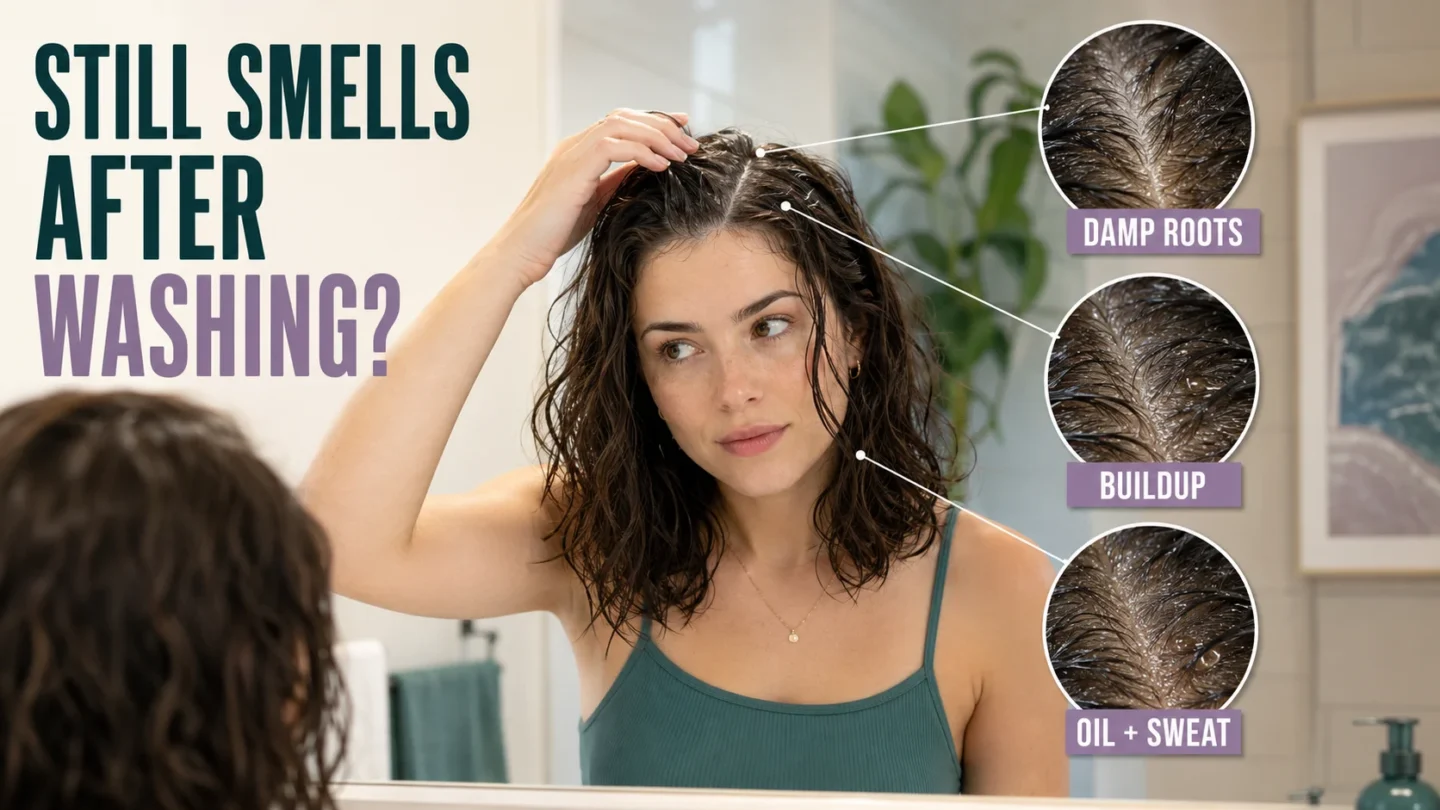
That doesn’t automatically mean your scalp is dirty or infected. Odor can remain when shampoo misses part of the scalp, product stays near the roots, dense hair remains damp, or oil and sweat return quickly.
The Cleveland Clinic includes sebum, sweat, dead skin, product residue and certain scalp conditions among the possible causes.
In a scalp consultation, timing tells me more than the exact smell.
When Does the Smell Return?
| Timing | First thing to check |
|---|---|
| While the hair is drying | Damp roots, the towel or leftover product |
| Within a few hours | A missed area, sweat or fast-returning oil |
| The next day | Dry shampoo, heavy products or washing frequency |
| With itching, flakes or soreness | Dandruff, irritation or another scalp condition |
Smell alone can’t diagnose fungus. It’s a clue, not a lab test.
1. Shampoo Didn’t Reach the Scalp
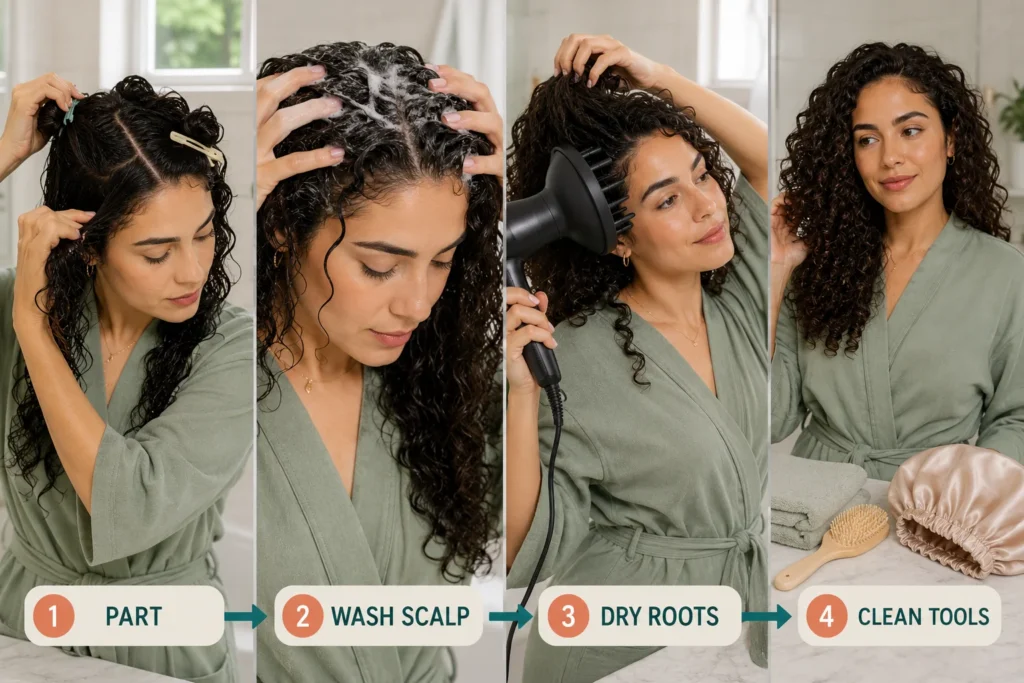
With thick, curly or coily hair, shampoo can foam over the outer hair without reaching the skin underneath. The crown, nape and area behind the ears are easy to miss.
Part dense hair into a few loose sections before shampooing. Work the cleanser against the scalp with your fingertips, then rinse through those same sections.
More foam isn’t necessarily a better wash. Sometimes it’s just more foam.
2. Product Stayed Near the Roots
Conditioner, curl cream, scalp oil and dry shampoo can mix with natural oil and sweat. Even a pleasant fragrance can turn stale when the product keeps building up.
Dry shampoo deserves particular attention. It absorbs visible oil but doesn’t remove old product, dead skin or microorganisms. The American Academy of Dermatology recommends washing regularly with shampoo and water rather than using dry shampoo as a replacement.
For one wash, simplify the routine:
- Keep conditioner below the ears.
- Skip scalp oils and dry shampoo.
- Use less styler near the crown.
- Rinse longer than usual.
If the smell takes longer to return, product residue was probably contributing.
Hair that also feels coated, heavy or limp may need occasional clarification. This guide explains when clarifying shampoo helps and when it may leave the hair unnecessarily dry.
3. Your Roots Never Fully Dried
The ends can feel dry while the roots underneath remain damp. Dense curls and coils are particularly good at hiding this.
Putting damp hair into a bun, bonnet or hat can trap moisture and existing odor close to the scalp. It doesn’t prove that mold or fungus is growing in your hair.
Lift a few sections and check the roots before covering or tying up your hair. If air-drying takes hours, use low or medium airflow and dry the scalp first. Your ends don’t need to be roasted along with it.
4. The Towel or Brush Put the Smell Back
Sometimes the shampoo worked. Then the clean hair touched a damp towel, oily brush, used bonnet or stale pillowcase.
Brushes collect scalp oil, shed skin and styling product around the base of the bristles. If yours has a grey coating or smells oily, follow the correct method for cleaning your hairbrush.
For the next wash, use a fresh towel and pillowcase. Wash anything that regularly touches your roots, including bonnets, hats and helmet linings.
The CDC also recommends regular scalp washing and avoiding shared brushes, combs and towels as part of basic hair and scalp hygiene.
The shower may be innocent. The towel might not be.
5. Oil and Sweat Return Quickly
If your scalp smells clean in the morning but oily by evening, the wash probably worked. The scalp may simply have become sweaty or greasy again.
Some people produce more sebum than others. Exercise, hot weather, hats and naturally oily roots can shorten the fresh period further. Sweat itself isn’t usually the whole smell. According to the Mayo Clinic, odor develops when sweat interacts with microorganisms on the skin.
Don’t try to “train” an uncomfortable, oily scalp by stretching wash days indefinitely. Wash often enough to keep the scalp comfortable, then protect dry lengths with conditioner.
If the roots become oily unusually fast, the causes and practical fixes are covered in why hair gets greasy so quickly.
6. Dandruff or Irritation Is Contributing
Can dandruff make your scalp smell? It can contribute, particularly when flakes appear alongside oil, itching or redness. The odor usually comes from the oily, inflamed scalp environment rather than the flakes having one specific smell.
An anti-dandruff shampoo may help when those symptoms are present. Follow its directions carefully. Some formulas need several minutes of contact with the scalp before rinsing, while using several medicated shampoos at once may leave the skin more irritated.
If you’ve already tried ketoconazole without improvement, don’t keep increasing the amount or using it every day. There are several reasons treatment can fail, including incorrect timing, inconsistent use or a problem that isn’t dandruff. This guide explains why Nizoral may not be working.
No flakes, redness or itching? A medicated dandruff shampoo may be solving the wrong problem.
7. It Could Be a Scalp Condition That Needs Treatment
One of the most searched questions around scalp odor is, “What does scalp fungus smell like?”
There isn’t a dependable fungal smell. Sour, musty, oily or cheese-like descriptions can’t identify an infection. Those odors can also occur with sweat, sebum, residue or damp hair.
Scalp ringworm, medically called tinea capitis, is more concerning when odor appears with:
- Scaly or inflamed patches
- Broken hairs or patchy hair loss
- Persistent itching
- Tender bumps, crusting or pus
- A rash that appears to be spreading
The American Academy of Dermatology notes that tinea capitis commonly causes scaly patches with broken hairs or hair loss. It can’t be confirmed by smell or a photograph alone.
Scalp ringworm also isn’t something to treat with an ordinary antifungal shampoo and hope for the best. The CDC says it usually requires prescription antifungal medicine taken by mouth. Shampoo may be used alongside treatment, but it isn’t a substitute for medical care.
Don’t pick, scratch or squeeze a sore area to inspect it. That can damage the skin and make an existing problem harder to manage.
What Shampoo Should You Use for a Smelly Scalp?
Choose shampoo according to what accompanies the odor, not whichever bottle has the strongest perfume.
| What you notice | Reasonable starting point |
|---|---|
| Heavy, coated hair without irritation | Regular shampoo or occasional clarifying |
| Oily roots and sweat | Shampoo suited to an oily scalp |
| Flakes with itching | Anti-dandruff shampoo used as directed |
| Dryness or burning after washing | A gentler, fragrance-free shampoo |
| Pus, sores, spreading redness or hair loss | Professional assessment before another product |
A heavily fragranced shampoo may cover the odor for a few hours. It won’t remove an infection, calm dermatitis or correct a wash routine that keeps missing the scalp.
When to See a Dermatologist
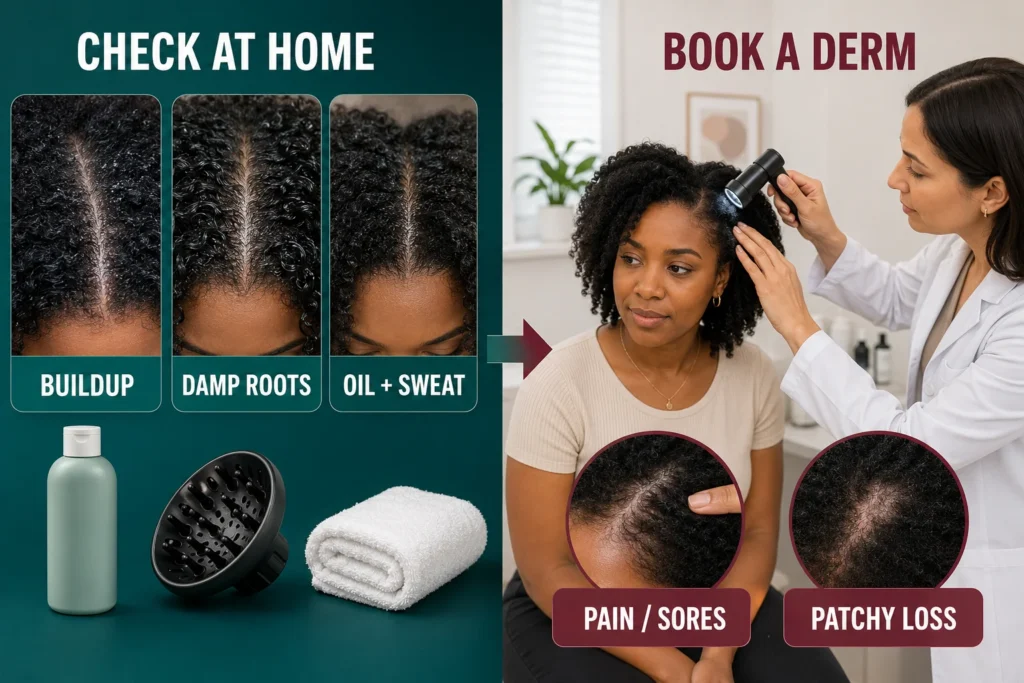
Arrange an assessment when the odor keeps returning despite careful washing, complete drying and clean tools, especially if you also notice:
- Pain or tenderness
- Pus, bleeding or open sores
- Thick crusts or spreading redness
- Patchy hair loss or broken hairs
- Severe or persistent itching
- Flaking that doesn’t improve with appropriate shampoo
Scalp odor can feel embarrassing, but dermatologists and trichologists deal with scalp problems routinely. There’s no need to arrive with a self-diagnosis. A clear description of when the smell began, how quickly it returns and what other symptoms appear is more useful.
The Bottom Line
If your scalp smells after washing, begin with the ordinary possibilities: make sure shampoo reaches the skin, rinse products thoroughly, dry the roots and clean anything that touches fresh hair.
Then watch the pattern. Odor that returns with oil or sweat needs a different response from odor accompanied by pain, flakes or hair loss.
Start with the simplest check. Escalate only when the symptoms give you a reason.