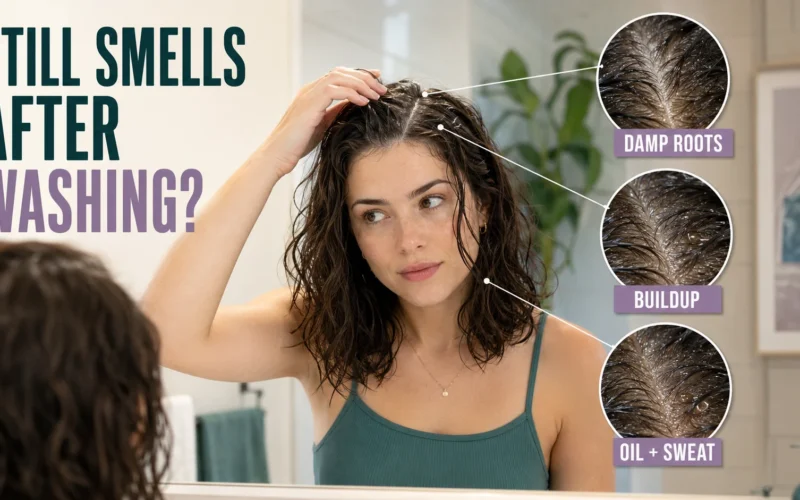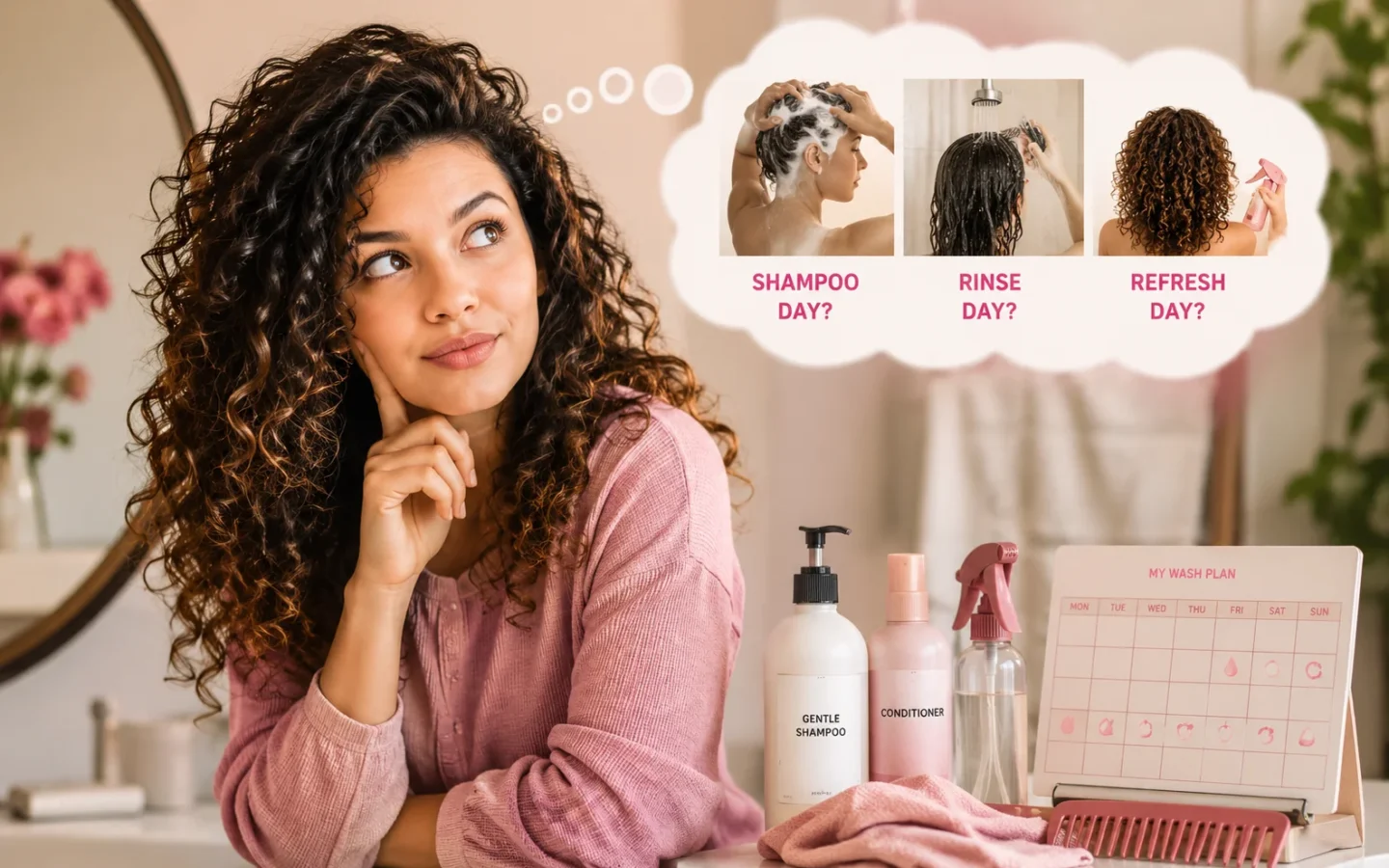
A client washed her hair every single day for fifteen years because she thought it was “too greasy.” Then she came to me. We had her switch to twice a week and just rinse with water on workout days. Two months later her scalp was calmer than it had been since high school. The greasiness wasn’t a hygiene problem. It was a panic response from a scalp that had been stripped daily for a decade and didn’t know how to stop overproducing oil.
That’s the loop I want you out of. Or into. Depending on which side you’re on right now.
Most articles answer “how often to wash curly hair” with a range like “one to five times a week” and call it a day. Useless. So here’s the short version, then I’ll show you how to actually pick your number.
| Curl pattern | Wash this often | Co-wash or rinse in between |
| Wavy (2A to 2C) | 2 to 3 times a week | Optional |
| Curly (3A to 3C) | Once or twice a week | Helpful mid-week |
| Coily (4A to 4C) | Once a week or every other week | Yes, when needed |
These are starting points, not commandments. The American Academy of Dermatology recommends curly and textured hair go once a week or every other week, and that lines up with what I see in my chair. But your number depends on what your scalp is actually doing this week, not what some chart says.
What Decides Your Real Number
Four things. Pay attention to these, not the chart.
Your scalp’s oil output. Some scalps run drier, some run oilier, even within the same curl pattern. Two 3B clients sat in my chair last month, same texture, same density. One needed to wash every five days. The other felt heavy by day three. Both were right for their own scalps.
How much you sweat. Gym five days a week changes the math completely. If your scalp is salty by 9 a.m., waiting a week isn’t realistic. We’ll get to what to actually do about that further down because it’s the part most curly guides skip.
Porosity. This is the one nobody mentions in wash-frequency articles. Low porosity hair sits there with product on the surface because it won’t absorb easily, which means buildup catches up faster and you need to clear it sooner. High porosity hair drinks everything in but loses moisture just as fast, so overwashing wrecks it. If you have no idea what your porosity is, the float test takes two minutes and matters more than your curl number.
How much product you layer. Cream plus gel plus oil plus refresh spray every day adds up. The more you put in, the sooner it needs to come out. Not a moral failing, just chemistry.
The Oily-Scalp Trap (the Daily Wash Loop)
This one I see constantly, so it gets its own beat.
You wash because your hair feels greasy. Then it feels greasy again the next day, faster than before. You wash again. Within a few weeks your scalp is producing oil like it has a quota to hit. That’s because your sebaceous glands respond to stripping by ramping up production, so the more you wash, the harder they work to replace what you keep taking away.
Breaking the loop feels weird because your hair will be greasy for the first ten to fourteen days while your scalp recalibrates. That’s not the routine failing. That’s the routine working. Push through.
Quick scalp check, no tools needed:
- Tight, itchy, or sore? You’re probably overwashing.
- Heavy, smelly, or flaky? Probably underwashing or buildup.
- Ends feel dry no matter what conditioner you use? Look at your frequency before you buy another mask.
That last one is the most common mistake I see. People shop their way out of a problem that was a wash schedule issue from the start.
Wash Frequency by Curl Type, for Real

Curl charts are useful until they’re not. Same 3B pattern, two different scalps, two different answers. So treat the numbers below as a place to start, then adjust to what your hair tells you over a month.
Wavy (2A to 2C). Your scalp oil reaches your ends easier than tighter curls, so you’ll feel greasy sooner. Two or three washes a week is the sweet spot for most wavy clients I see. Push past three and your waves go limp and frizz at the same time, which is a fun combination nobody asks for.
Curly (3A to 3C). This is where the once-or-twice-a-week range works for most people. The kicker is product layering. If you’re using leave-in plus cream plus gel plus an oil refresh between washes, you’re going to hit buildup by day five whether your scalp likes it or not. Lighter routine, longer between washes.
Coily (4A to 4C). Oil barely makes it past your roots on tight coils, so the ends stay thirsty no matter what your scalp is doing. Once a week or every other week is standard, with the AAD specifically backing this range for textured hair. The catch is that going too long with product piled on can leave the scalp feeling heavy and itchy. A mid-week rinse or co-wash usually solves it.
One thing I want to call out, because cultural advice gets weird here. I’ve heard clients say “I was told not to wash my African hair often,” then come in with scalps that feel coated and uncomfortable. The “less is more” rule is real for the lengths of coily hair, but your scalp still needs to be clean. Once every two weeks, minimum. Don’t let anyone shame you into ignoring a scalp asking for help.
The Gym Question
If you work out four or five times a week, the standard once-a-week advice falls apart. Sweat sitting on your scalp isn’t just uncomfortable, it mixes with product residue and dead skin, and that’s the recipe for itch and breakouts on the hairline.
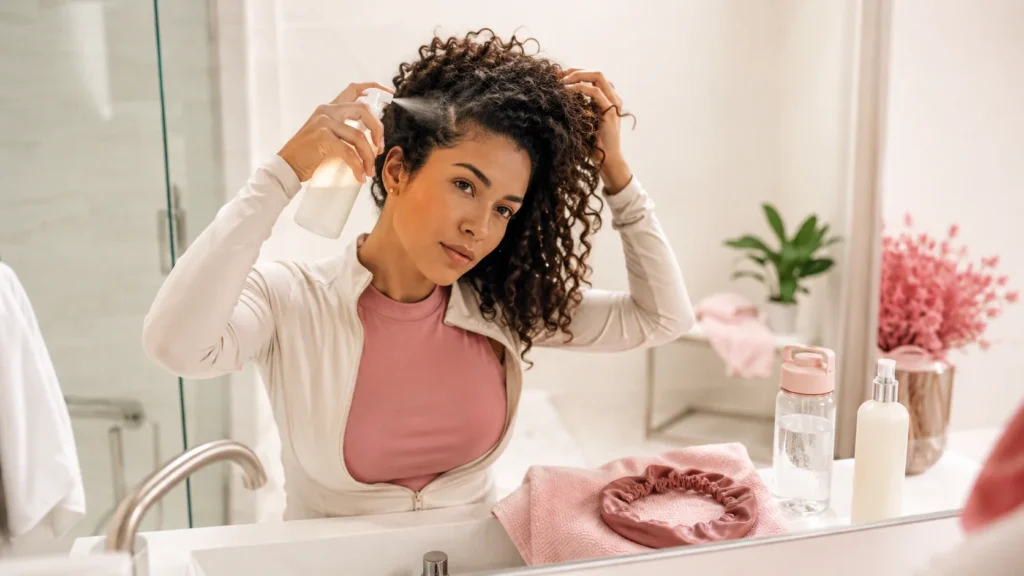
What I actually tell active clients:
- Rinse with water on workout days you’re not washing. Plain water, scalp focus, gentle scrunch. No shampoo. This clears the salt and lets your style recover.
- Wash properly once or twice a week, on your sweatiest workout days. Combine the wash with the workout instead of adding extra wash days.
- A satin or silk band during the workout keeps sweat off your hairline and saves a wash some days. Sounds small. Genuinely works.
- Dry shampoo is your enemy here, not your friend. It feels like a shortcut, but it adds to the buildup your scalp is already fighting. Use it once between washes if you have to, not every day.
The point isn’t to wash less for the sake of washing less. It’s to keep your scalp clean without stripping the ends raw. Two different goals, one routine.
Co-Wash, Rinse, or Shampoo. Which One When.
These get treated as interchangeable, which is how people end up with either greasy scalps or fried ends.
Shampoo cleans your scalp properly, especially with sulfate-free formulas built for curls. This is what actually removes oil, sweat, and product. Don’t skip it for weeks at a time hoping co-wash will do the same job. It won’t.
Co-wash (conditioner-only washing) cleans gently and adds moisture. Good for in-between days when your hair feels heavy but not actually dirty. Bad as your only cleansing method long-term, because conditioner doesn’t fully clear scalp buildup.
Water rinse is the most underused tool in the curly world. Just water, scalp massage, scrunch. Resets your style, gets sweat and surface dust off, takes five minutes. Use it freely.
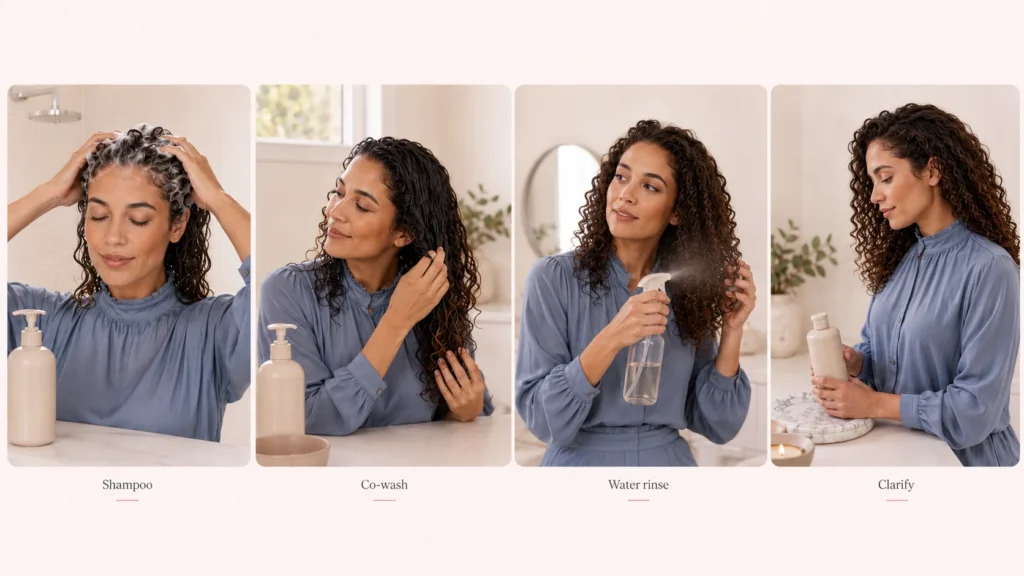
Roughly how I’d map them:
| If your hair feels… | Reach for |
| Greasy at the roots, dirty, smelly | Shampoo, scalp focus |
| Heavy or weighed down, but not dirty | Co-wash |
| Sweaty or flat, scalp is fine | Water rinse |
| Coated and unresponsive to anything | A clarifying wash (occasional reset) |
That last one is its own conversation. If your hair has stopped responding to conditioner and your curls feel limp no matter what you do, a clarifying shampoo for curly hair once every few weeks resets things. Don’t make it your weekly routine.
When the Real Problem Isn’t Frequency
Sometimes you’re washing the right amount and your hair still feels wrong. Worth checking these before you change your schedule again.
- Your shampoo is too harsh. Sulfates strip curls fast. A sulfate-free formula at the same frequency can completely change how your hair behaves.
- You’re not conditioning enough. Curly hair needs more conditioner, longer dwell time, more often. Most clients I see are under-conditioning, not over-washing.
- You skipped clarifying for six months. Buildup mimics greasy hair. If nothing absorbs anymore, it’s not a wash-day problem, it’s a buildup problem.
- Your water is hard. Mineral deposits make curls feel coated no matter how often you wash. A chelating wash every few weeks helps.
- You’re towel-drying rough. Friction roughens the cuticle. Microfiber or an old cotton t-shirt, not your bath towel.
If your ends are dry and you’ve already cut back to once a week, the answer isn’t washing even less. It’s adding moisture back through a better conditioner, a weekly mask, and protecting your hair at night with a satin pillowcase. Frequency was never the only lever.
Adjust This, Not That
If your current schedule isn’t working, change one thing at a time. Otherwise you won’t know what fixed it.
Try this order:
- Change the shampoo (sulfate-free first if you haven’t).
- Change the conditioner (more product, longer wait).
- Change the frequency by one wash up or down.
- Add a clarifying wash if buildup is the suspect.
- Then look at refresh products and how often you layer them.
Give each change two to three weeks before judging. Curly hair takes time to reset. A bad wash day doesn’t mean your new routine failed.
What to Actually Do This Week
Start where your scalp is right now, not where some chart says you should be. If you’re washing daily and feeling greasy, drop to every other day this week and rinse with water in between. If you’re stretching washes to ten days because someone told you “curly hair shouldn’t be washed often” and your scalp feels heavy, give it a proper shampoo sooner. Listen to your scalp, not the internet.
The right frequency is the one where your scalp feels comfortable, your curls hold their shape, and your ends don’t feel like straw. That number is yours to find, but the chart at the top gets you close enough to start.