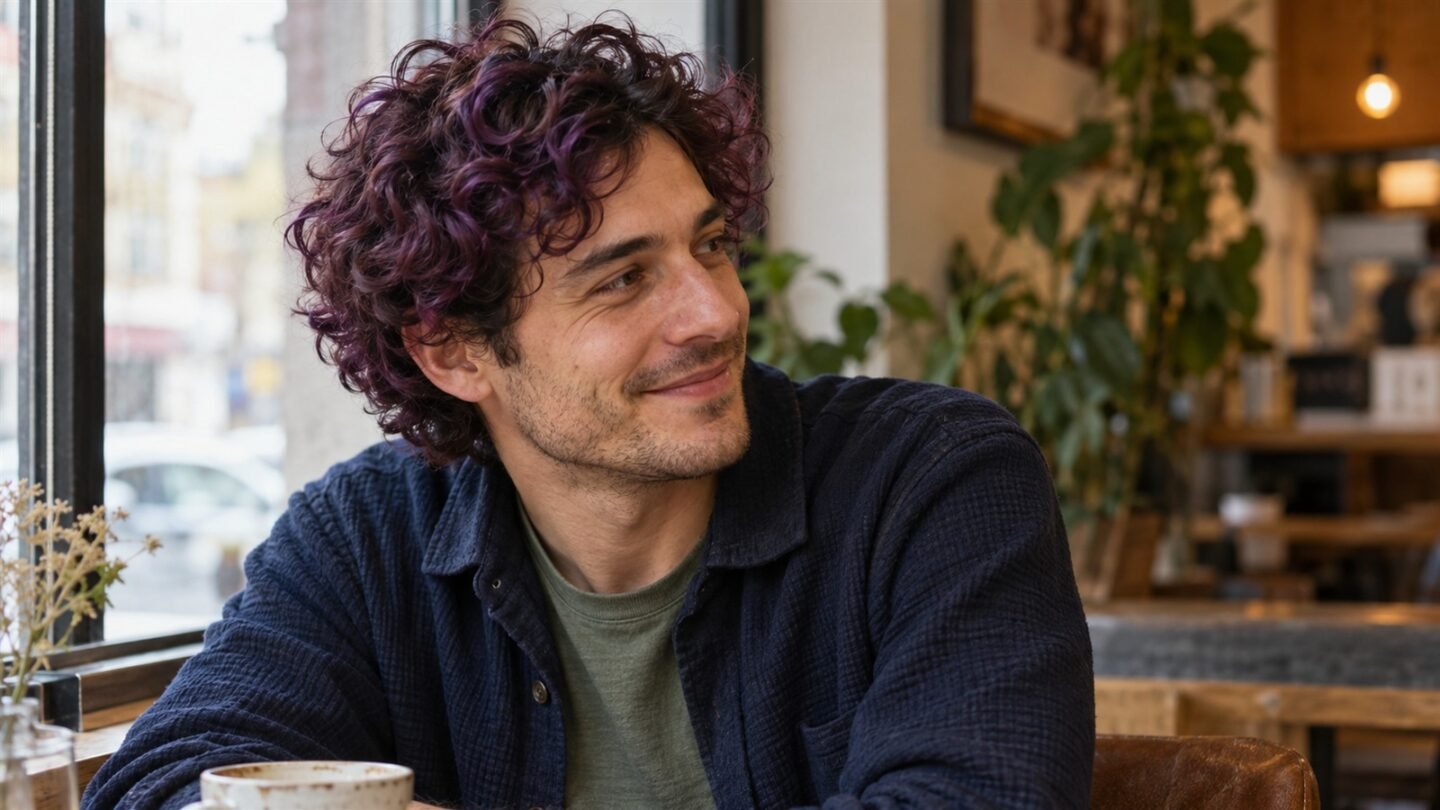
Purple hair on men can look almost black, clearly violet or bright enough to lead the whole haircut. The useful question is not simply which purple you like. It is how much contrast you want, where the color should sit and what your starting hair must go through to show it.
Dark plum is the easiest route to a subtle result on brown or black hair, although it may show mainly in strong light. Royal violet, lavender and other brighter shades usually need a lighter canvas. Highlights, tips and face-framing panels can give you visible purple without committing every curl. If you are still choosing among color families, start with our broader hair color guide for curly hair.
Choose the purple by starting base, not the swatch alone
| Look | How it reads | What the starting hair changes | Maintenance reality |
|---|---|---|---|
| Dark plum crop | Nearly black indoors, purple in direct light | Can add a purple cast to dark hair, but an exact vivid plum may still need lift | Lowest-contrast grow-out |
| Royal violet top | Clearly purple from across the room | Dark hair normally needs meaningful pre-lightening | Visible fade and root contrast |
| Fine violet highlights | Natural dark curls with flashes of color | Only selected ribbons need to be light enough | Less obvious grow-out than full color |
| Lavender tips | Light purple concentrated at the ends | Pastel lavender needs a pale, even base | Ends can be refreshed or eventually trimmed |
| Face-framing panels | Strong color around the eyes and forehead | Front sections take most of the lightening | Prominent roots and frequent tone changes |
No photograph can guarantee the same result on your hair. Previous permanent dye, uneven porosity and old bleach all change how the base lifts and how purple fades. A strand test is more useful than promising that one formula will reproduce a screen image.
1. Dark plum curly crop with a low taper
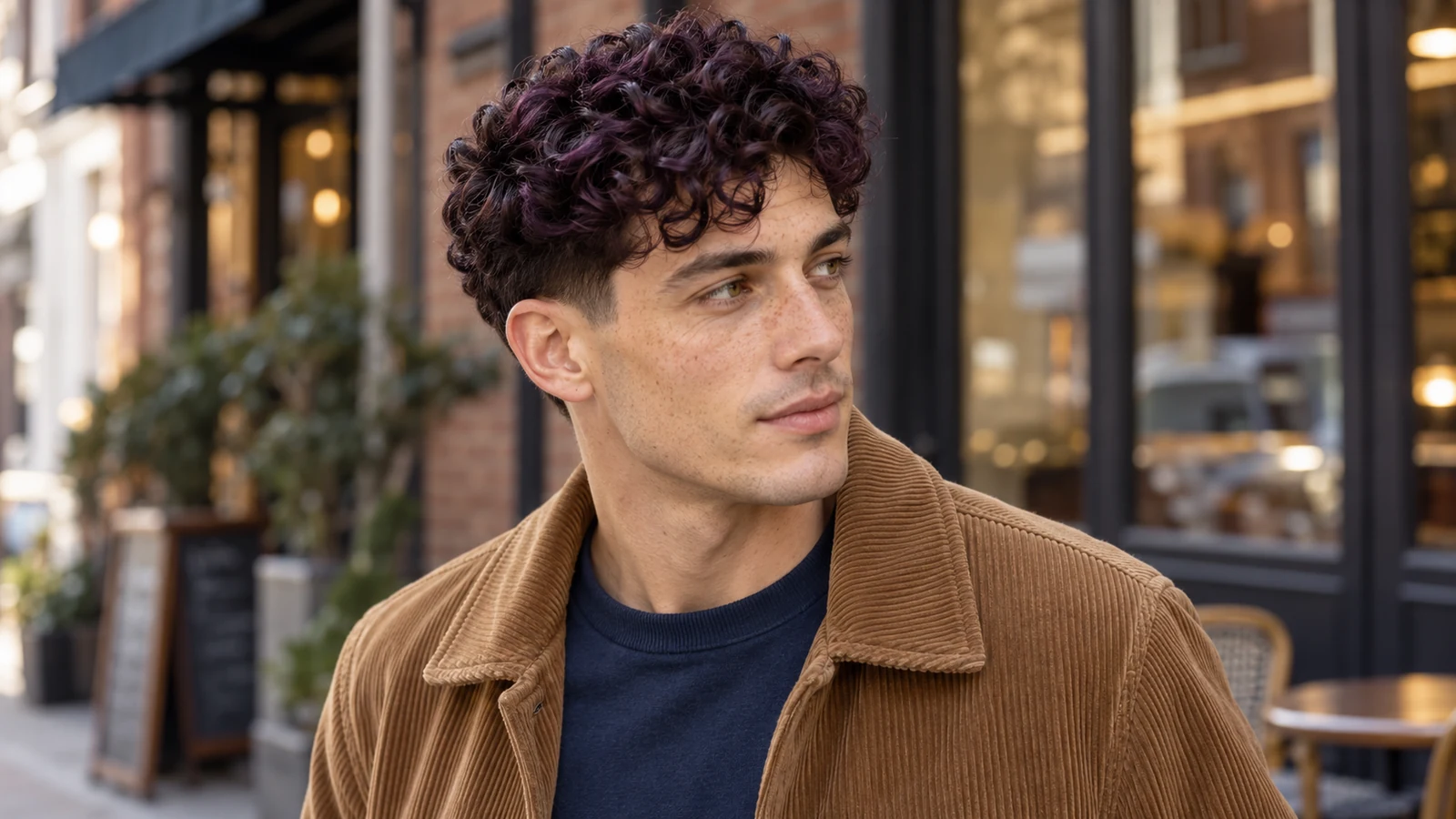
Deep plum is the quietest option here. On short dark curls, the color can look espresso or black in low light, then reveal a red-violet cast near a window or outdoors. The low taper keeps the outline neat without removing the colored area that gives the look its depth.
This is a sensible direction if you want purple to feel wearable rather than fluorescent. Ask the colorist whether your natural base can show the chosen plum as a deposit-only result or whether a small amount of lift is needed for visible purple. “Dark” does not automatically mean “no bleach,” and the answer depends on both the target and what is already in the hair.
2. Royal violet curls over a clean fade
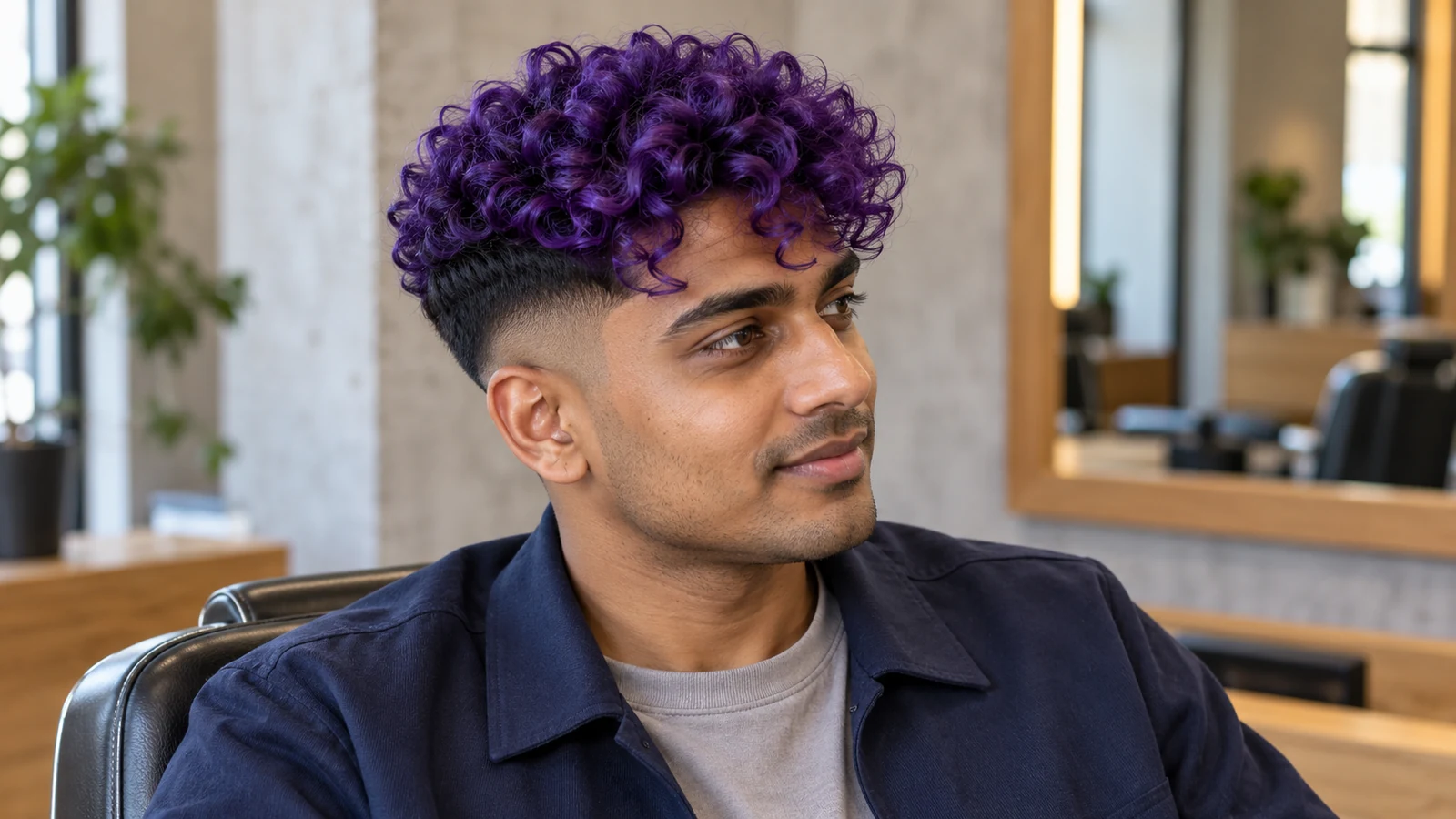
A royal violet top creates the strongest contrast between color and haircut. The natural dark fade sharpens the edges, while the longer curls hold enough surface area for violet to read clearly instead of looking like a faint tint.
This is a bright result, so dark brown or black hair generally needs pre-lightening. The American Academy of Dermatology notes that greater lightening requires stronger peroxide and causes more damage. On curls, ask for a conservative stopping point if the strand test becomes rough, weak or loses spring. Our guide to bleached curls and realistic recovery covers those warning signs in detail.
3. Fine violet highlights through medium curls
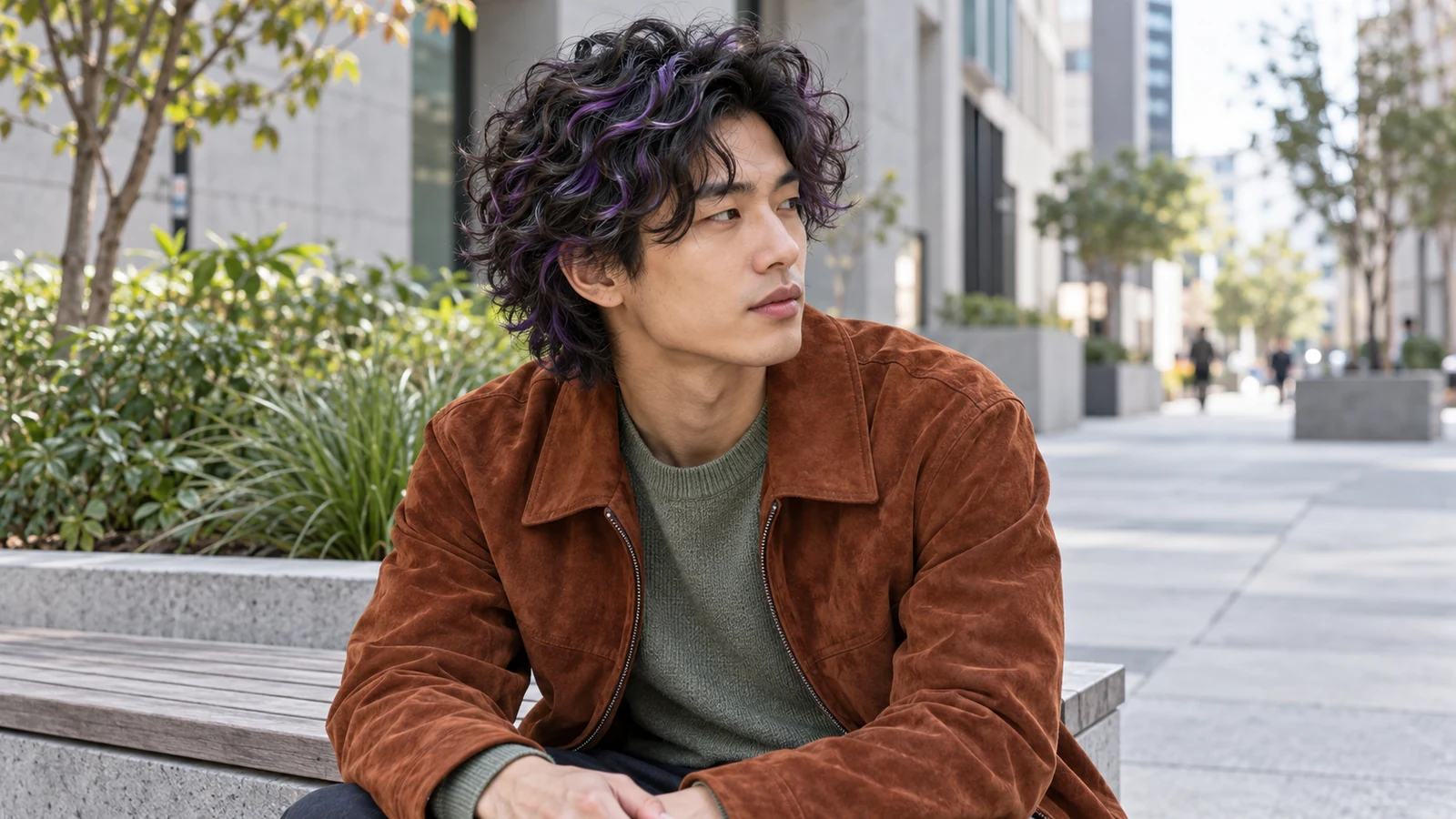
Fine violet highlights let the natural base remain part of the design. Instead of coloring every strand, the colorist selects narrow curl ribbons so purple appears and disappears as the hair moves. The effect is more dimensional than a few thick stripes and less demanding than a fully violet head.
Placement matters more than the number of foils. Ask for highlights that follow complete curl clumps rather than slicing randomly through them. More color near the front makes the result immediately noticeable; spacing the ribbons through the crown produces quieter flashes. The haircut should leave enough length for each highlighted curl to bend at least once, or the placement can read as spots rather than ribbons.
4. Lavender tips on longer curls
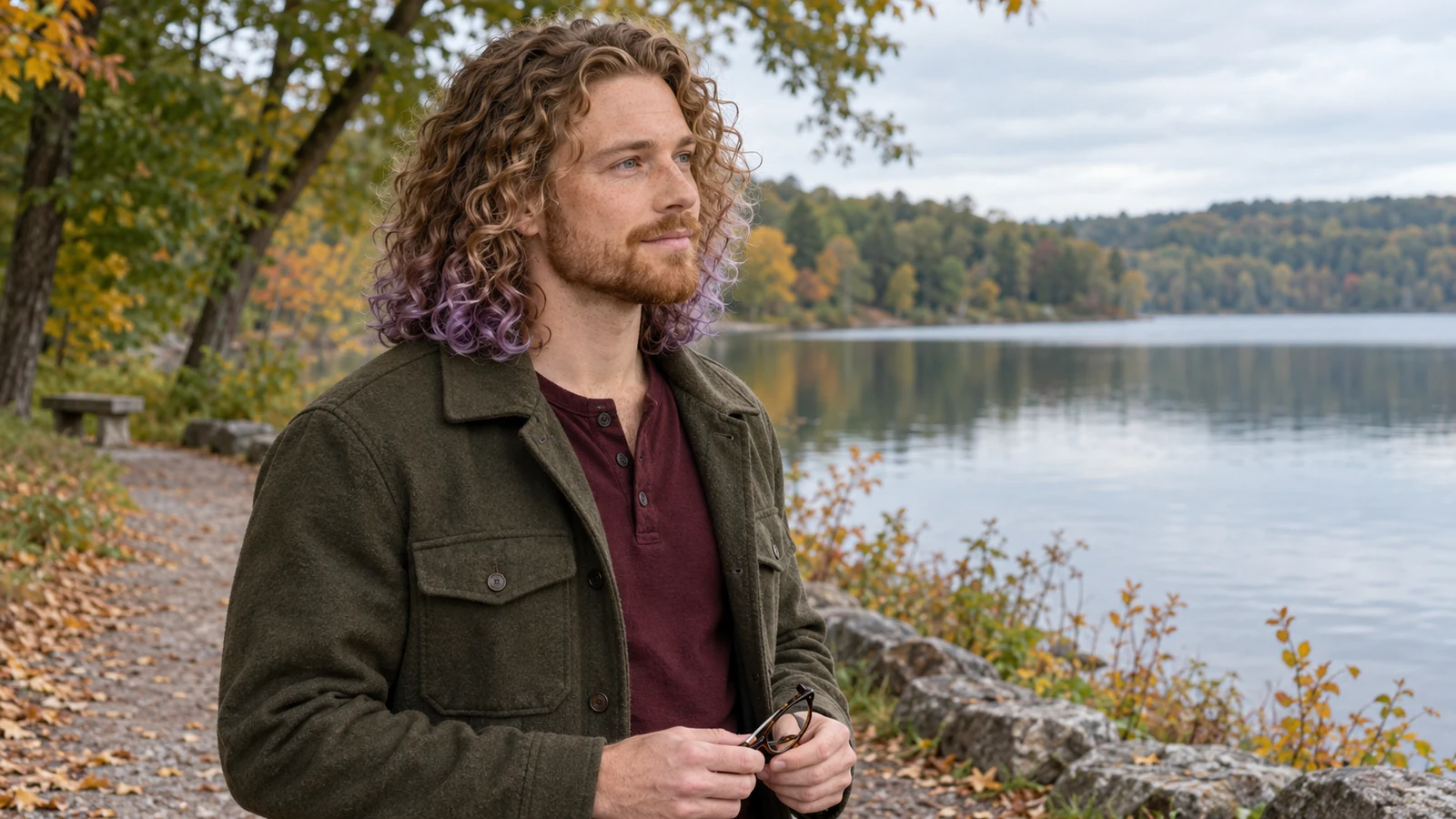
Lavender tips keep the roots and most of the length natural, then place the lightest purple at the ends. The result works especially well on shoulder-length curls because the colored portion forms a clear border around the silhouette.
Pastel does not mean easy. Lavender needs a pale, even base, so naturally dark ends may require more lifting than a deep violet look. Ends are also the oldest and often most weathered part of long hair. If a test strand cannot reach the required level while remaining strong, choose a deeper purple or shorten the colored zone rather than chasing a fragile pastel. The advantage is that the placement can grow down and eventually be trimmed without creating a full-head root line.
5. Magenta-violet face-framing panels on a curly shag
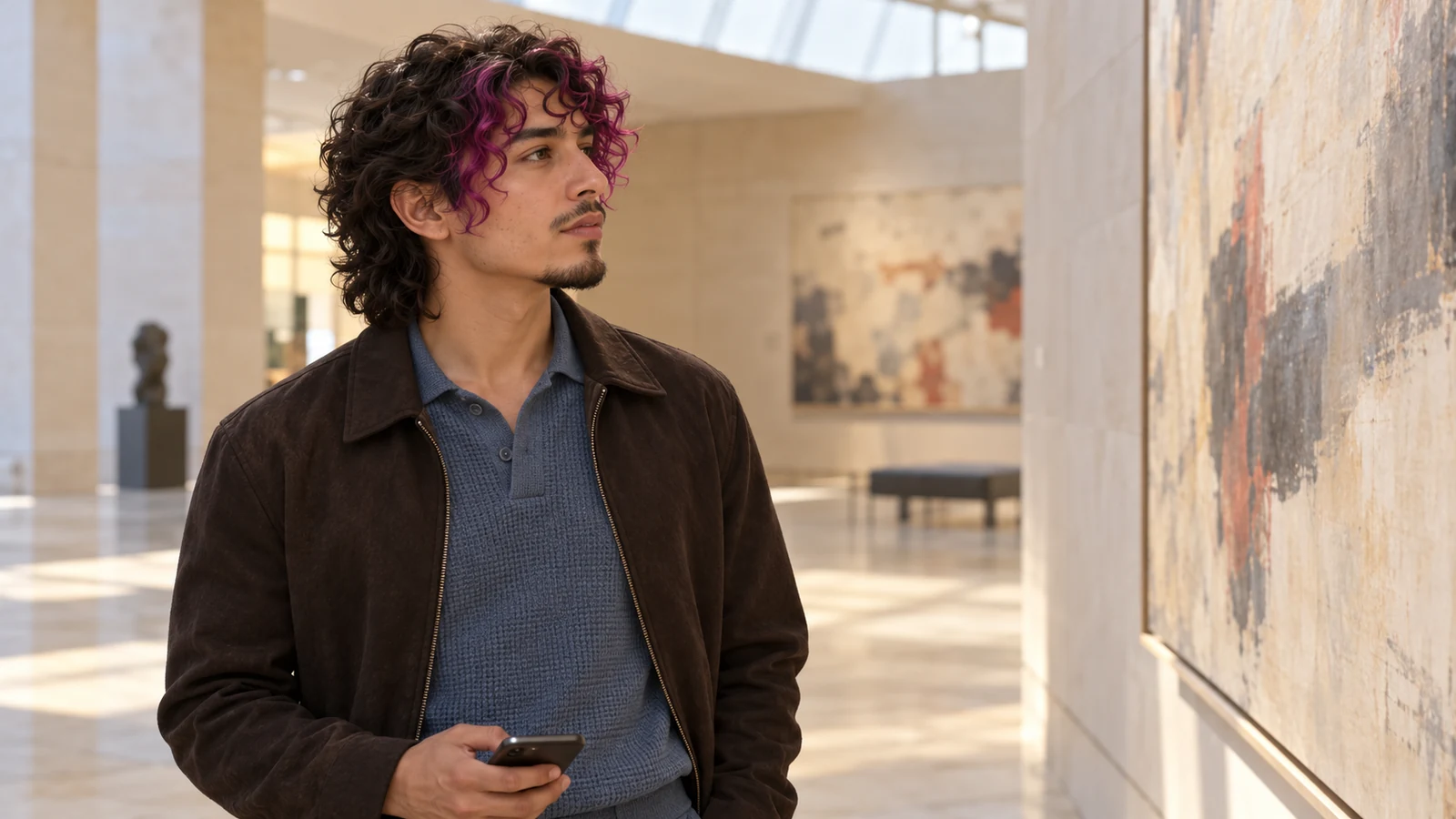
Two face-framing panels put the brightest color where people notice it first. On a curly shag, the purple moves through the fringe while the dark crown and longer back keep the haircut grounded. A red-leaning magenta-violet looks warmer than royal violet and may fade toward pink rather than blue.
This placement is bold even though only part of the hair is colored. New growth appears directly at the hairline, and the front curls are exposed to frequent touching and washing. Ask how wide each panel will be, whether any dark pieces will remain between them and where the purple should stop. Those details decide whether the result looks like two deliberate accents or an accidental block.
Match the haircut to the color placement
A fade makes a fully colored top look cleaner and creates deliberate contrast with natural sides. Scissor-cut medium curls give highlights more room to travel. Long curls make tips and ombré placement easier to read, while a fringe or shag puts face-framing color in constant view. If the cut is not settled yet, compare options in our curly hairstyles for men chooser before deciding where the purple belongs.
Bring references for both the haircut and the color. Tell the barber or colorist your normal curl shrinkage, how often you wear the hair forward, and which sections you are willing to lighten. Ask to see the placement on dry, naturally arranged curls before the service begins.
Plan for fading before the first appointment
Purple does not fade to one universal color. A red-based plum may move toward berry or pink; a blue-based violet can become cooler and smokier. The exposed base underneath also matters. A pale yellow base, warm orange lift and previously colored strand will not reveal the same faded result.
Wash frequency, water temperature, UV exposure and the exact formula affect how long the tone stays recognizable. Ask the colorist what the chosen shade normally fades toward and whether a color-depositing product is appropriate for that formula. Do not improvise by leaving dye on longer. The FDA advises following package directions and performing the specified skin test before every use, even if you have colored before without a reaction.
The best purple hair choice is the one that still makes sense after the first vivid week. Choose dark plum for subtle contrast, fine highlights for movement, tips for a removable color zone, face-framing panels for immediate impact or full royal violet when you accept the lift and upkeep. Then let the haircut give that color a clear shape.