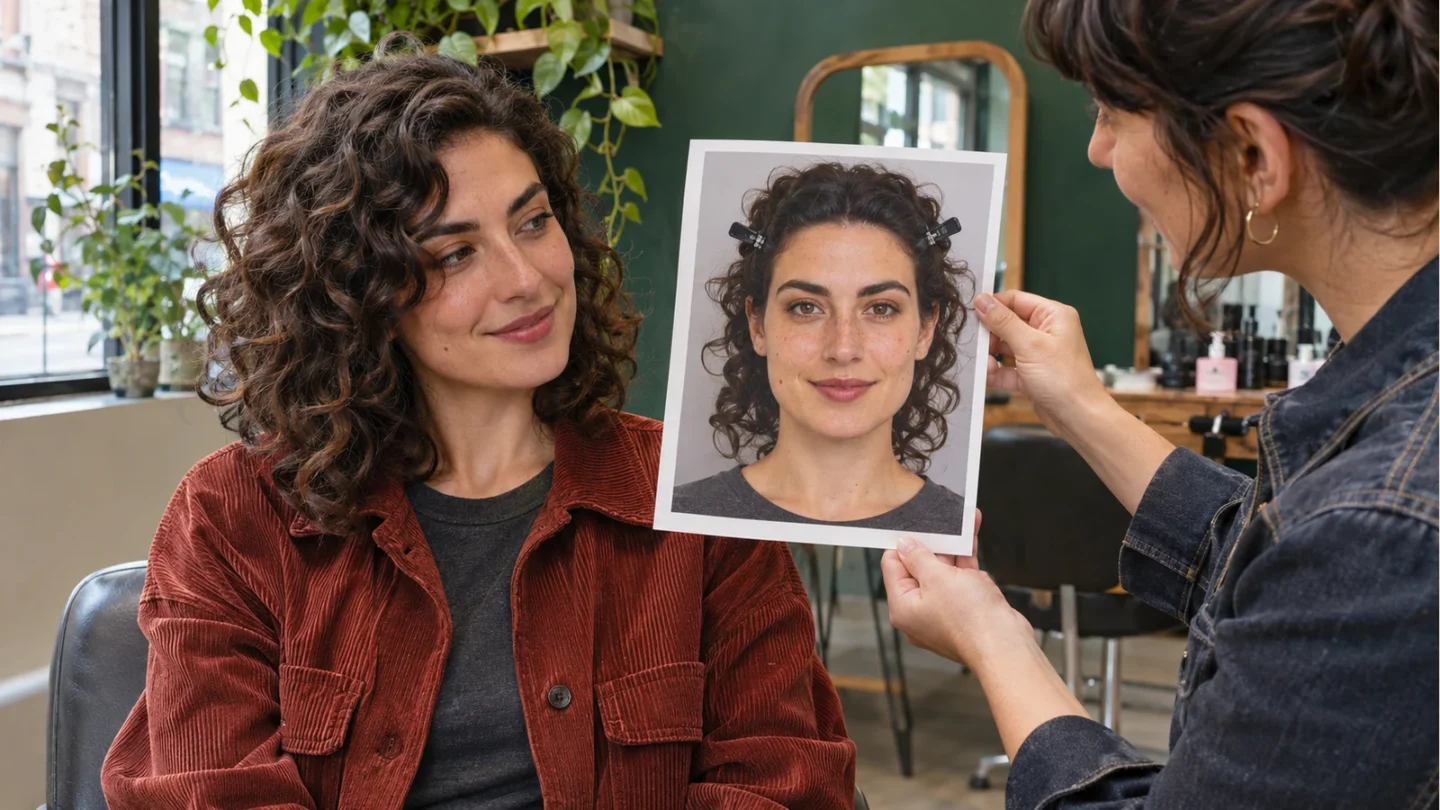
If one guide calls your face round and another says oval, you probably didn’t measure wrong. A face-shape label comes from comparing proportions and deciding where one category ends and the next begins. Two tools can draw that line in different places.
To find your face shape for a haircut, start with a straight-on photo and compare four distances: face length, cheekbone width, forehead width and jaw width. If the proportions sit near two categories, take both as possible descriptions. For curly hair, the amount of volume around your cheeks and where your shortest layers land will often tell you more about the cut than a single label.
What a face-shape tool actually measures
- Face length: from the chosen top point of the forehead to the bottom of the chin.
- Cheekbone width: across the face at cheekbone level.
- Forehead width: across the temples.
- Jaw width: straight across between the two jaw corners, without tracing the jawline.
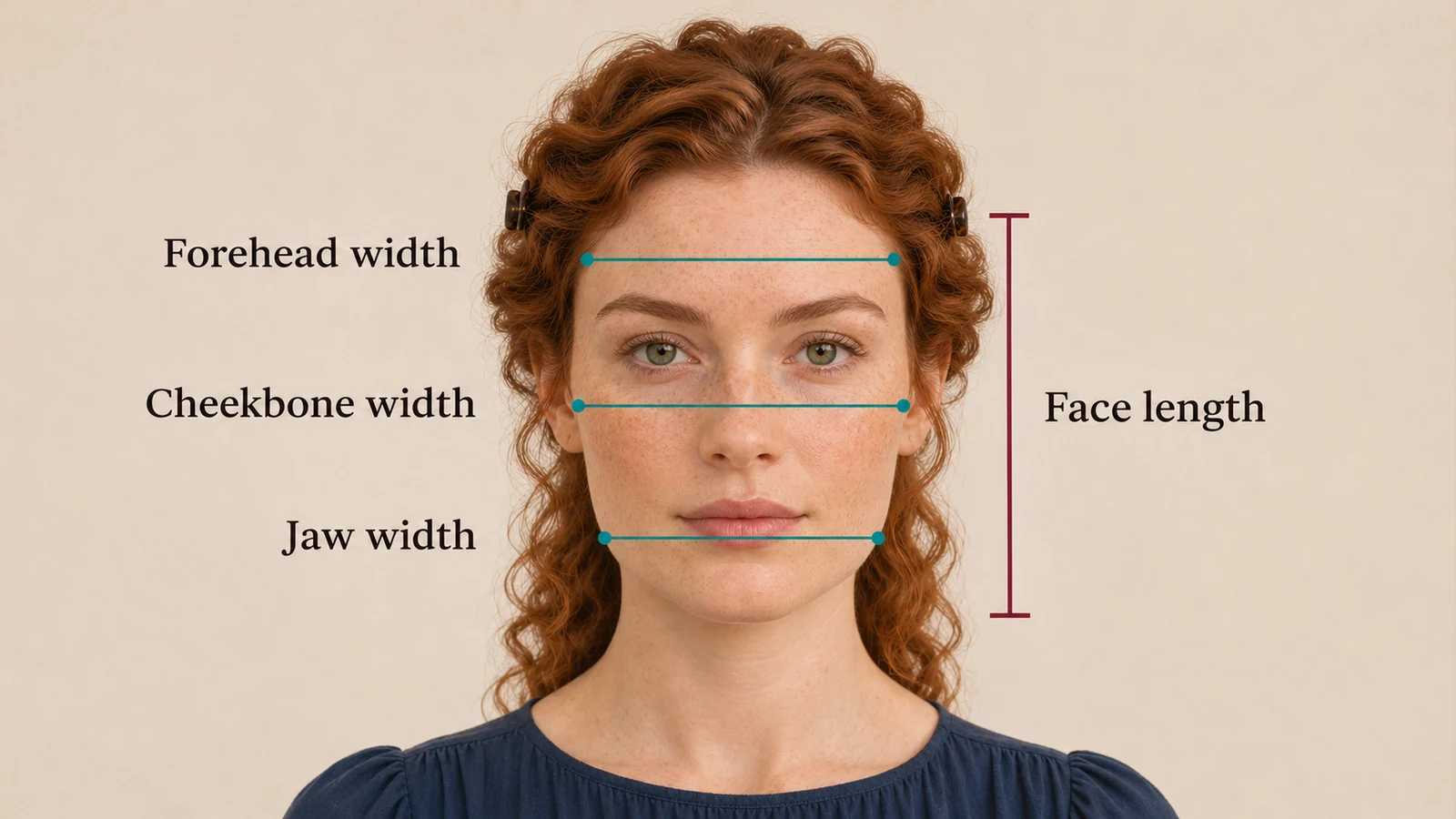
Divide one distance by another and you get a ratio. A face length of 118 pixels and a cheekbone width of 100 pixels give a ratio of 1.18. Double both distances and it stays 1.18. That is why the size of the printout doesn’t matter, provided the photo hasn’t been stretched. Taking a new photo from much closer, however, can change perspective and apparent proportions.
The Face Analysis uses Google’s MediaPipe Face Landmarker, which estimates 478 facial landmarks. Its horizontal coordinates are scaled to the image width and vertical coordinates to the image height. The tool converts both axes to the same units before comparing a horizontal distance with a vertical one.
There’s a practical catch: the tool’s top point sits on the forehead, below the hairline. If you measure from your hairline by hand, your length ratio will usually be higher. And when curls or bangs hide the temples, the tool is estimating points you can’t clearly see. That is a good reason to retake the photo rather than put more faith in the number.
Where one face shape ends and another begins
The Face Analysis tested its measuring code on the Face Research Lab London Set, a public collection of 102 adults photographed under standard conditions. These are the contributor’s reported results for the neutral front-facing photos. The ranges cover the middle 80% of this sample.
| Ratio | Median | Middle 80% |
|---|---|---|
| Face length ÷ cheekbone width | 1.18 | 1.12 to 1.23 |
| Jaw width ÷ cheekbone width | 0.79 | 0.77 to 0.82 |
| Forehead width ÷ cheekbone width | 0.94 | 0.91 to 0.97 |
| Forehead width ÷ jaw width | 1.19 | 1.12 to 1.25 |
The tool’s oblong rule starts at a length-to-cheekbone ratio of 1.229. Its heart rule uses a forehead-to-jaw ratio of 1.239 or higher. Other rules can overlap, so the detector checks them in order and uses the first match. Oval is the fallback. The team selected thresholds using this same set, and the people in it did not come with verified shape labels. The figures describe how one tool divides one sample. They don’t establish universal cutoffs, population frequencies or an accuracy rate.
Why a small photo change can flip the label
In its published October 2026 analysis, The Face Analysis reported that rotating the same front-facing photo by 5 degrees changed the label for 17 of the 102 faces. This was a tilt of the image itself, not a person turning their head. Rotating a flat image doesn’t change its underlying distances. The detector estimated some points differently, and those small shifts were enough to cross a category boundary.
How to check your face shape before a curly haircut
- Put the phone at eye level, step back from the lens and look straight ahead in even light. Use a timer if it helps.
- Clip curls away from the temples and jaw without pulling the skin. Keep your expression relaxed and your chin level.
- On a printout or in a photo editor, measure the four distances in the same units. Compare length to cheekbone width, then compare the three widths. Use the same endpoints if you try a second photo.
- Take a second photo with your hair down, styled as you usually wear it. Bring both views to your consultation. The first shows your face outline; the second shows where your curls add width, how much they spring up and where they fall when dry.
If you’d rather have software estimate the points, The Face Analysis offers a face shape tool. Treat its label as a second opinion about proportions. When two labels seem to fit, use our hairstyles by face shape guide to shortlist looks from both. Then ask your stylist where the shortest curl will land dry, especially if you’re considering bangs or face-framing layers.
What a face score can’t tell you
The same measurements can be combined into a score, but the result depends on what the creator chooses to reward. The Face Analysis gives symmetry 40% of its composite, with the remaining 60% split across three ratios scored for closeness to the golden ratio. The resulting 1 to 10 number is benchmarked against the same reference set.
In the contributor’s analysis, that composite had a Spearman correlation of −0.07 with attractiveness ratings for the 102 neutral photos. The estimate is close to zero in this sample. The same analysis found a median absolute score change of 1.3 points between neutral and smiling photos. This is one developer’s test of one formula, but it shows why you shouldn’t use a photo score to choose a cut or judge your appearance. If you’re deciding between two styles, compare where the layers and volume sit when your own curls are dry. That’s a much more useful conversation to have with your stylist.