The best curly hair accessories do two jobs at once: they make a style look intentional and hold it without crushing the curl pattern. A cap that is too shallow, a clip that is too small or a headband that grips too tightly may stay in place, but the flattened roots and snagged strands are not much of a trade.
You do not need a drawer full of accessories. A roomy cap, a smooth scarf, one correctly sized clip, a comfortable headband and a soft scrunchie can cover most everyday situations. The useful choice depends less on the trend and more on your curl volume, hair density and where you want the accessory to sit.
| If you want to | Try | Check before wearing |
|---|---|---|
| Contain curls on a casual day | A roomy, adjustable baseball cap | The crown has enough depth and the opening does not trap curls |
| Add color without changing the style | A silk or satin scarf | The knot sits away from fragile ends and the fabric does not slide |
| Create a quick updo | A large, smooth-edged claw clip | The teeth close around the section without forcing the hinge |
| Keep shorter curls away from the face | A fabric or flexible headband | It stays put without leaving pressure marks |
| Secure a ponytail or puff | A satin scrunchie or snag-free tie | One or two loose wraps hold without pulling the hairline |
Wear a Baseball Cap Without Packing Down Every Curl
A baseball cap works best when the shape accommodates the hair instead of forcing the hair to fit. Look for an adjustable closure and enough crown depth for your natural volume. If the band feels comfortable but the top of the cap is pressing firmly against the roots, the profile is probably too shallow.
With long curls, try a low puff or ponytail through the back opening, leaving enough looseness at the crown to prevent a stretched, flat look. A low braid also keeps the ends controlled without creating a bulky knot beneath the cap. Short curls can remain loose around the sides and back; position the cap lightly rather than pulling it down until the curls disappear.
Color and embroidery can turn the cap into part of the outfit rather than an emergency cover-up. Readers choosing branded or custom designs can explore personalized richardson hats for sale, then compare the profile, closure and crown depth instead of choosing by artwork alone. A good-looking cap still needs to fit the volume you plan to wear underneath it.
If you want the curls loose after removing the cap, avoid starting with damp hair. Let the roots dry fully, place the cap without compressing the crown and carry a small pick for gentle lifting afterward. Do not rake through the lengths just to repair one flat area.
Use a Scarf as a Headband, Ponytail Tie or Braid Detail
Scarves are unusually flexible because the same piece can become a headband, a ponytail accent or part of a loose braid. Fold a square scarf into a narrow band and tie it beneath the curls for a simple face-framing style. If smooth fabric slips, place the knot low at the nape or secure the scarf with two small pins hidden behind the ears.
For a ponytail, wrap the scarf around a soft hair tie rather than asking the scarf itself to carry all the tension. In a braid, treat the fabric as one loose strand and leave room for the curls instead of pulling every section tight. Silk and satin reduce rough friction, while cotton tends to grip more securely but may feel less smooth against dry ends.
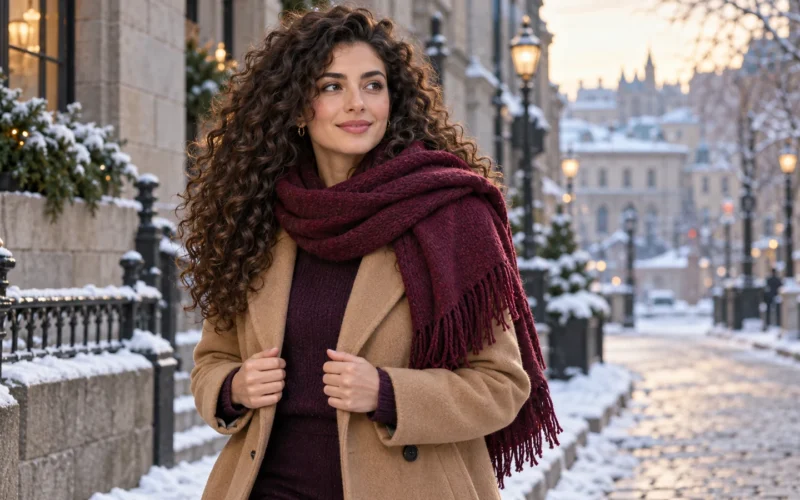
Cold-weather fabrics and coat collars introduce different problems. Our guide to styling curly hair with scarves and winter accessories explains how to position them without trapping the ends or flattening the roots.
Choose a Claw Clip That Matches Your Density
A claw clip should close around the section without the hinge looking strained or the teeth scraping the scalp. Fine or short curls may stay secure in a medium clip, while dense, long hair often needs a larger clip with a wider opening. Bigger is not automatically better: an oversized heavy clip can slide or pull when it holds only a small section.
For a relaxed twist, gather the hair low, turn it upward once and clip across the folded section. Let the ends spill naturally over the top instead of tucking and retucking them until the curls lose shape. A half-up clip is useful when you want the face clear but still want most of the curl pattern visible.
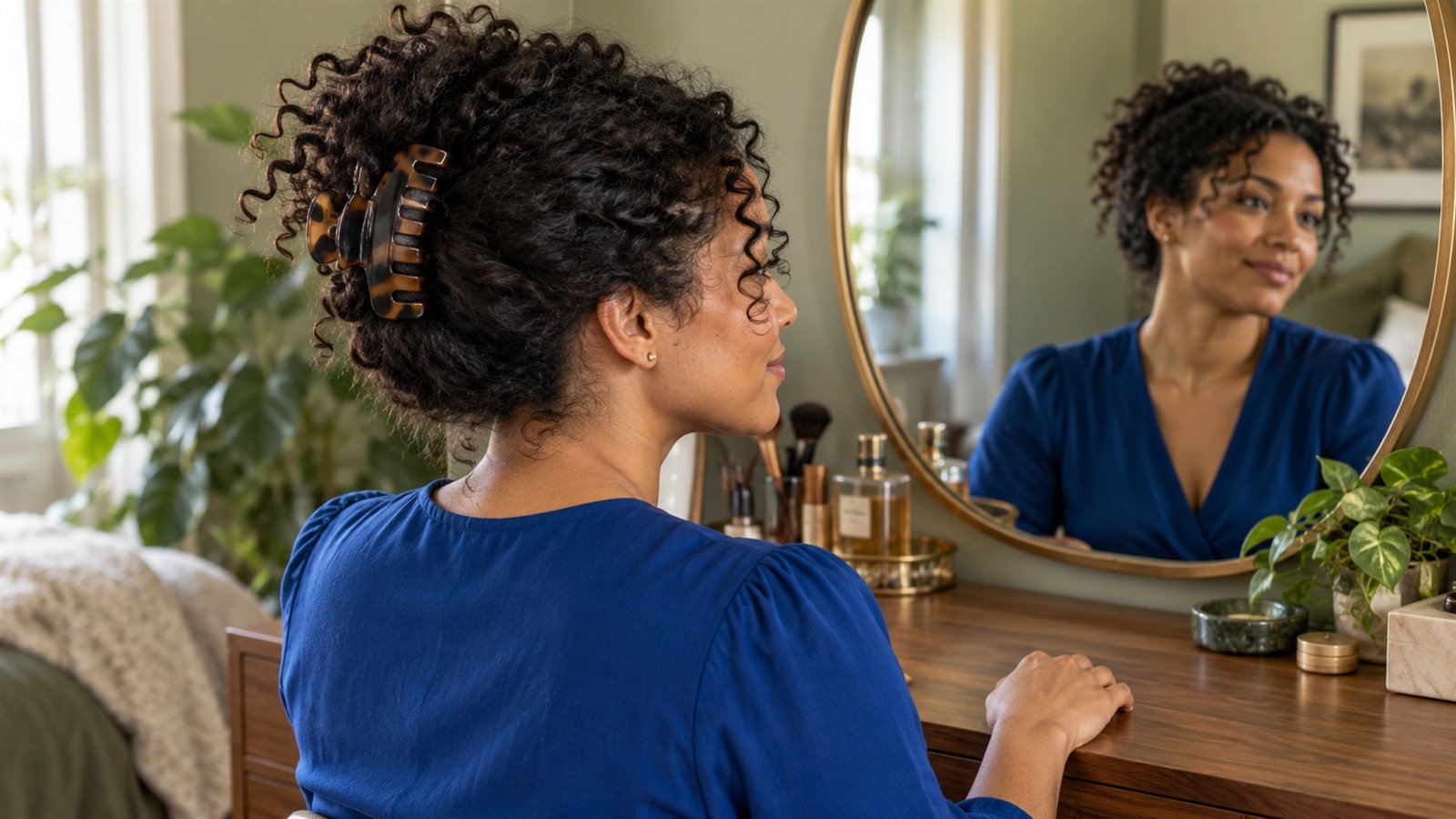
Run a finger over the teeth and seams before wearing a new clip. Rough edges, exposed springs and decorative pieces that catch easily are warning signs. Remove the clip by opening it fully, not by dragging it through the curls.
Use Headbands Without Squeezing the Hairline
A headband is most useful when it holds shorter layers and lets the rest of the hair keep its shape. Wide fabric bands balance voluminous curls and spread pressure over a larger area. Narrow bands give a cleaner, more understated look, but rigid versions can become uncomfortable behind the ears.
Place the band where the curls naturally separate rather than pushing it repeatedly toward the crown. If it slides, choose a textured fabric lining or anchor it discreetly with pins. If it causes a headache or leaves a deep mark, the fit is wrong even if the style looks polished.
Make Ponytails and Puffs Gentler With the Right Tie
Satin scrunchies and smooth, snag-free ties are easier to remove than bare rubber bands or elastics with exposed joins. Use the fewest wraps that hold the style. A high puff can show off shorter curls, while a low ponytail gives longer hair a neater outline beneath a cap or scarf.
Rotate the placement instead of pulling the same area tightly every day. The American Academy of Dermatology warns that repeated pulling can contribute to traction alopecia. Pain, stinging or a visibly stressed hairline is not a normal sign that an accessory is working.
Match the Accessory to the Outfit, Not Every Color
An accessory looks more considered when it repeats one element from the outfit rather than matching everything. A cap can echo the color of a jacket or shoes. A patterned scarf works well against simple clothing, while a metallic barrette can add enough detail to a monochrome look without competing with the curls.
Scale matters too. Dense, voluminous curls can visually support a wider headband or larger clip. Fine curls often suit lighter pieces that do not overpower the shape. Choose one obvious focal point; wearing a statement scarf, ornate clip and bold cap at the same time usually hides more of the hairstyle than it enhances.
Build a Small Collection That Solves Real Styling Problems
Start with the situations you actually encounter: a cap for outdoor days, a smooth scarf for color, a clip for quick twists, a headband for shorter layers and a scrunchie for ponytails or puffs. Neutral versions are easy to repeat, while one patterned or brightly colored piece can change the mood of familiar clothes.
Before buying multiples, wear one accessory for a full ordinary day. Notice whether it shifts, catches, creates pressure or leaves the curls difficult to restore. If a cap or headband flattens only the roots, the targeted steps in our morning curl refresh guide can lift that area without soaking the entire style.
Everyday accessories should make curly hair easier to style, not create another recovery routine. Match the size to your density, keep the tension comfortable and let the curls remain part of the look. The best accessory is the one you can remove without finding pulled roots, trapped ends or a completely different hairstyle underneath.