A low manufacturing quote can look brilliant until packaging, testing and shipping costs appear. Even worse, the approved sample may be lovely while the finished batch sprays unevenly or arrives with leaking cans.
The safest choice is not automatically the cheapest factory. It is the manufacturer that clearly explains the total cost, reproduces approved samples and provides evidence for its quality claims.
Compare these five things first
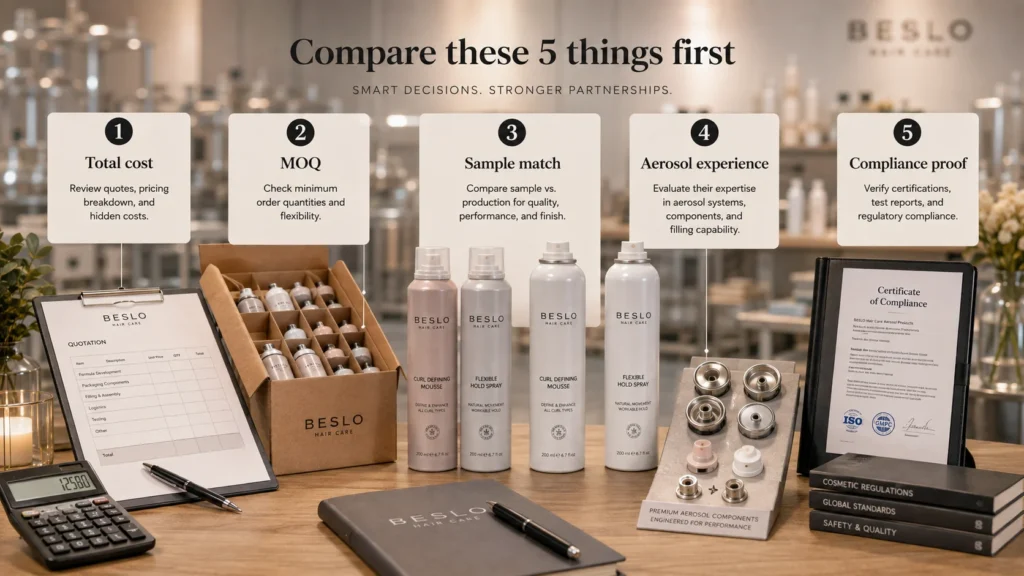
| Check | Question to ask | Warning sign |
|---|---|---|
| Total cost | What is included in the final quote? | Important charges appear later |
| MOQ | Which component controls the minimum order? | One unexplained MOQ |
| Sample | How will production match it? | No written specification |
| Aerosol experience | What systems and tests are available? | General cosmetics experience only |
| Compliance | Which documents support each claim? | “Globally compliant” without proof |
A confident sales representative is helpful. A written answer is better.
Calculate the real cost before comparing quotes
There is no universal price for private-label aerosol production. Cost depends on the formula, container, valve, actuator, printing, order quantity, testing and destination.
Request an itemized quotation covering:
- Formula development and filling
- Can, valve and actuator
- Printing, labels and cartons
- Samples and revisions
- Product and packaging tests
- Freight and dangerous-goods handling
- Setup or artwork charges
- Deposit and payment terms
MOQ also needs explaining. A factory may accept a smaller formula batch while its printed-can supplier requires a much larger order.
Ask for the formula, packaging and finished-product minimums separately.
You also need to know when the production timeline starts. Is day one triggered by payment, sample approval, final artwork or packaging arrival? If “30 days” has no agreed starting point, it is mostly a hopeful calendar.
Give every manufacturer the same product brief
Factories cannot quote accurately when the request is simply, “I want a curl product.”
Prepare a short brief that covers:
- Intended customer
- Hair characteristics
- Desired hold and finish
- Product format
- Fragrance direction
- Ingredients or claims to avoid
- Target retail price
- Countries where it will be sold
- Expected first order
Product format should follow the customer’s desired result. Our guide to mousse versus gel for curly and wavy hair explains why mousse usually favors volume while gel provides stronger definition and hold.
Curl pattern is only part of the picture. Density, strand thickness, damage and high or low porosity can change how rich or lightweight a formula should feel.
Then decide how much customization you need:
- Stock formula: Faster and simpler, but less distinctive.
- Semi-custom formula: An existing base with limited changes.
- Custom formula: Greater control, but more sampling, testing and development.
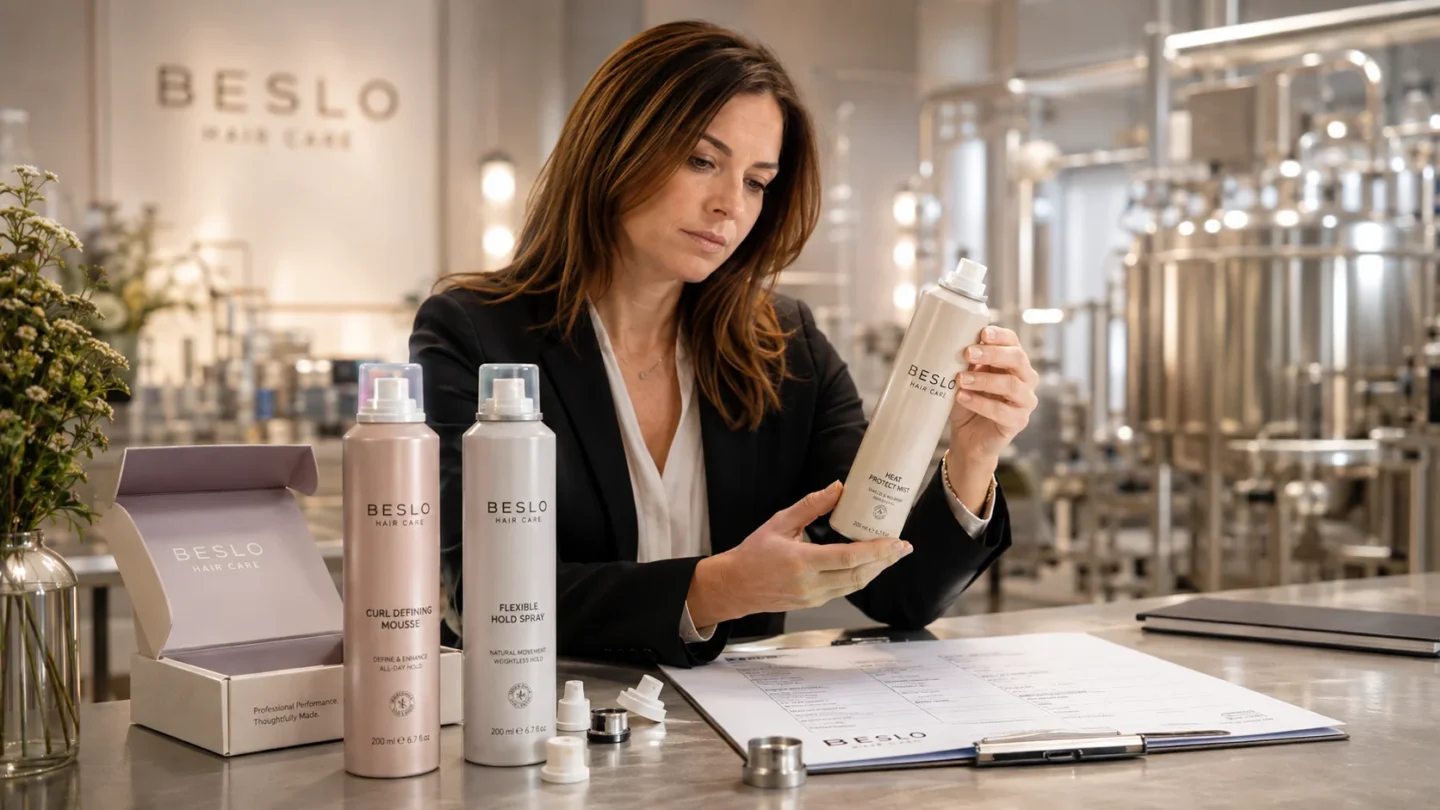
BESLO Cosmetics states that its in-house laboratory can prepare custom samples before full production. When evaluating this service, ask how many revisions are included, who owns the finished formula and what happens if production does not match the approved sample.
Check aerosol experience, not just cosmetic experience
A factory that fills shampoo bottles is not automatically equipped to make a dependable styling spray or mousse.
The formula must work with the can, valve, actuator and dispensing system. Otherwise, the product may clog, leak or spray differently as the container empties.
Ask:
- Which aerosol systems can the facility produce?
- Why is the proposed system suitable for your formula?
- Is the sample made in the final commercial package?
- How are the valve and actuator selected?
- Which leakage, pressure and compatibility tests are performed?
- Does the spray remain consistent throughout use?
When comparing an aerosol hair care manufacturer, use the capabilities BESLO describes, including conventional and Bag-on-Valve systems, as points to verify through samples and test documentation.
Bag-on-Valve can be useful when a formula needs separation from the propellant. It is not automatically the best or most affordable option for every product.
Approve samples with a scorecard
“It seems good” is not a useful approval standard.
Review every sample using the same criteria:
- Scent and appearance
- Spray pattern or foam consistency
- Drying time
- Hold and final feel
- Residue, flaking or stiffness
- Actuator clogging
- Performance on the intended hair types
Use a simple approval process:
Product brief → sample → written feedback → revised sample → approved specification → production
Keep the approved sample and its written specification. If the production batch feels different, you need something more reliable than everyone’s memory.
Verify the impressive-looking claims
A long row of certification logos does not automatically prove that a factory is suitable for your product.
The official ISO 22716 standard covers good manufacturing practices for producing, controlling, storing and shipping cosmetics. If certification is claimed, request the certificate, facility address, scope, issuing body and expiry date.
For the United States, the FDA explains that cosmetic facilities and products may require registration and listing. It also makes clear that FDA registration is not product or facility approval.
For the European Union, product information is submitted through the Cosmetic Products Notification Portal by the responsible person or, in some situations, the distributor. CPNP notification is not a general factory certificate.
Request documents that apply to your actual product and destination:
- Manufacturing certificates
- Formula and ingredient specifications
- Batch Certificate of Analysis
- Stability and packaging-compatibility information
- Batch traceability procedure
- Complaint and recall process
Check that every certificate belongs to the facility producing your order.
Watch for these red flags
Pause before paying a deposit if the manufacturer:
- Refuses to provide current documents
- Uses different packaging for samples and production
- Cannot explain the total MOQ
- Avoids discussing formula ownership
- Guarantees compliance in every country
- Cannot explain how failed batches are handled
- Changes ingredients without written approval
One unclear answer can be corrected. A collection of them is a warning.
Make the final decision
Shortlist two or three manufacturers and send each one the same brief. Request the same cost breakdown, testing details and production timeline.
Compare them on:
- Total cost per sellable unit
- Quality and repeatability of the sample
- Aerosol manufacturing experience
- Strength of the documentation
- Communication and reorder reliability
A beautiful sample may win your attention. A repeatable, documented process is what protects your brand.