You know that conditioner your friend won’t stop talking about? Five-star reviews, waitlisted twice, supposedly transformed her hair overnight? There’s a real chance it’s doing nothing for yours. Not because the product is bad. Because your hair physically can’t absorb it the same way hers does.
That’s porosity. And it controls more of your hair’s behavior than most people realize.
I test porosity in every single consultation at my salon. It’s the first thing I assess before recommending anything, and the International Association of Trichologists considers it foundational for a reason. Two clients with identical curl patterns can need completely opposite products based on porosity alone. Miss this step and you end up doing what most of my clients did before they came in: buying a new bottle every few weeks, blaming the brand, trying the next one. For years. The fix was never the product. It was understanding what their hair could actually do with it.
What Porosity Actually Is (30-Second Version)
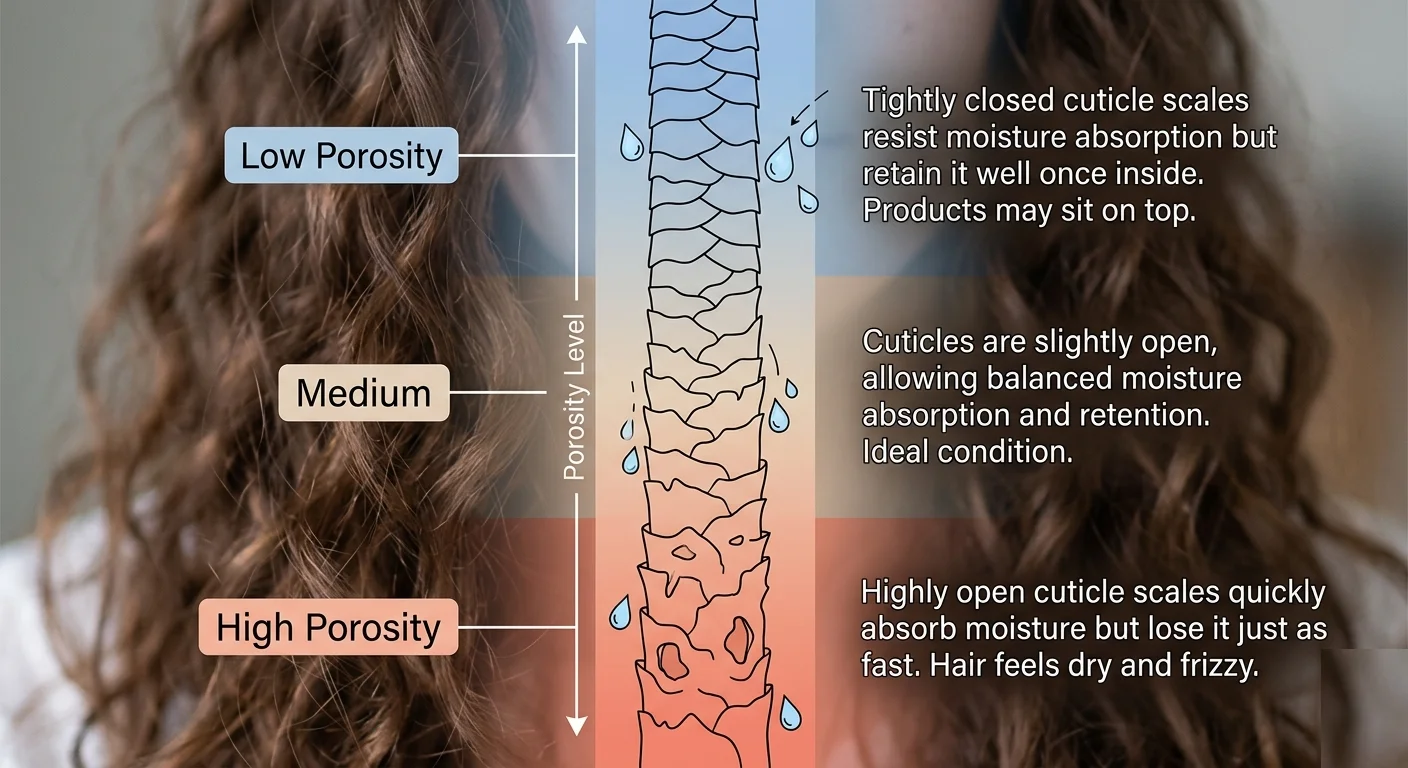
Your hair strand has an outer layer called the cuticle. Think of it like roof shingles, tiny scales overlapping each other.
High porosity means those scales are lifted, chipped, or have visible gaps from damage or genetics. Moisture rushes in fast, leaves just as fast. Your hair absorbs everything and holds nothing.
Low porosity is the opposite. Shingles pressed flat and tight. Products sit on the surface. Moisture barely gets through. Your hair rejects everything and feels coated.
Medium porosity sits in the middle. Balanced moisture exchange. If you have this, most products work fine and you’re probably not reading this article.
Research published in Cosmetics journal confirmed that both chemical treatments and repeated physical handling progressively alter cuticle permeability, which directly changes how hair absorbs and releases water. Your porosity isn’t always what you were born with. It shifts over time based on what you’ve put your hair through.
The Float Test: Helpful but Not the Full Picture
You’ve probably seen this one. Drop a clean hair strand in room temperature water. Sinks fast, high porosity. Floats, low porosity.
It’s a decent starting point. I tell clients to try it. But I’ve also seen it mislead people plenty of times.
Product residue makes strands float even when porosity is high. Fine hair sinks from weight alone regardless of porosity. And here’s what nobody mentions online: your porosity can vary along the same strand. Roots might be low porosity because they’re newer growth, while your ends are high porosity from years of heat and sun exposure. One strand in a glass doesn’t capture that.
Forget the glass of water for a second. Just watch your hair over a normal week:
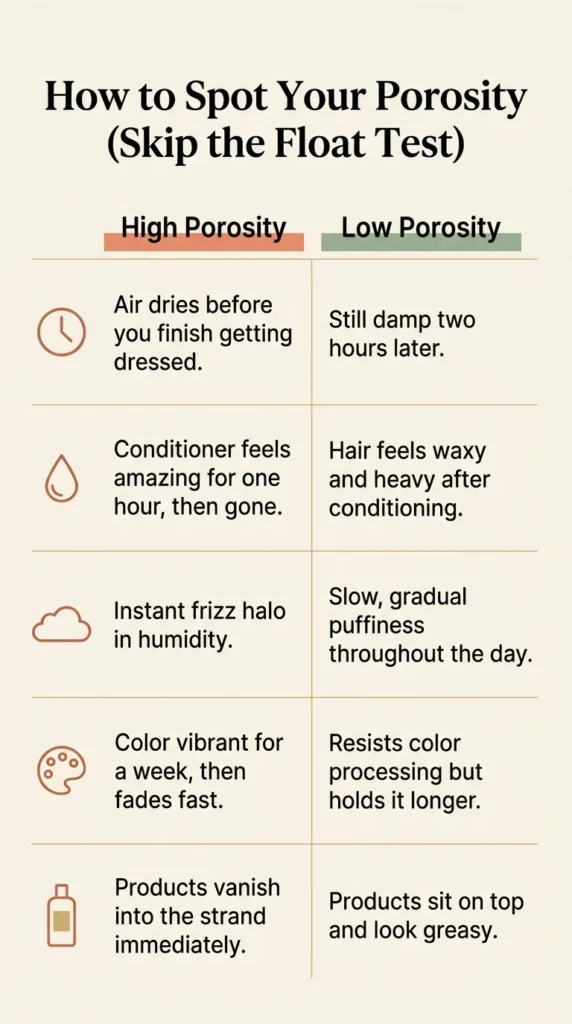
Honestly? A week of paying attention to those things tells you more about your porosity than any single test will.
Why High Porosity Hair Burns Through Products
I had a client last month going through a full bottle of leave-in every two weeks. She thought she wasn’t using enough. The real problem? Her cuticle couldn’t hold any of it.
That’s the high porosity cycle:
- Moisture floods in through cuticle gaps
- Strand swells
- Hair dries, moisture escapes
- Strand shrinks back down
- Repeat. Every single wash day.
A 2023 study on cuticle damage found that surfactant exposure alone increased porosity by over 15% in untreated hair. The more the cuticle lifts, the faster everything you apply washes out.
Stacking more moisturizing products won’t fix this. You’re filling a bucket with holes in it.
What actually works: layering with a seal.
- Protein treatment first to temporarily patch cuticle gaps
- Moisture on soaking wet hair while the strand is still receptive
- A frizz control serum as the final step to slow moisture loss
Skip that seal and everything you applied is gone before your hair finishes drying. If frizz is your main battle, I wrote a full breakdown of what causes it and why. Once you know the cause, Lisett’s fix-it guide is the next step.
Why Low Porosity Hair Feels Greasy and Dry at the Same Time
This one confuses people more than anything I see. Hair feels weighed down but also frizzy. Oily at the roots, dry at the ends. Most clients assume it’s a scalp issue.
It’s not. Every product from the last three washes is still sitting on the surface. The cuticle is so flat and tight that nothing penetrated it. The hair underneath is actually dry while the outside feels slick.
Two fixes most people skip:
Heat during conditioning. Not styling heat. Gentle warmth. Warm water in the shower, a warm towel wrap for ten minutes while your conditioner sits. Same product, completely different results with warmth helping it through the cuticle.
Regular clarifying washes. Co-wash only routines are a trap for low porosity hair. Products can’t absorb in, so they definitely can’t rinse out easily either. A gentle clarifying shampoo every week or two clears the buildup so fresh products have a shot.
Quick rule for low porosity: if the ingredient list leads with shea butter or coconut oil, it’s probably too heavy. Stick to water-based leave-ins, glycerin, aloe. Anything that feels light going on.
The Part Nobody Talks About: Mixed Porosity
Something I almost never see addressed online. Most people don’t have uniform porosity across their entire head.
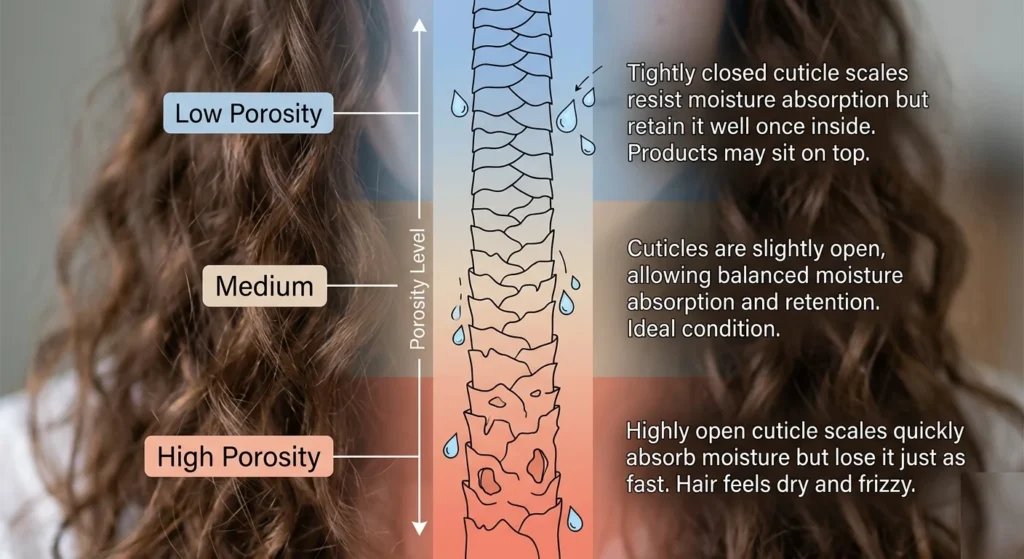
Think about it. Your roots are newer growth. Less sun, less heat damage, less chemical history. Your ends have survived years of everything. NIH research confirmed that UV exposure alone progressively degrades cuticle integrity along the fiber. Porosity naturally increases the further you get from the root.
Your hair isn’t one porosity type. It’s a gradient.
Had a client who watched porosity videos, did the float test, decided she was low porosity, and bought an entire low porosity line. The roots looked great. Ends were a disaster. Dry, frizzy, splitting. Because her ends needed the exact opposite approach.
The fix is simple but nobody does it:
| Hair Section | Typical Porosity | What It Needs |
| Roots | Lower (newer growth) | Lighter products, minimal oils |
| Mid-lengths | Medium to high | Balanced moisture and light sealing |
| Ends | Highest (most damage) | Heavier sealing, protein, extra protection |
Products That Work on Each Porosity Type
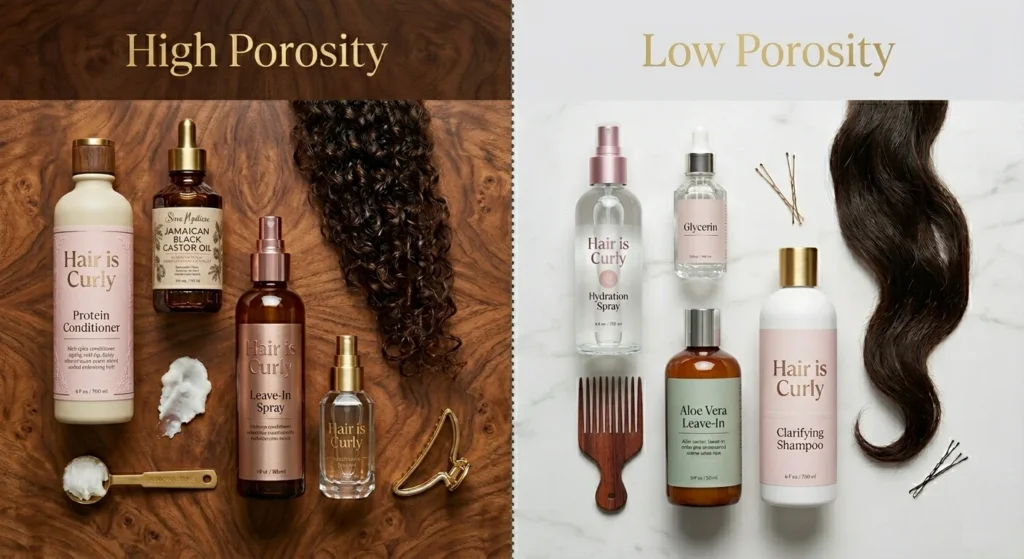
This is where most online advice falls apart. Someone recommends a “holy grail” product without mentioning porosity, and half the people who buy it wonder why it flopped.
High porosity essentials:
- Protein-based conditioners (hydrolyzed keratin, rice protein)
- Heavier oils for sealing (castor, avocado)
- Leave-ins applied to soaking wet hair only
- A curl serum as your final barrier step
Low porosity essentials:
- Water-based, lightweight leave-ins
- Humectants like glycerin and aloe
- Warm water and heat-assisted conditioning
- Clarifying shampoo on rotation
Mixed porosity (most people):
- Light products at roots, heavier at ends
- Seal mid-lengths and tips, skip sealing the roots
- Alternate between protein and moisture treatments weekly
One thing I tell every client: stop copying someone else’s routine. Their porosity isn’t yours. A product that transforms 3B curls with high porosity will wreck 2A waves with low porosity. The reviews aren’t lying. They’re just reviewing for their hair, not yours.
When Porosity Changes on You
Your porosity right now isn’t necessarily what it was two years ago. Or what it’ll be next year.
Things that increase porosity over time:
- Repeated heat above 300°F (flat irons regularly hit 400°F+)
- Bleaching or chemical straightening, sometimes after just one session
- Years of UV exposure without protection
- Harsh sulfate shampoos stripping the cuticle wash after wash
Things that don’t actually change porosity (despite what the internet says):
- Cold water rinses. They feel nice. They don’t physically close cuticle gaps.
- Apple cider vinegar rinses. Temporary smoothing at best. Not structural repair.
- One deep conditioning session. Helpful? Sure. Cuticle-repairing? Not permanently.
If your hair used to hold moisture fine and now can’t, something shifted. Usually it’s cumulative damage that crosses a threshold. The float test you did three years ago doesn’t apply anymore.
Here’s my honest take: porosity damage from heat and chemicals doesn’t fully reverse. You manage it, protect new growth differently, and let the damaged length grow out. Anyone selling you a “porosity repair” product is oversimplifying what’s happening at the structural level.
Where to Go From Here
Now you know your porosity. Maybe you realized you’ve been treating the wrong type this whole time. That’s not a failure, that’s actually the most common thing I hear in consultations.
I covered what causes frizz and why in a separate article, start there if you’re still figuring out what type you’re dealing with. If you already know the cause and want the action plan, Lisett covers how to fix it based on your specific type.
And if you take one thing from this article: your hair isn’t difficult. It’s just been getting the wrong instructions.