PDRN skincare has been described as “salmon DNA,” “salmon sperm serum” and, less convincingly, a shortcut to younger skin. The first two phrases need context. The third needs evidence.
PDRN stands for polydeoxyribonucleotide. It’s a mixture of purified DNA fragments traditionally obtained from salmon or trout reproductive cells. The ingredient has a medical history in tissue-repair research, but topical PDRN serums and creams are a newer part of the story.
As a dermatologist with training in clinical pharmacology, I’m interested in one distinction that marketing tends to skip: evidence for an ingredient injected into tissue cannot automatically be applied to a serum sitting on the skin’s surface.
Quick answer: PDRN may support hydration, soothing and the appearance of healthier skin, particularly when combined with ingredients such as hyaluronic acid, niacinamide or peptides. However, research on injectable or wound-care PDRN is much stronger than evidence for ordinary topical cosmetics. A PDRN serum isn’t the same treatment in a dropper bottle.
I haven’t personally tested every PDRN product discussed in this guide. My assessment is based on published research, current ingredient lists and what the evidence can reasonably tell us about topical use.
PDRN price check
How Much Does PDRN Skincare Cost?
Most popular PDRN serums cost more than a basic hydrating serum. Here is what three widely available 30 mL formulas currently cost.
Medicube PDRN Pink Peptide Serum
30 mL serum
Anua PDRN Hyaluronic Acid Capsule 100 Serum
30 mL serum
VT Cosmetics PDRN 100 Essence
30 mL essence
PDRN percentages are not standardized across brands. Compare the complete formula, ingredient source, fragrance and supporting ingredients instead of assuming the most expensive bottle is strongest.
Prices checked June 22, 2026. These are examples, not ranked recommendations. HairIsCurly does not receive commission from these links. Retail prices and formulations can change.
The “salmon DNA” description needs translating
Traditional PDRN is usually made by extracting and purifying DNA fragments from salmonid sperm cells. That explains the attention-grabbing nickname, but the finished cosmetic ingredient isn’t raw salmon reproductive material.
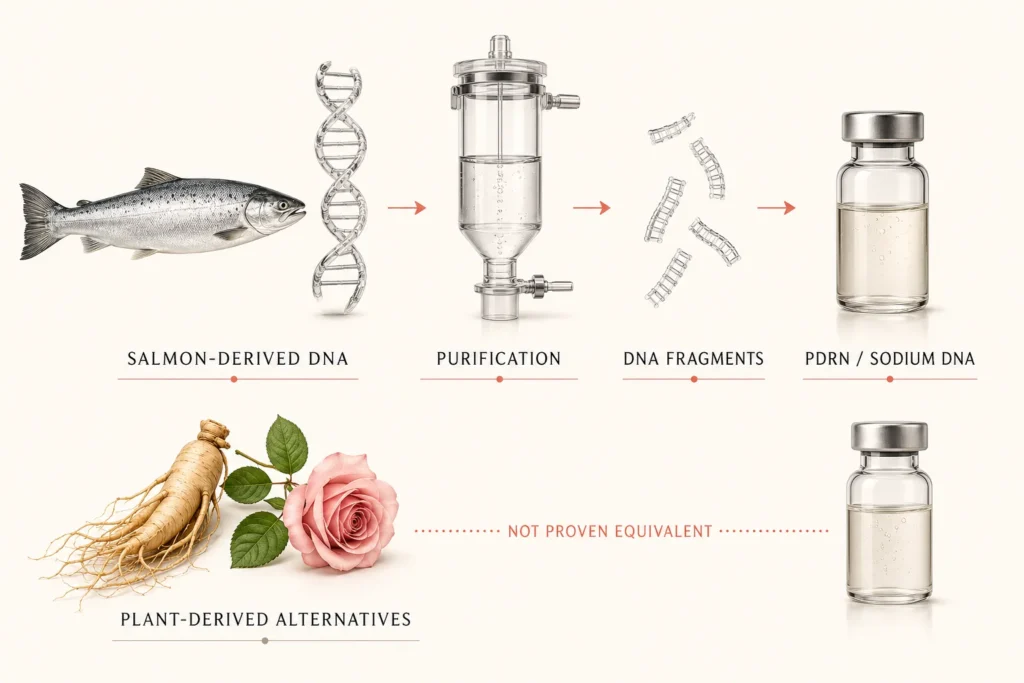
On an ingredient list, it may appear as:
- PDRN
- Polydeoxyribonucleotide
- Sodium DNA
- Hydrolyzed DNA
Not every product marketed as PDRN uses the same source, concentration or molecular size. Some newer formulas advertise plant-derived or “vegan PDRN,” often sourced from ingredients such as ginseng or rose.
Early laboratory research has explored plant-derived PDRN-like materials, but that doesn’t prove they work exactly like salmon-derived PDRN in human skin. “Vegan PDRN” is better treated as a related emerging ingredient than a confirmed one-for-one replacement.
A serum isn’t a skin booster in a prettier bottle
PDRN appears in both topical skincare and professional procedures. Those uses shouldn’t be blended together.
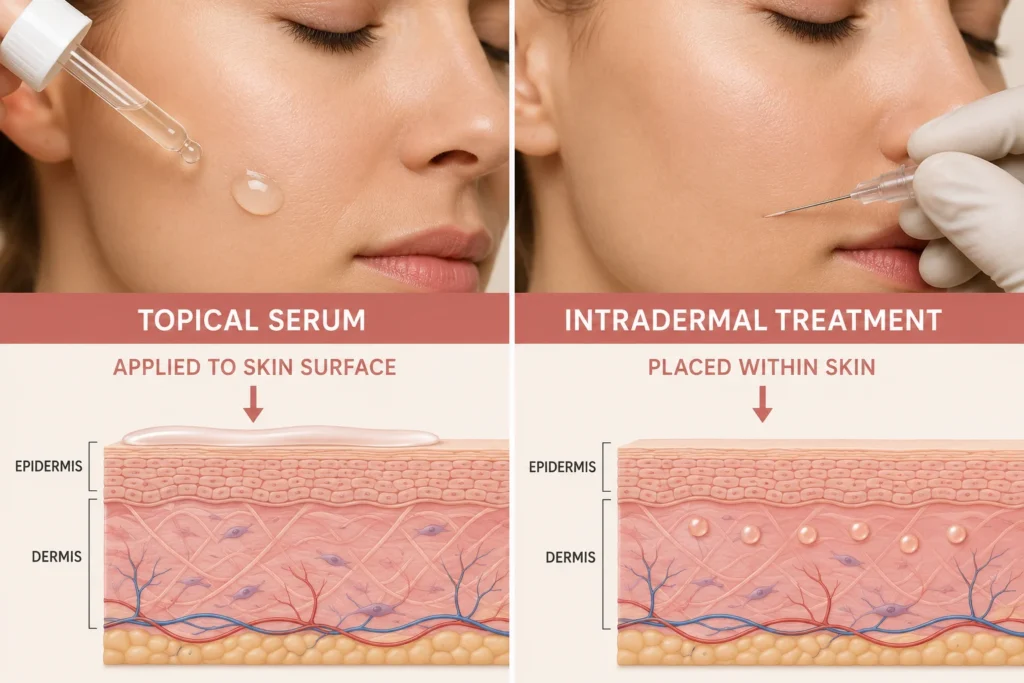
| Topical PDRN skincare | Injected or intradermal PDRN/PN | |
|---|---|---|
| How it’s delivered | Applied to the skin’s surface | Placed within the skin by a qualified medical professional |
| Common formats | Serums, creams, masks and ampoules | Injections or procedure-assisted treatments |
| Evidence | Limited product-specific human research | More clinical research, although methods and formulations vary |
| Realistic expectation | Hydration, soothing or cosmetic support from the complete formula | Procedure-specific results that depend on the product, technique and patient |
| Main concerns | Irritation, fragrance, breakouts or sensitivity to another ingredient | Swelling, bruising, infection and other procedure-related risks |
A 2025 review covering 175 studies found promising findings around tissue repair, inflammation and skin regeneration. Much of that evidence, however, comes from medical applications, injections or experimental delivery methods.
That matters because DNA fragments are relatively large molecules. How much useful material penetrates intact skin from a conventional serum remains an open question.
PDRN and PN are related, not interchangeable
PDRN and polynucleotide, usually shortened to PN, are frequently treated as two names for the same ingredient. They’re related, but not identical.
PN generally contains longer, higher-molecular-weight DNA chains. PDRN is more fragmented and contains shorter chains. Their sources and proposed biological effects may overlap, while their physical behavior and clinical use can differ.
A recent review comparing PN and PDRN also noted inconsistencies in how these terms are used. That’s another reason to check the actual treatment or ingredient rather than relying on the front label.
What can topical PDRN realistically do?
Current research doesn’t justify calling topical PDRN a proven wrinkle treatment, acne treatment or scar remover. That doesn’t make every PDRN serum useless. It means expectations need to match the evidence.
| Popular claim | A more accurate reading |
|---|---|
| “Deeply hydrates skin” | Possible, but glycerin, hyaluronic acid, panthenol and other humectants may be doing much of the work. |
| “Repairs the skin barrier” | A well-formulated product may support dry or stressed skin. Evidence isolating topical PDRN’s contribution is limited. |
| “Boosts collagen” | Laboratory and procedural research is promising, but it doesn’t prove that every topical serum produces the same effect. |
| “Fades acne scars” | Topical PDRN isn’t an established acne-scar treatment. Texture and deeper scars usually need more targeted care. |
| “Calms sensitive skin” | It may feel soothing in a gentle formula. Added fragrance, alcohol or multiple actives can quickly spoil that advantage. |
The useful question isn’t simply whether a bottle contains PDRN. It’s whether the complete formula suits your skin and whether its price is justified by what it can realistically deliver.
Can acne-prone skin use PDRN?
Topical PDRN isn’t known as a common pore-clogging ingredient, but that doesn’t make every PDRN serum acne-friendly.
The complete formula matters. Fragrance, rich emollients or another active ingredient may trigger irritation or breakouts even when PDRN itself isn’t the problem.
For acne-prone skin, look for:
- A lightweight serum rather than a heavy cream
- Fragrance-free or low-fragrance formulas
- Clearly listed ingredients and PDRN source
- No collection of strong actives you didn’t ask for
Test the product on a small area before applying it across your face. The American Academy of Dermatology explains how to patch-test skincare and what to do if a reaction develops.
PDRN also shouldn’t replace a proven acne treatment. There isn’t enough evidence to say that an over-the-counter PDRN serum treats active acne or prevents scarring.
Could it sit beside retinol?
PDRN and retinol aren’t known to have a direct conflict. They can usually appear in the same routine if the PDRN product is gentle and your skin already tolerates retinol.
Still, don’t introduce both on the same night. If irritation appears, you won’t know which bottle started the argument.
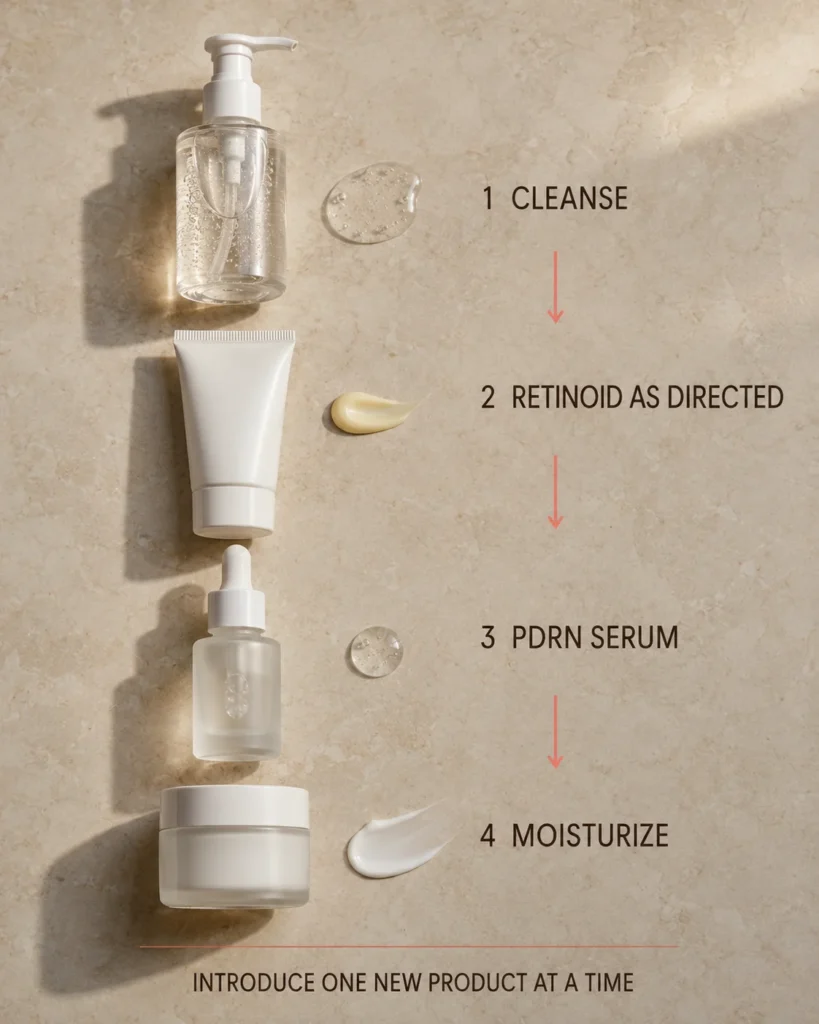
Add one product at a time. A simple evening order would be:
- Gentle cleanser
- Retinoid used as directed
- PDRN serum, if tolerated
- Moisturizer
If your retinoid is prescribed, follow your dermatologist’s instructions rather than changing its application order around a new cosmetic serum.
PDRN doesn’t need its own seven-step ritual
Apply a topical PDRN serum after cleansing and before moisturizer. If you use several products, work from the thinnest texture to the thickest.
During the day, finish with broad-spectrum sunscreen. PDRN doesn’t replace sun protection, no matter how futuristic the bottle looks.
Stop using the product if you develop persistent burning, swelling, itching or a worsening rash. Anyone with a fish allergy should confirm the ingredient source and speak with a clinician before using salmon-derived PDRN because cosmetic purification and testing can vary.
Read the back label, not just the pink bottle
Before buying, check:
- Ingredient name: Look for Sodium DNA, PDRN or hydrolyzed DNA.
- Source: Salmon-derived, plant-derived or not disclosed.
- Supporting formula: Humectants, peptides, niacinamide and soothing ingredients can influence the result.
- Fragrance: Especially important for reactive or acne-prone skin.
- Evidence: Brand claims and percentage graphics aren’t substitutes for product-specific research.
Be cautious when a brand promises to repair DNA, erase acne scars or reproduce injectable results. Those claims reach well beyond what topical evidence currently supports.
Is PDRN skincare worth it?
PDRN skincare may be worth trying if you want a hydrating, supportive serum and don’t mind paying roughly $20 to $30. Choose it for the complete formula, not because “salmon DNA” sounds more advanced than glycerin.
It isn’t an essential step. Sunscreen, moisturizer and appropriately selected acne or anti-aging treatments have stronger practical foundations. PDRN belongs in the optional-interesting category, not the drop-everything-and-buy-it category.
For now, topical PDRN is an emerging ingredient with promising biology but limited proof that an ordinary serum delivers the dramatic repair advertised online. That may change as better product-specific trials arrive. Until then, measured expectations are the most evidence-based ingredient in the routine.