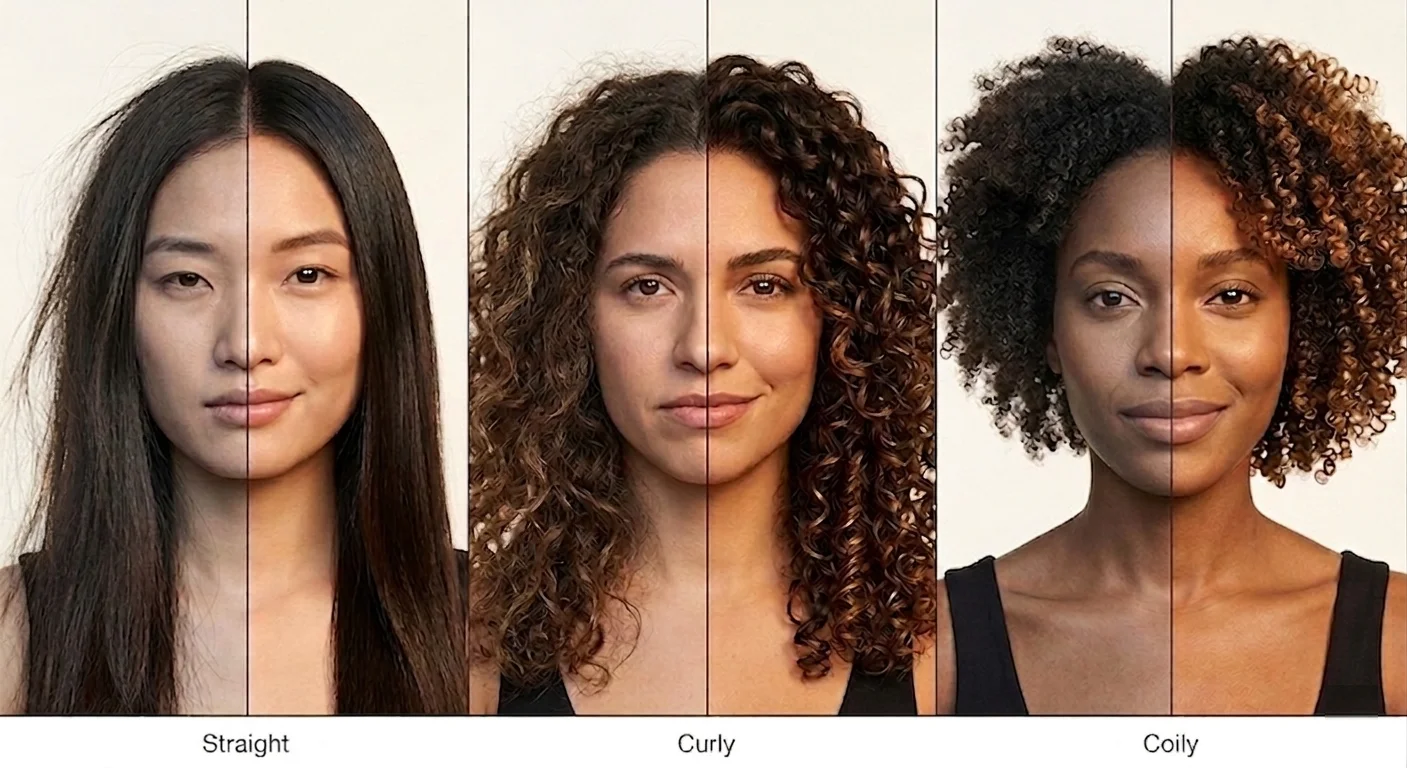
Had a client last year, natural 4A hair, spent close to $300 on a “complete frizz system” from one of those big-box beauty stores. Three products, all from the same line, all promising the same thing. She came in holding the bottles like evidence. Still frizzy. Still frustrated.
That’s not unusual. Most people chasing frizz fixes have a bathroom shelf that looks like a product graveyard.
Here’s the thing though. Frizz isn’t a product problem, at least not always. It starts much earlier than that, inside the hair strand itself, and until you understand what’s actually happening there, you’re essentially shopping blind.
What’s Actually Happening Inside Your Hair
The outer layer of your hair strand is called the cuticle. Overlapping scales, like roof shingles sitting flat. When they stay flat, your hair looks smooth, reflects light, and behaves. When they lift, air moisture gets inside the shaft. The shaft swells. Unevenly. That uneven swelling is frizz.
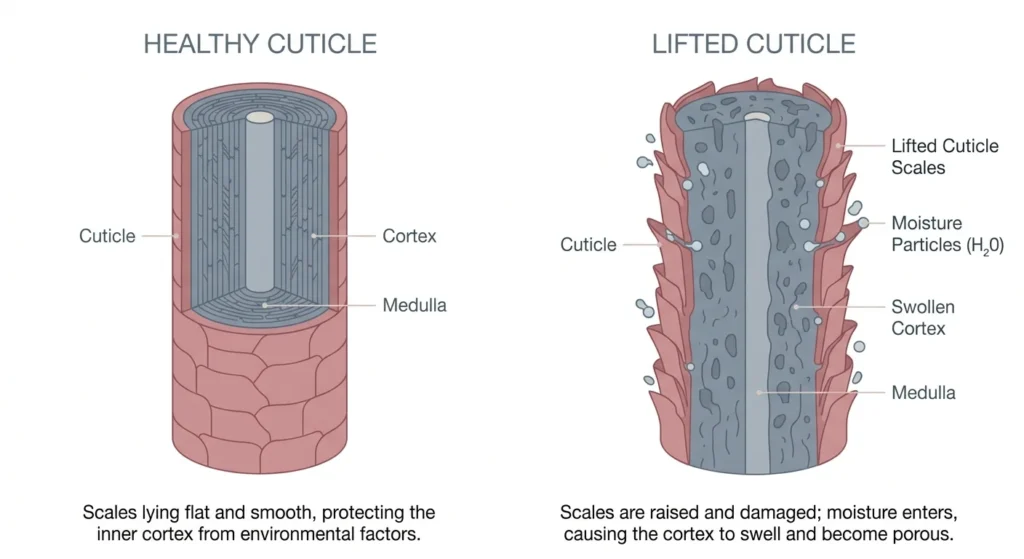
Simple as that.
Now those cuticle scales don’t just lift randomly. Something disrupts them. Heat, chemical processing, rough handling, even your water pH can do it. Natural porosity plays a role too, but more on that next.
Research through the National Institutes of Health confirms this directly. The cuticle functions as the primary moisture barrier in the hair fiber. When it’s compromised, the hair becomes hygroscopic, meaning it actively pulls moisture from surrounding air. That’s the frizz mechanism, right there in biology.
Hair Porosity: Why It Matters for Frizz
Porosity is how easily your hair absorbs moisture and holds it. It’s also why two people can use the same product on the same day and get completely different results.
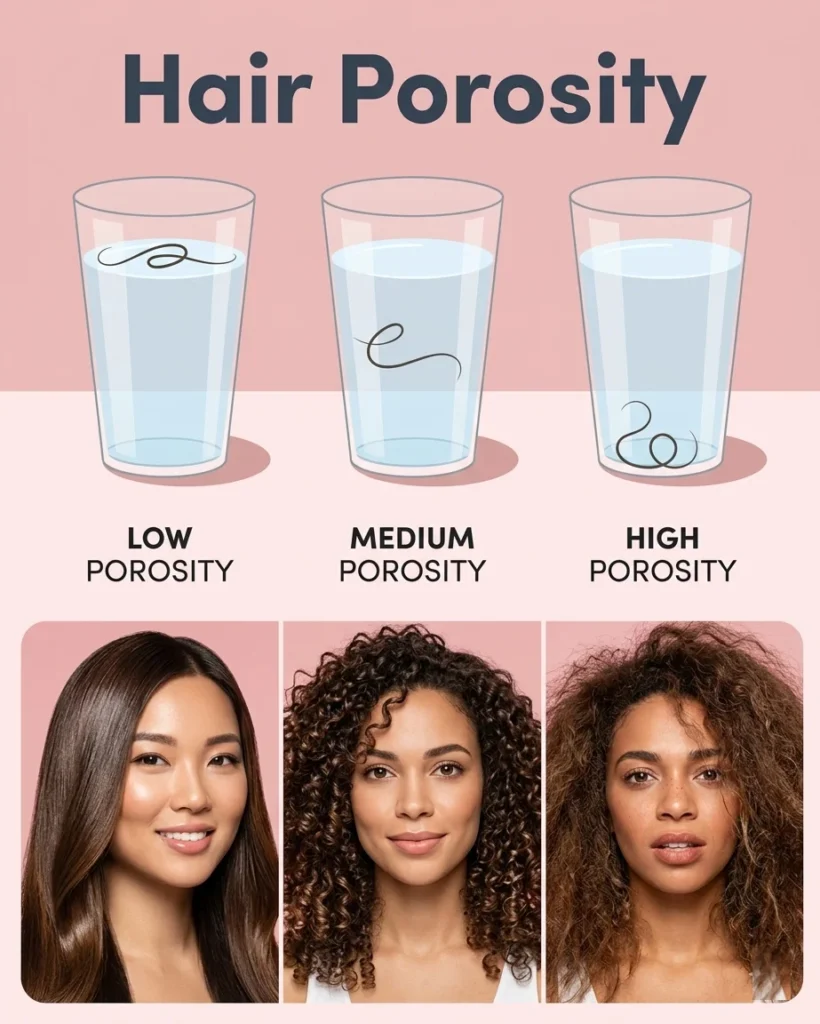
| Porosity Type | What’s Happening | How Frizz Shows Up |
| High | Cuticle has gaps, moisture enters and exits fast | Dry within an hour of conditioning, sharp frizzy halo |
| Low | Cuticle sits too flat, moisture barely penetrates | Products sit on top, humidity causes puffiness |
| Medium | Balanced moisture exchange | Manageable, unless heat or chemical damage is involved |
Quick at-home check: float a clean strand in room temperature water. Sinks fast, high porosity. Stays at the surface, low porosity. Not perfect science but enough to point you in the right direction, You can also follow a more accurate method for how to properly test your hair porosity at home.
The International Association of Trichologists treats porosity assessment as foundational before any treatment recommendation. Knowing yours tells you which ingredients will actually penetrate your hair versus which ones are just sitting there.
Humidity Gets Blamed. But It’s Usually Not the Root Problem.
Every summer I hear some version of “I can’t do anything with my hair when it’s humid.” And humidity is absolutely a trigger. Just not the cause.
Hair is naturally hygroscopic. It wants to be in balance with the moisture level of whatever air it’s sitting in. Healthy hair with a smooth, intact cuticle handles that balancing act reasonably well. Damaged or highly porous hair? It goes into overdrive. Swells fast, strands push against each other, and no serum on the market fully overrides what’s happening structurally.
One client of mine, low porosity 2C waves, moved from Arizona to Florida. Her hair completely changed. Back in Arizona, her hair was dry and brittle, searching for moisture, never finding it. Florida flipped the problem entirely. Too much moisture getting in too fast. Same hair, same products, completely different behavior in a different climate.
That’s hygroscopy in action. The hair isn’t malfunctioning. It’s responding exactly as the biology would predict.
A 2019 review in the Journal of Cosmetic Science found that humectant and film-forming ingredients do help buffer hair against environmental moisture changes, but only effectively when the cuticle surface is intact enough to allow proper adhesion. Damaged hair simply doesn’t hold those ingredients the same way.
So fighting humidity with products before addressing the cuticle condition is working backwards. Fix the structure first. Then the humidity becomes something manageable rather than something your hair loses to every single morning.
A lightweight frizz control serum for curly hair applied on damp hair is one of the simpler ways to start building that barrier. This works best when combined with a consistent routine like this curly hair routine for beginners.
Straight Hair Gets a Pass. Curly and Coily Hair? Not So Much.
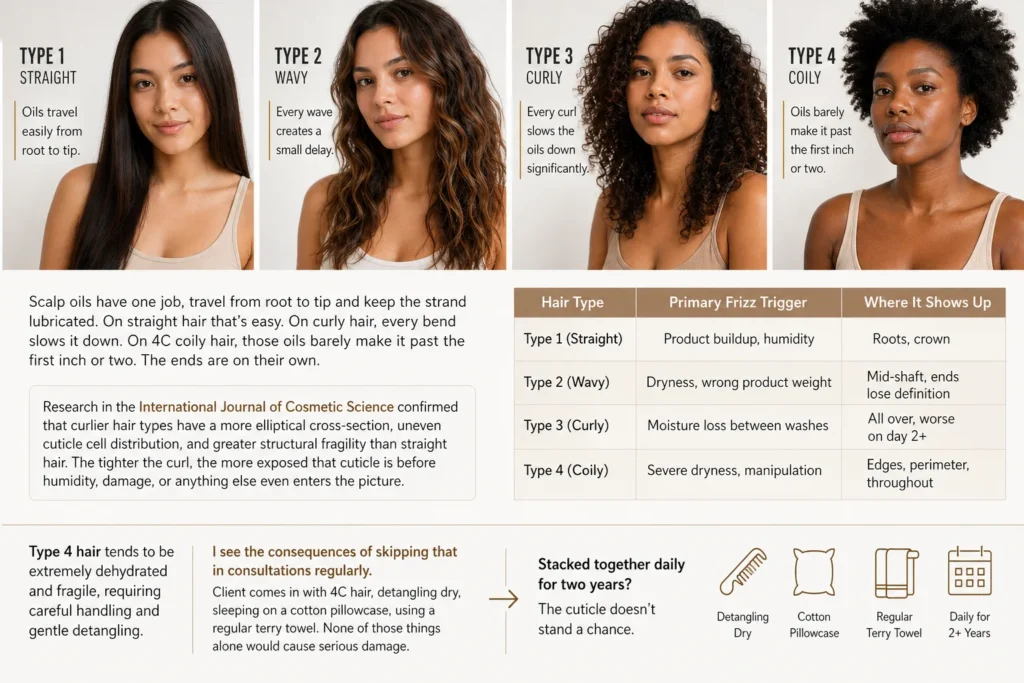
Scalp oils have one job, travel from root to tip and keep the strand lubricated. On straight hair that’s easy. On curly hair, every bend slows it down. On 4C coily hair, those oils barely make it past the first inch or two. The ends are on their own.
Research in the International Journal of Cosmetic Science confirmed that curlier hair types have a more elliptical cross-section, uneven cuticle cell distribution, and greater structural fragility than straight hair. The tighter the curl, the more exposed that cuticle is before humidity, damage, or anything else even enters the picture.
Frizz also doesn’t look the same across hair types, which is why generic advice fails so consistently:
| Hair Type | Primary Frizz Trigger | Where It Shows Up |
| Type 1 (Straight) | Product buildup, humidity | Roots, crown |
| Type 2 (Wavy) | Dryness, wrong product weight | Mid-shaft, ends lose definition |
| Type 3 (Curly) | Moisture loss between washes | All over, worse on day 2+ |
| Type 4 (Coily) | Severe dryness, manipulation | Edges, perimeter, throughout |
Type 4 hair tends to be extremely dehydrated and fragile, requiring careful handling and gentle detangling. I see the consequences of skipping that in consultations regularly. Client comes in with 4C hair, detangling dry, sleeping on a cotton pillowcase, using a regular terry towel. None of those things alone would cause serious damage. Stacked together daily for two years? The cuticle doesn’t stand a chance.
What Heat Does to Hair That a Good Conditioner Can’t Undo
Porosity is a surface conversation mostly. Heat damage goes deeper and that’s where people get stuck.
Repeated high heat changes the protein bonds inside the cortex, the actual inner structure of the strand. Frizzy hair from heat damage is often characterized by a zigzag shape rather than an S-pattern, with cuticles open and strands pulling in opposite directions. In some sections that becomes permanent.
I can usually tell which situation a client is dealing with fairly quickly. Genetics-based high hair porosity responds to protein treatments, settles into a consistent routine, stays manageable. Heat damage responds for a week or two then reverts because the structural problem underneath isn’t something you can condition away. Mixed damage is the hardest, parts of the hair respond, parts don’t, and the client thinks the product stopped working when really it’s just hitting a wall in the damaged sections.
Some clients describe their hair “not being the same” after years of straightening. They’re accurate. The curl or wave pattern disrupted at the cortex level doesn’t come back the same way surface frizz resolves. New growth can be handled differently going forward. The already-damaged length has to grow out. Not what anyone wants to hear but it’s the honest answer.
How to Actually Stop the Frizz Based on What’s Causing It
High hair porosity and heat damaged hair are not the same problem. Neither is low porosity puffiness. Treating them identically is why most people cycle through products for years without landing anywhere useful.
High porosity, gaps in the cuticle, moisture in and out fast, responds to sealing. Heavier oils, butters, proteins that physically close those gaps. The Flo-etry curl serum works here specifically because it delivers nourishing oils without the weight that kills curl definition.
Low porosity is the opposite problem. The cuticle is too flat, products can’t penetrate. Lighter humectant-based formulas applied to very warm damp hair work better here than anything heavy.
Heat damaged sections need honesty more than products. New growth gets protected differently going forward. The already-damaged length grows out. In the meantime a good leave-in conditioner for curly hair keeps those sections manageable without false promises.
Routine and product order matter as much as the products themselves. Lisett walks through the full fix step by step in How to Fix Frizzy Hair, covering what to use, in what order, for which hair type. what to use, in what order, for which hair type. If curls specifically are the battle, Frizzy Curly Hair covers what the curl pattern changes about everything.
The Questions I Actually Get Asked About Frizzy Hair
Why did my hair suddenly get frizzy when it wasn’t before?
Something shifted, even if it wasn’t obvious. Could be seasonal humidity, a new product changing your hair’s moisture balance, or early heat damage that’s only now surfacing visibly. Sudden frizz is worth investigating rather than just switching products again.
Does frizzy hair mean it’s damaged?
Not necessarily. Plenty of people have naturally high hair porosity that frizzles without any damage involved whatsoever. If your hair used to behave differently though, that change is usually telling you something structural happened.
Why is my hair frizzy right after washing?
Hot water and sulfate shampoos lift the cuticle. If nothing seals it back down before drying, the cuticle stays open and humidity moves in.A conditioner or a leave-in conditioner for curly hair applied to damp hair before drying makes a bigger difference than most people expect.
Does trimming actually help?
For surface frizz at the ends, yes. Split ends travel up the shaft and create texture above the actual split point. Trimming removes that. It won’t resolve porosity issues but the ends will visibly behave better.
Why does frizz get worse the longer hair dries?
Moisture is leaving the shaft and the cuticle reacts to that loss. Products applied to soaking wet hair often just dilute and drip off before absorbing. Try applying damp hair instead, that one change alone gets different results for a lot of people.

1 Comment on Why Is My Hair So Frizzy? A Trichologist Explains
Just like you mentioned in this article, I also went through all the same things in the beginning. Reading your article reminded me of my own frizzy hair struggles. It had troubled me so much, and I was really stressed because of it. Your article was really greatkeep it up!